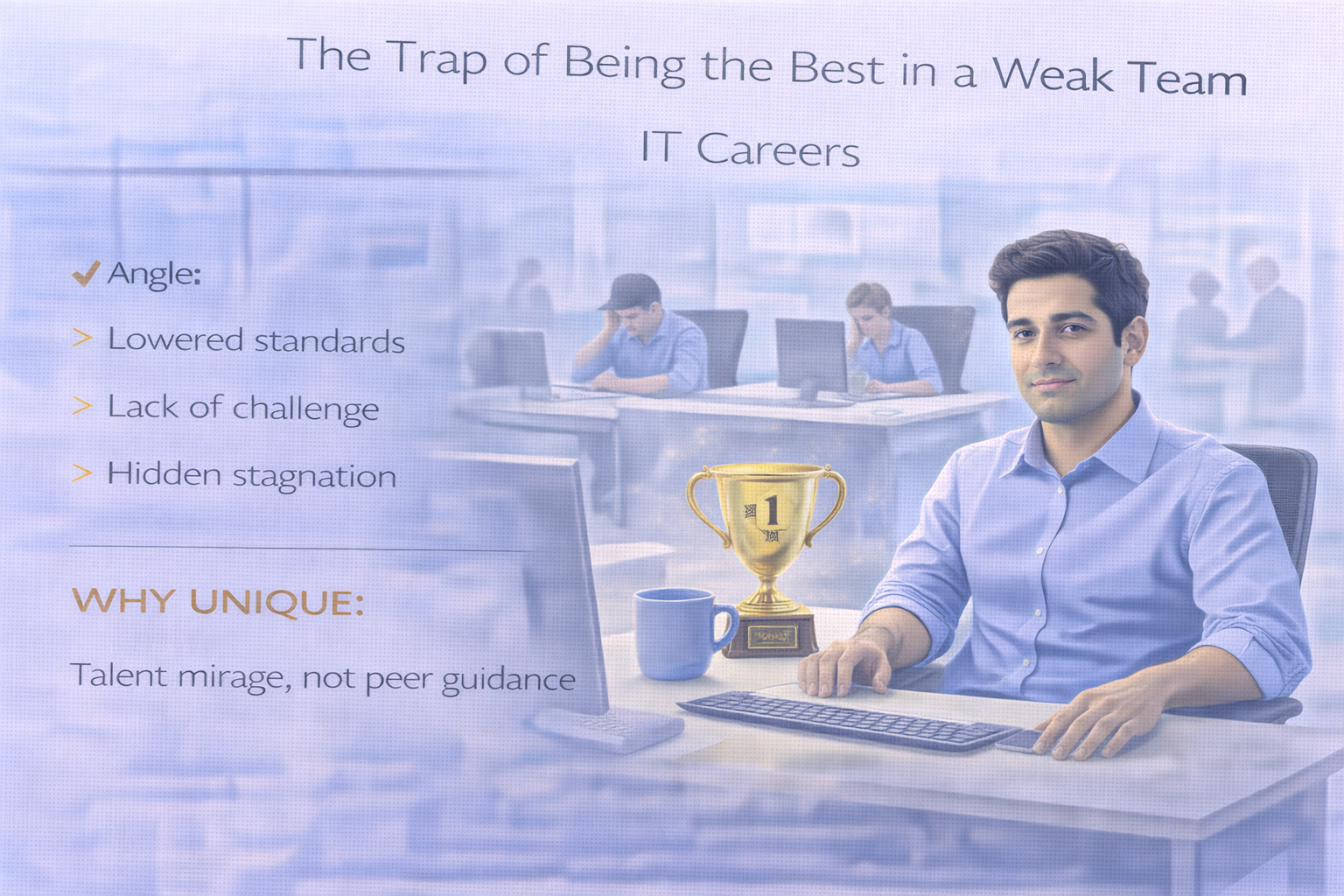
Why Being the Best in a Weak Team Can Hurt IT Careers
Being the top performer in a team feels like success. You deliver more, solve harder problems, and are often the most reliable person others depend on. Recognition comes easily, and confidence grows.
But in IT careers, being the best in a weak team can quietly become a long-term disadvantage.
This blog explores how low benchmarks, skill ceilings, and false excellence limit growth — even when performance looks strong on the surface.
The Low-Benchmark Problem: Winning Against Weak Standards
Performance is always relative.
In weak teams:
- Expectations are low
- Complexity is limited
- Mistakes are normalized
- Best practices are inconsistent
Standing out in such environments is easy.
The danger is that professionals start calibrating their ability against weak standards. Improvement slows because the bar to “excel” is already low.
You win — but the game itself is small.
Skill Ceiling: When the Environment Stops Stretching You
Strong growth requires resistance.
In weak teams:
- There are fewer people to learn from
- Feedback lacks depth
- Advanced problems are rare
- Architectural discussions are shallow
Over time, the environment stops stretching capability.
Professionals may appear highly competent locally, but their skills plateau globally.
False Excellence: When Confidence Outpaces Capability
False excellence forms when praise comes from comparison, not challenge.
Being “the best here” can create:
- Overconfidence
- Reduced urgency to improve
- Avoidance of stronger environments
The illusion breaks when professionals move to:
- Stronger teams
- Higher-performance organizations
- More demanding roles
Suddenly, past excellence feels insufficient.
Why This Is Not About Leaving Immediately
This is not advice to abandon teams impulsively.
The risk is staying after growth has stopped.
Healthy teams:
- Raise standards over time
- Introduce stronger peers
- Increase problem complexity
When none of this happens, loyalty becomes a growth constraint.
Final Insight
Being the best feels rewarding — but only when the environment itself is strong.
IT careers grow fastest when professionals choose challenging peers and high standards over easy dominance.
It’s better to struggle in a strong team than to dominate a weak one.