Many students imagine software development as a single developer sitting alone and writing code.
But real-world software development works very differently.
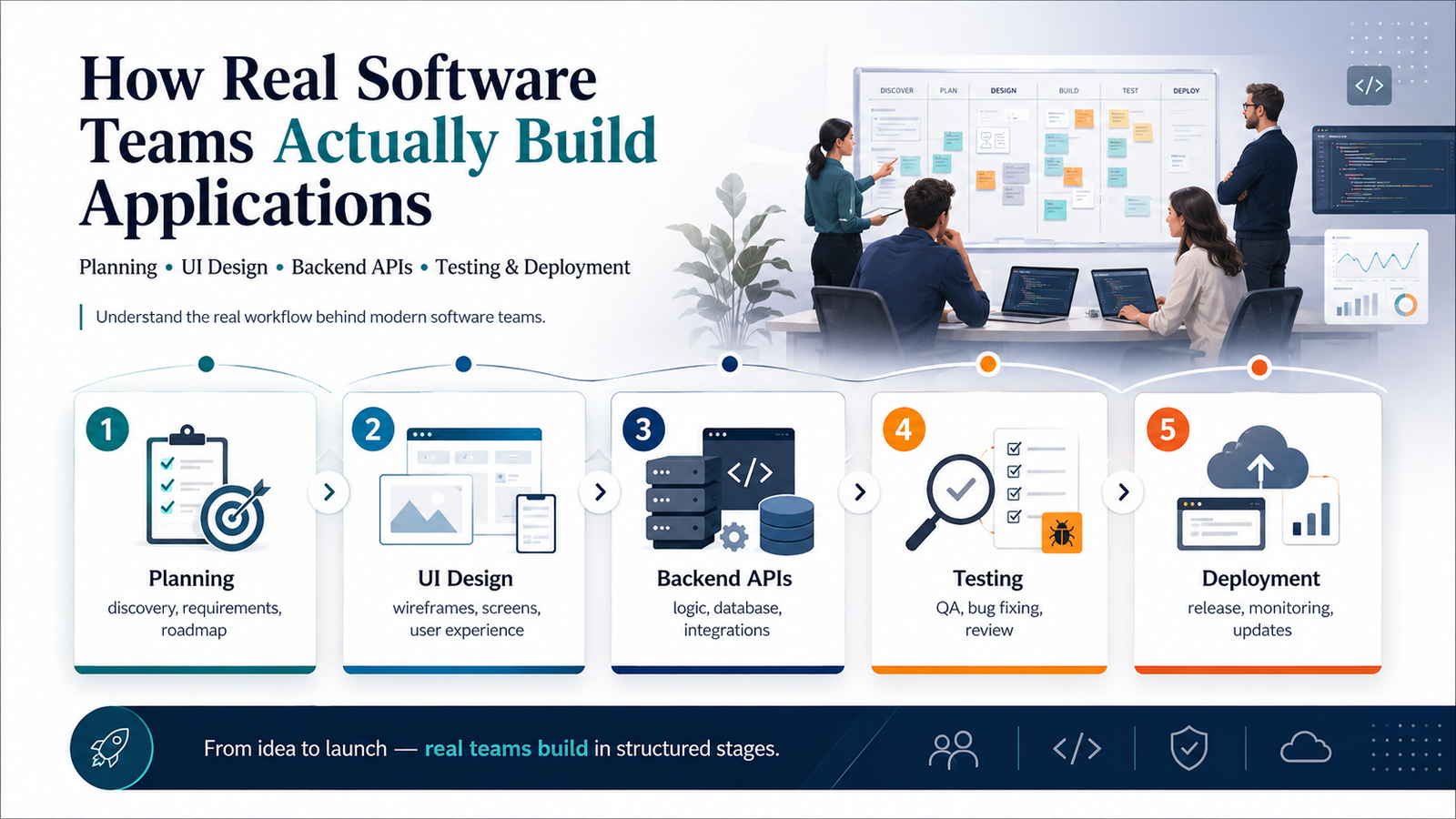
Modern applications are built by teams of developers, designers, testers, project managers, and DevOps engineers working together in structured workflows.
From planning and UI design to backend APIs, testing, and deployment, software development is a collaborative process.
Understanding how real software teams build applications helps students develop an industry-ready mindset.
This guide explains the complete application development workflow followed by real software teams.
🚀 Step 1: Planning & Requirement Analysis
Every successful software project starts with planning.
Before writing code, teams first understand:
✔ Business goals
✔ User requirements
✔ Features needed
✔ Project scope
✔ Timelines
Questions Teams Ask:
- What problem will the application solve?
- Who are the users?
- What features are required?
- What technologies should be used?
Planning helps avoid confusion later.
👉 Good software development begins with clear requirements.
🧠 Step 2: UI/UX Design
Once planning is complete, UI/UX designers create the application interface.
The goal is to make applications:
✔ User-friendly
✔ Visually appealing
✔ Easy to navigate
Designers Usually Create:
- Wireframes
- UI mockups
- User flows
- Interactive prototypes
Popular Tools:
- Figma
- Adobe XD
- Sketch
👉 Good UI design improves user experience significantly.
💻 Step 3: Frontend Development
Frontend Developers build everything users see inside the application.
They convert UI designs into working interfaces.
Frontend Development Includes:
✔ Responsive layouts
✔ User interactions
✔ Forms & dashboards
✔ API integration
Common Technologies:
- HTML
- CSS
- JavaScript
- React
- Angular
👉 Frontend development focuses on user experience.
⚙️ Step 4: Backend API Development
Backend Developers build the server-side logic powering the application.
They create APIs that connect frontend applications with databases and business logic.
Backend Development Includes:
✔ APIs
✔ Authentication systems
✔ Database management
✔ Business logic
✔ Security handling
Common Technologies:
- Java
- Node.js
- Python
- Spring Boot
- Databases
👉 Backend systems make applications functional and scalable.
🗄️ Step 5: Database Management
Most applications need databases to store information.
Teams design databases for:
- Users
- Orders
- Products
- Transactions
- Analytics
Popular Databases:
- MySQL
- PostgreSQL
- MongoDB
👉 Database design affects application performance and scalability.
🤝 Step 6: Team Collaboration Using Git & GitHub
Real software teams collaborate using version control systems.
Developers use:
✔ Git
✔ GitHub
✔ Pull requests
✔ Branching workflows
This helps teams:
- Manage code safely
- Collaborate efficiently
- Track changes
- Review code professionally
👉 Git workflows are essential in modern development.
🧪 Step 7: Testing the Application
Before deployment, applications go through testing.
Testing helps identify:
✔ Bugs
✔ Performance issues
✔ Security problems
✔ UI issues
Types of Testing:
- Manual testing
- API testing
- Unit testing
- Automation testing
👉 Testing improves software quality and reliability.
☁️ Step 8: Deployment & Hosting
Once the application is tested, teams deploy it to servers or cloud platforms.
Deployment Includes:
✔ Hosting setup
✔ Cloud deployment
✔ CI/CD workflows
✔ Monitoring systems
Common Platforms:
- AWS
- Vercel
- Netlify
- Docker
👉 Deployment makes applications available to real users.
📈 Step 9: Maintenance & Updates
Software development does not end after deployment.
Teams continuously:
✔ Fix bugs
✔ Improve features
✔ Optimize performance
✔ Add updates
Modern applications evolve continuously.
💡 Why Understanding Team Workflows Matters for Students
Students who understand real software workflows:
✔ Become more industry-ready
✔ Understand collaboration better
✔ Build practical projects correctly
✔ Prepare better for internships & jobs
This mindset helps students transition smoothly into professional environments.
⚠️ Common Beginner Misconceptions
Many beginners think:
❌ Software development is only coding
❌ One developer builds everything alone
❌ UI, backend, testing, and deployment are separate worlds
Reality:
Modern development is collaborative and interconnected.
🎯 Skills Students Should Learn for Real-World Development
To become industry-ready, students should learn:
✔ Programming fundamentals
✔ Git/GitHub workflows
✔ APIs & databases
✔ UI basics
✔ Testing concepts
✔ Deployment basics
👉 Practical exposure matters more than theory alone.
🚀 Final Thoughts
Real software development is a structured team process involving planning, design, coding, testing, deployment, and collaboration.
Understanding these workflows helps students develop a professional engineering mindset.
If you want to become job-ready:
✔ Build real projects
✔ Learn team collaboration
✔ Understand complete workflows
✔ Practice deployment & testing
👉 Don’t just learn coding
👉 Learn how real software teams actually build products
🚀 Forsk Coding School – IT Training Institute
Build your career with practical training in coding, AI, and modern technologies. Learn through real projects and industry-focused guidance.
📺 YouTube: https://www.youtube.com/@ForskCodingSchoolJaipur
📘 Facebook: https://www.facebook.com/ForskCodingSchool
📸 Instagram: https://www.instagram.com/forskcodingschool/
💼 LinkedIn: https://www.linkedin.com/company/forskcodingschool
#ITTraining #Coding #ArtificialIntelligence #WebDevelopment #CareerGrowth #Jaipur