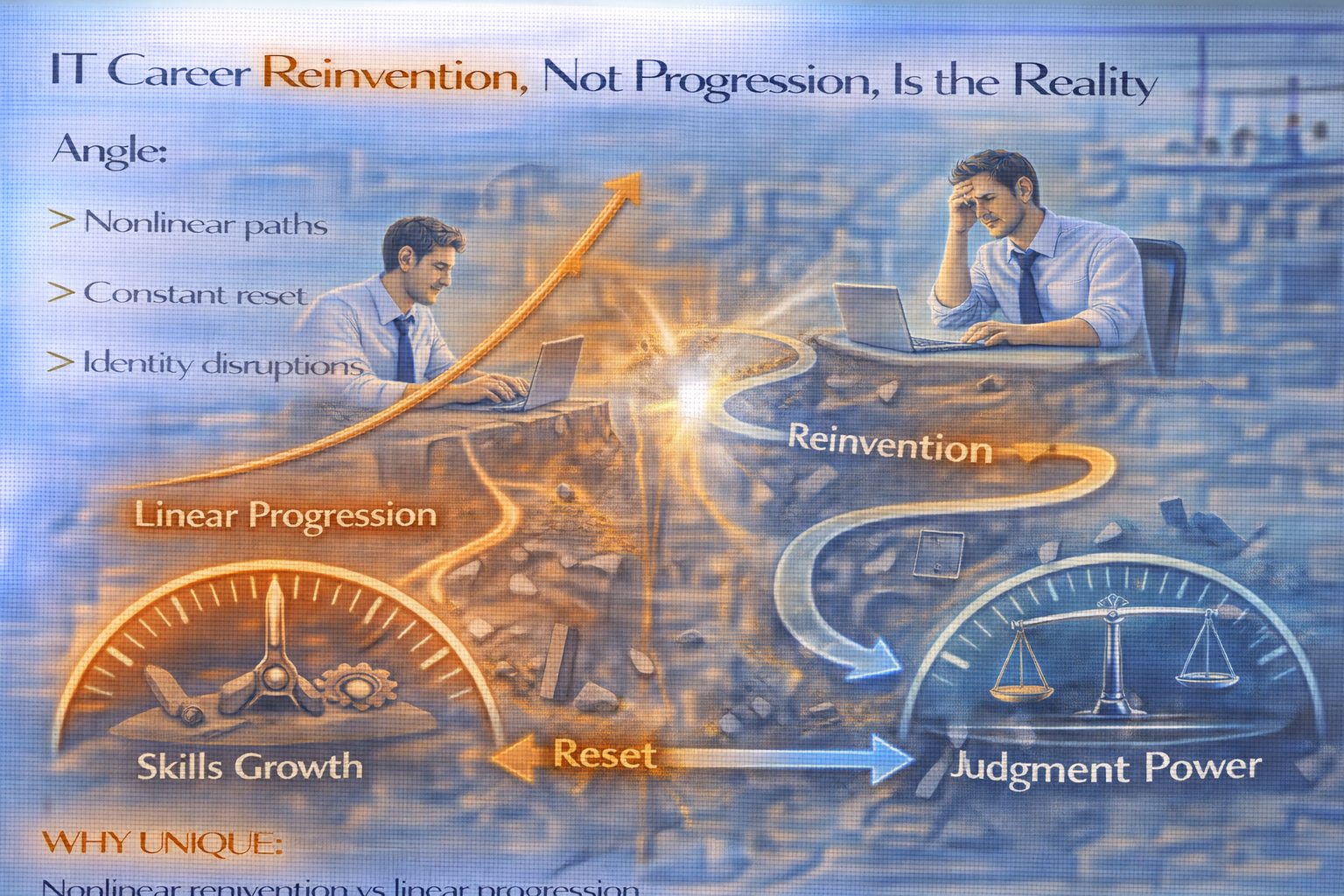
Most IT professionals imagine their careers as a straight line.
Junior → Mid → Senior → Lead → Manager.
Each step higher than the last.
This ladder mindset feels logical — but it no longer matches reality.
Modern IT careers are not built through steady progression.
They are built through repeated reinvention.
The Myth of Linear Growth in IT
Linear progression assumes:
- Skills age gracefully
- Roles expand predictably
- Experience always increases value
In IT, none of this is guaranteed.
Technologies shift.
Business models change.
Roles disappear and reappear under new names.
Progression without reinvention leads to stagnation — even while titles improve.
How Reinvention Actually Works
Reinvention is not promotion.
It is a cycle:
- Old strengths lose relevance
- New problems demand different capabilities
- Identity must adjust to match new value
Each cycle requires letting go of how you were valuable before.
That is why reinvention feels uncomfortable — even when it leads to growth.
Identity Shifts, Not Just Skill Shifts
Most professionals try to solve career stagnation by adding skills.
But reinvention is rarely about tools alone.
It involves identity shifts:
- From implementer to problem-framer
- From specialist to integrator
- From executor to decision contributor
Until identity changes, new skills remain underused.
Why Progression Without Reinvention Breaks Careers
When professionals cling to progression:
- They optimize existing strengths
- They resist roles that don’t reward past expertise
- They defend relevance instead of rebuilding it
This creates a paradox:
The more experience they have, the harder change becomes.
Reinvention Is the Real Seniority Skill
Long-lasting IT careers show a pattern:
- Early years focus on execution
- Mid years demand perspective
- Later years require judgment and context
Each phase invalidates part of the previous one.
Those who reinvent move forward.
Those who only progress get stuck — even at high levels.
How to Start Thinking in Reinvention Cycles
You don’t reinvent overnight.
You prepare for it.
Practical shifts:
- Measure relevance, not seniority
- Ask what problems you are becoming better at solving
- Detach self-worth from specific tools or roles
- Expect old advantages to expire
Reinvention is not failure.
It is maintenance.
Final Thought
Progression feels safe.
Reinvention feels risky.
But in IT, the real risk is assuming yesterday’s strengths will carry you forward.
Careers don’t move up in straight lines.
They move forward through reinvention — again and again.