Early in an IT career, technology feels like everything.
Languages, frameworks, tools, versions — mastery of technology defines value.
But over time, a quiet shift happens.
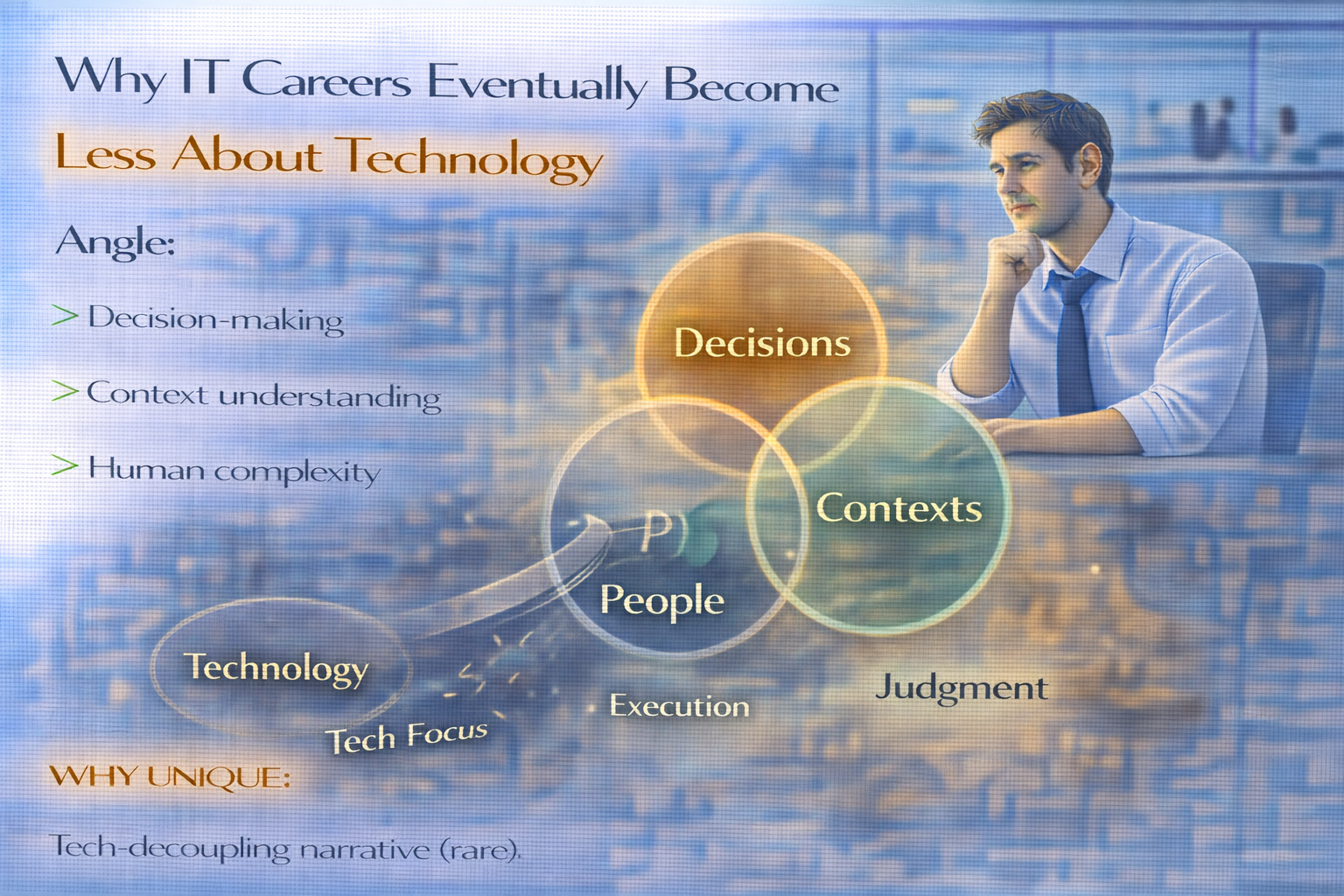
The professionals who continue to grow discover that their careers become less about technology and more about decisions, context, and people.
This shift is rarely discussed — and often misunderstood.
Why Technology Dominates Early Careers
In the beginning, technology is the fastest signal of competence:
- You can measure output
- You can test correctness
- You can compare skill levels
Technology creates clarity.
It tells you whether something works or not.
That clarity makes it comforting.
The Ceiling of Pure Technical Excellence
At a certain point, technical skill alone stops differentiating professionals.
Many people can:
- Write clean code
- Learn new frameworks
- Follow best practices
What starts to matter more is:
- Which problems are chosen
- Why a solution exists
- How trade-offs are managed
Technology becomes necessary — but no longer sufficient.
The Rise of Decision-Making
As careers mature, value shifts toward decisions:
- Deciding what not to build
- Choosing between imperfect options
- Balancing speed, quality, and cost
- Understanding second-order consequences
These decisions are contextual.
They can’t be automated.
And they can’t be Googled.
Context Understanding Beats Tool Mastery
Experienced IT professionals operate in context:
- Business constraints
- Organizational dynamics
- Human behavior
- Long-term impact
Two engineers can design the same system.
The one who understands context will make better decisions — even with the same tools.
Human Complexity Enters the Picture
Technology behaves predictably.
People do not.
As responsibility grows, careers involve:
- Influencing without authority
- Explaining trade-offs to non-technical stakeholders
- Managing disagreement and ambiguity
These challenges cannot be solved with better code.
Why This Shift Feels Uncomfortable
Many professionals resist this transition because:
- Technology feels objective
- Judgment feels subjective
- Authority replaces execution
Letting go of tech-central identity feels like losing competence — even when it’s not.
Integrating Technology Instead of Replacing It
Mature IT careers don’t abandon technology.
They decouple identity from tools.
Technology becomes:
- A means, not the goal
- One input into broader decisions
- A lever for impact, not identity
This integration allows long-term relevance.
Final Thought
Technology opens the door to an IT career.
But it doesn’t carry you through it.
The professionals who last are not those who know the most tools —
They are those who understand when, why, and for whom technology should be used.