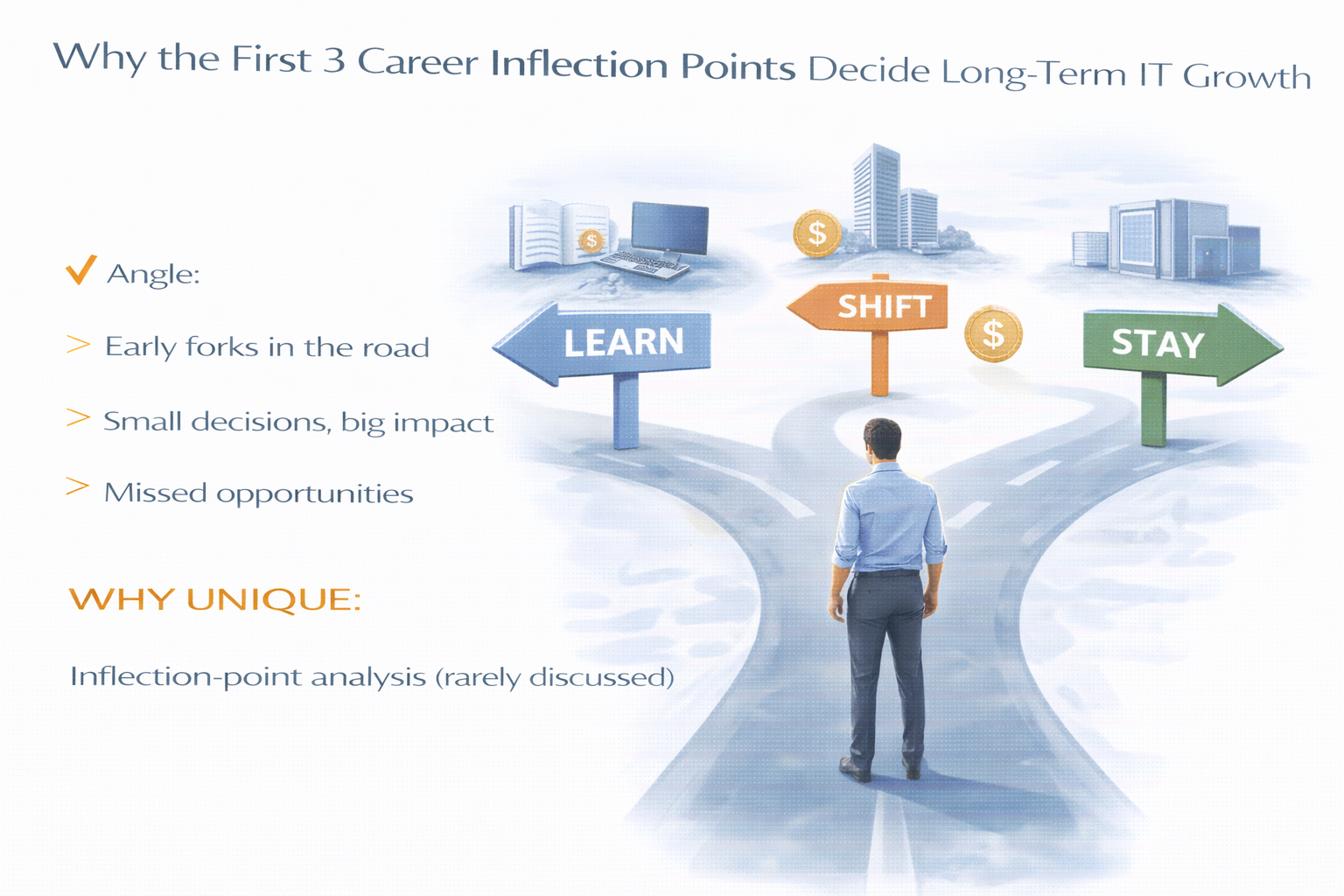
Most IT professionals believe careers are shaped by major promotions, big company switches, or sudden breakthroughs. In reality, long-term IT growth is decided much earlier—often before professionals realize they are making career-defining choices.
This article explores career inflection points: early, subtle forks in the road where small decisions quietly determine long-term trajectory.
What Is a Career Inflection Point?
An inflection point is not a dramatic event. It’s a moment where direction changes—even slightly—and momentum begins to compound.
In IT careers, these points often appear as:
- Choosing what to learn deeply
- Deciding which problems to accept or avoid
- Picking comfort over uncertainty—or vice versa
The first three such moments matter disproportionately.
Inflection Point 1: Learning Depth vs Fast Exposure
Early in careers, professionals face a quiet choice:
- Go deep into fundamentals
- Or skim many tools quickly
Fast exposure feels productive. Depth feels slow.
Those who choose depth build transferable thinking skills. Those who chase speed often hit a ceiling later, struggling to adapt when tools change.
This decision shapes how easily future learning happens.
Inflection Point 2: Problem Ownership vs Task Execution
Another early fork appears in daily work:
- Own problems end-to-end
- Or execute assigned tasks only
Execution builds reliability. Ownership builds judgment.
Professionals who lean into ownership develop system thinking and decision credibility—skills that unlock senior roles. Those who avoid it remain operationally useful but strategically limited.
Inflection Point 3: Discomfort vs Stability
The third inflection point is emotional:
- Stay where you feel competent
- Or move where you feel challenged
Stability feels responsible. Discomfort feels risky.
But early voluntary discomfort strengthens adaptability. Delayed discomfort arrives later as forced disruption.
This choice often decides whether growth is gradual or abrupt.
Why These Early Choices Matter So Much
Early decisions compound because:
- Skills stack over time
- Reputation forms early
- Opportunities follow demonstrated patterns
By mid-career, options narrow—not because of lack of talent, but because earlier paths limited exposure.
Missed Opportunities Are Usually Invisible
Most missed opportunities don’t look like mistakes.
They look like:
- Safe choices
- Reasonable decisions
- Comfortable progress
Only in hindsight do professionals realize how early forks shaped later ceilings.
Can Inflection Points Be Revisited?
Yes—but later correction is harder.
Rebuilding depth, ownership, or adaptability mid-career requires unlearning comfort and absorbing short-term setbacks.
Those who act early pay small costs. Those who delay pay compound interest.
Final Thoughts
Long-term IT growth is not decided by one big break.
It is decided by the first three inflection points most professionals barely notice.
Small choices, made early, quietly shape decades.
The earlier you recognize the fork, the more control you keep over your career.