Most IT professionals expect career failure to come from obvious errors.
A bad company choice. A wrong technology bet. A missed opportunity.
But many IT careers don’t fail loudly.
They drift.
No big mistakes. No dramatic setbacks. Just a slow movement away from where the career should have gone.
The Illusion of “Everything Is Fine”
Career drift is dangerous because it feels harmless.
- The salary increases gradually
- The role feels familiar
- The work is manageable
- There is no immediate pain
From the inside, nothing seems wrong.
From the outside, years later, the gap becomes obvious.
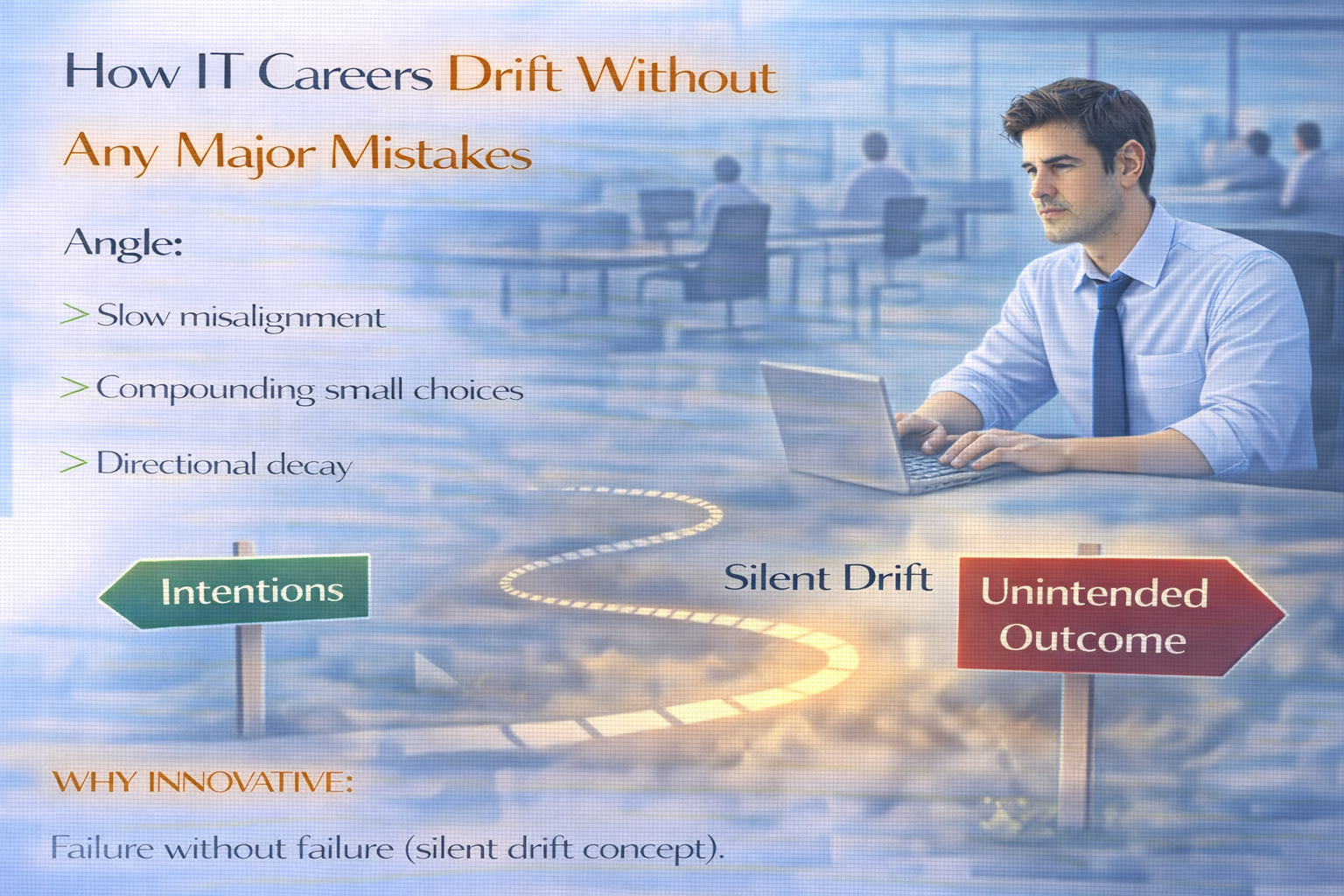
Slow Misalignment: The Invisible Shift
Drift begins when small choices stop aligning with long-term direction.
Examples:
- Choosing convenience over learning
- Staying because the team is comfortable
- Accepting roles that pay well but teach little
- Delaying hard transitions “for now”
Each decision feels rational.
Together, they quietly change trajectory.
Compounding Small Choices
Careers compound like interest — but not always positively.
Small choices repeat:
- You keep working on the same type of problems
- You avoid unfamiliar responsibilities
- You stop exploring adjacent skills
Over time, these choices compound into:
- Narrow expertise
- Reduced adaptability
- Fewer credible exit options
No single decision caused this.
The pattern did.
Directional Decay in IT Careers
Directional decay happens when effort continues but direction degrades.
You work hard.
You stay busy.
You deliver results.
But the direction of value creation slowly weakens.
Five years later, you realize:
- Your experience is deep but context-bound
- Your market relevance has shifted
- Your options are fewer than expected
The career didn’t stop.
It drifted.
Why Drift Is Hard to Detect Early
Drift lacks negative feedback.
There is no clear failure signal.
In fact, short-term rewards often reinforce it:
- Stability feels like progress
- Familiarity feels like mastery
- Comfort feels like security
By the time discomfort appears, reversing direction requires much more energy.
How to Interrupt Career Drift
Drift is not prevented by motivation.
It is prevented by periodic recalibration.
Practical habits:
- Regularly ask what skills you are not developing
- Measure learning, not just output
- Check if your role expands future options
- Compare current direction with long-term intent
Small course corrections early prevent painful pivots later.
Final Thought
Most IT careers don’t fail because of one wrong move.
They fail because of many reasonable moves in the wrong direction.
Drift is subtle.
And only awareness can stop it.