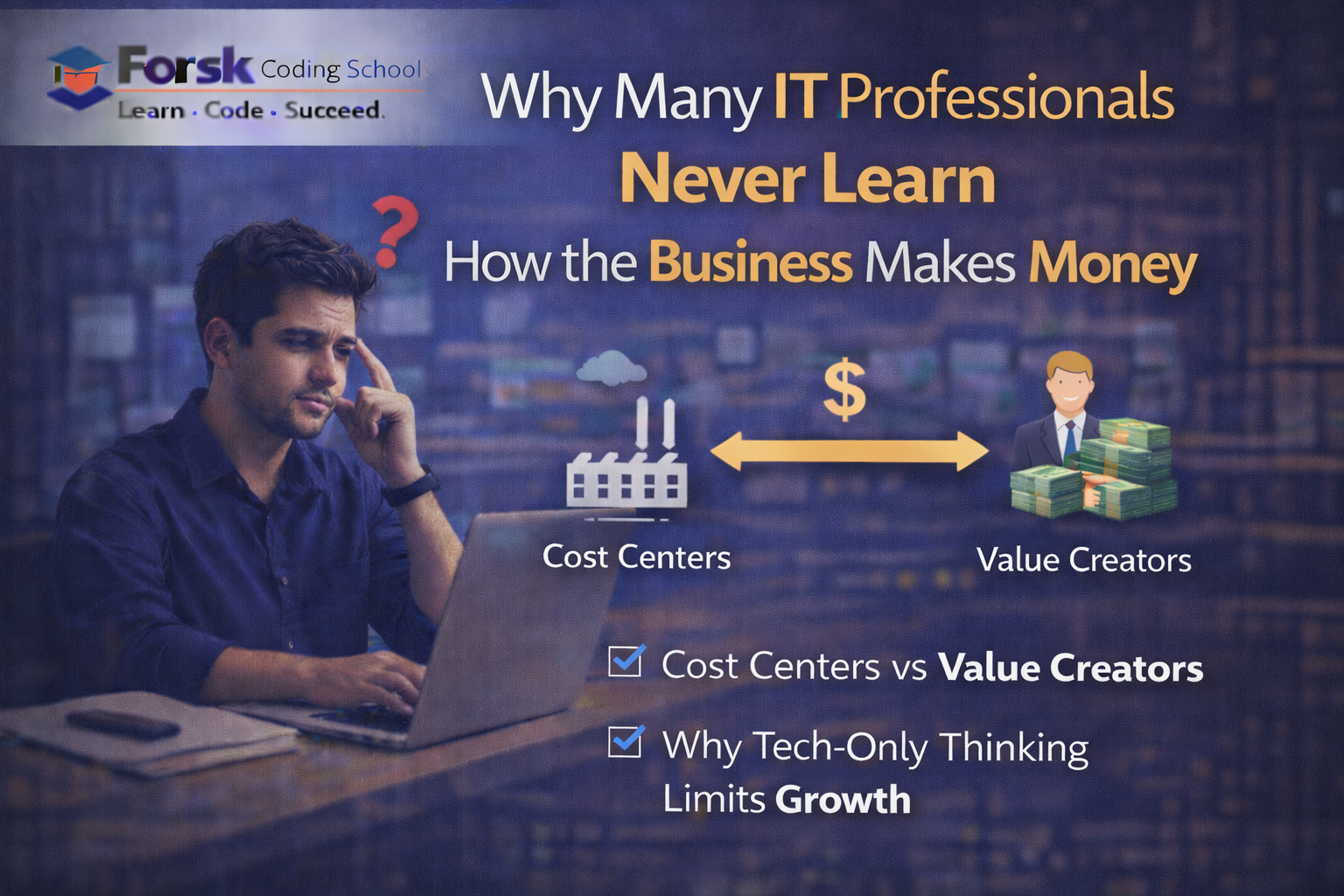
A large number of IT professionals spend years building software, maintaining systems, and solving technical problems—yet never truly understand how their company actually makes money. This gap is not accidental. It is one of the most common and limiting blind spots in IT careers.
This blog explores why business knowledge is missing in many IT roles, how tech-only thinking quietly restricts growth, and why understanding revenue, cost, and value creation is essential for long-term career progression.
The Business Knowledge Gap in IT Careers
Most IT professionals are trained to focus on:
- Code quality
- System performance
- Feature delivery
Very few are encouraged to ask:
- Who pays for this product?
- How does this feature generate revenue?
- What costs does this system reduce or increase?
As a result, years pass without real business understanding.
IT as Cost Center vs Value Creator
How IT Becomes a Cost Center
When IT professionals focus only on execution:
- They are seen as expense units
- Budgets become tightly controlled
- Decisions are made elsewhere
In this model, IT is something the business spends on, not something that creates value.
How IT Becomes a Value Creator
When IT professionals understand business impact, they:
- Build solutions that increase revenue
- Reduce operational costs
- Improve customer experience
At this point, IT shifts from cost center to strategic asset.
Why Tech-Only Thinking Limits Growth
Technical Excellence Has a Ceiling
Pure technical strength can take a career far—but not indefinitely.
Without business understanding:
- Promotion opportunities slow
- Leadership roles remain out of reach
- Decision-making power stays limited
This is where many IT careers quietly plateau.
Decisions Are Business-Driven
Senior roles require:
- Trade-off analysis
- Cost–benefit thinking
- Risk evaluation
Professionals who cannot connect technology to business outcomes are excluded from these conversations.
Why Many IT Professionals Avoid Business Learning
Common reasons include:
- Belief that “business is management’s job”
- Comfort in technical problem-solving
- Fear of finance and non-technical concepts
Unfortunately, avoidance does not protect careers—it limits them.
What Business Knowledge IT Professionals Should Learn
You don’t need an MBA. You need clarity on:
- Revenue models (how money comes in)
- Cost structures (where money goes)
- Customer value (why users pay)
- Impact metrics (how success is measured)
This knowledge transforms how you design and prioritize solutions.
Career Impact of Business Understanding
IT professionals with business literacy:
- Are trusted with larger responsibilities
- Participate in planning and strategy
- Move into leadership and architect roles faster
They are seen as partners—not just implementers.
How to Build Business Understanding in IT
Start small:
- Ask why a feature matters
- Learn how your product earns revenue
- Understand customer pain points
- Observe how decisions are justified
Over time, this awareness reshapes your professional value.
Final Takeaway
Many IT professionals limit their own growth by never learning how the business makes money.
Technical skills keep systems running.
Business understanding decides who grows, who leads, and who influences decisions.
In IT careers, real power comes from connecting technology to value.
If you don’t understand how money flows, you’ll always be treated as a cost—not a creator.