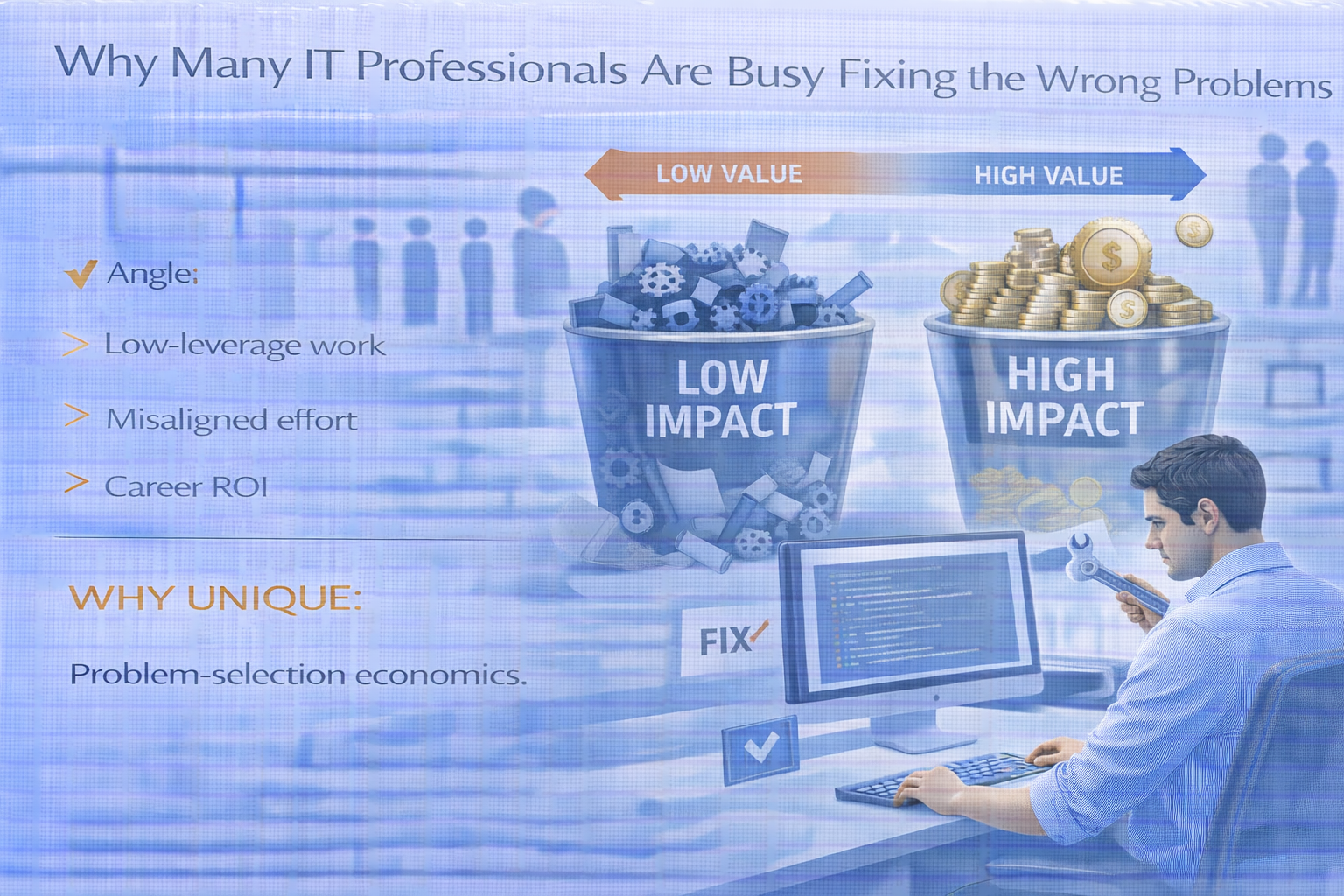
In IT careers, being busy is often mistaken for being effective. Long hours, constant firefighting, and endless task lists create a sense of productivity—but many professionals remain stuck despite working hard.
The reason is rarely lack of skill or effort. More often, it’s problem-selection failure.
This article explores why many IT professionals invest their energy in low-impact problems—and how misaligned effort quietly erodes career growth.
Activity Is Not Impact
IT environments reward visible busyness:
- Closing many tickets
- Fixing recurring bugs
- Responding quickly to issues
But not all problems are equal. Some fixes improve systems permanently. Others only reduce noise temporarily.
Professionals who spend most of their time on low-leverage tasks appear productive but generate little long-term value.
Low-Leverage Work Traps
Low-leverage problems share common traits:
- Symptoms instead of root causes
- Short-term relief with no structural change
- Repeated fixes for the same issue
Examples include:
- Restarting services instead of fixing architecture
- Manual data cleanup instead of automation
- Patchwork performance fixes instead of redesign
These tasks keep systems running—but careers stagnant.
Misaligned Effort in Career Growth
Effort creates returns only when aligned with leverage.
Many IT professionals unknowingly optimize for:
- Speed over significance
- Comfort over challenge
- Urgency over importance
As a result, they become reliable executors rather than valued problem-framers.
Career growth favors those who choose the right problems, not those who solve the most problems.
The Economics of Problem Selection
Every problem has a return on investment:
- Time invested
- Skill gained
- Visibility created
- Reusability of solution
High-leverage problems:
- Scale across teams or systems
- Improve future work
- Build decision-making credibility
Low-leverage problems consume time without compounding value.
Why Smart Professionals Still Fall Into This Trap
Several forces push IT professionals toward the wrong problems:
- Organizational pressure to “stay busy”
- Fear of tackling ambiguous, high-risk issues
- Lack of authority to choose better problems
Over time, professionals adapt to survival mode instead of strategic growth.
How to Shift Toward High-Leverage Work
Professionals who grow faster learn to:
- Ask which problems repeat—and why
- Prefer permanent fixes over quick wins
- Invest time in solutions that scale
- Align effort with long-term system health
This shift requires courage, not intelligence.
Final Thoughts
IT careers are shaped less by how hard you work—and more by what you choose to work on.
Busy professionals fix many problems.
Growing professionals fix the right ones.
In the long run, problem selection—not problem solving—determines career ROI.