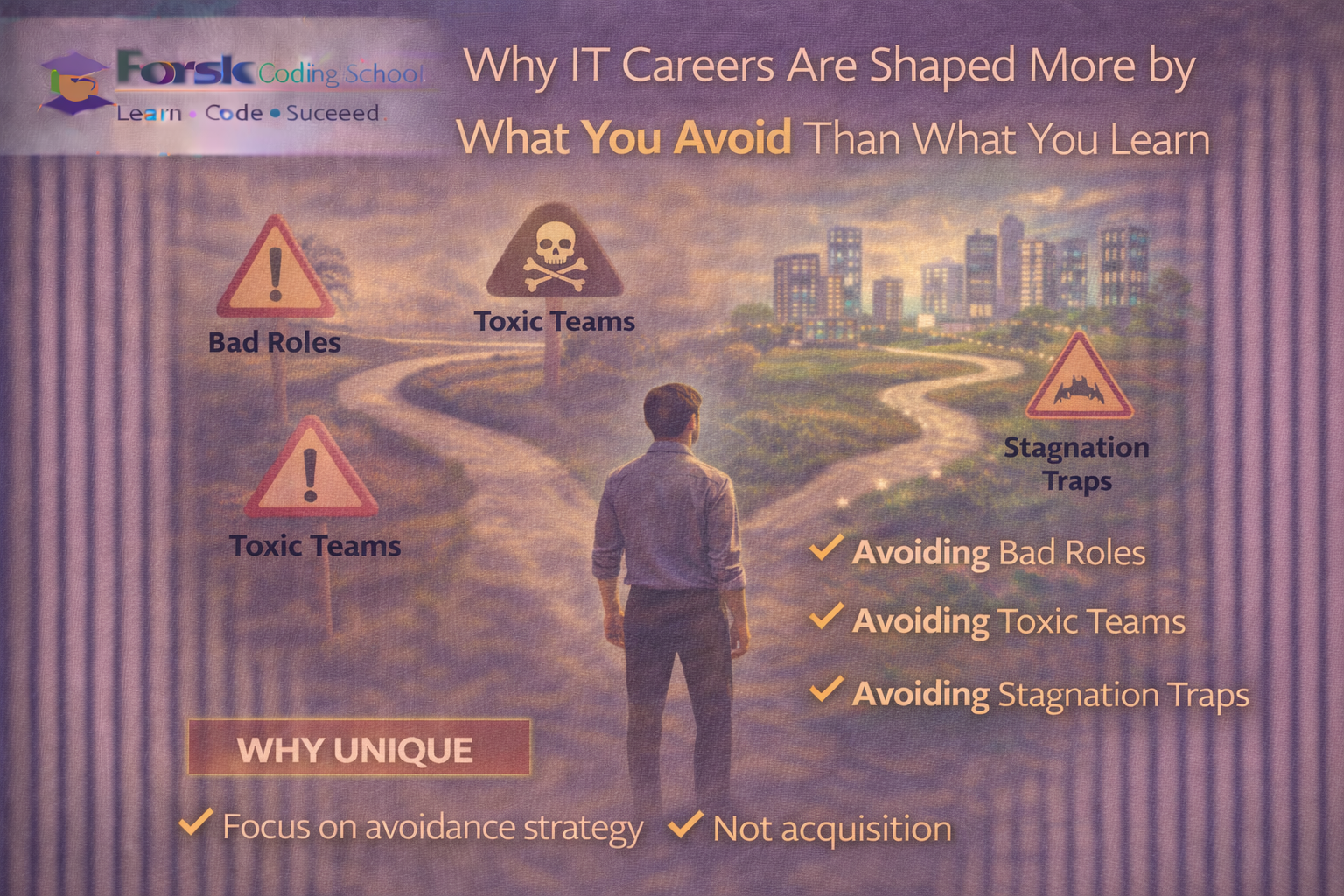
Why IT Careers Are Shaped More by What You Avoid Than What You Learn
IT careers are usually discussed in terms of acquisition—new skills, new tools, new certifications, and new roles. While learning matters, long-term career outcomes are often shaped more by what professionals consciously avoid. Bad roles, toxic teams, and stagnation traps quietly do more damage than missing any single skill.
This perspective is not pessimistic. It is strategic avoidance, a concept borrowed from decision science.
Learning Adds Skills, Avoidance Protects Trajectory
Learning expands capability. Avoidance protects direction. Many IT professionals keep learning continuously but still feel stuck because they remain in environments that block growth.
Avoidance decisions act as guardrails. They prevent irreversible damage to confidence, reputation, health, and momentum.
Avoiding Bad Roles That Limit Exposure
Not all roles are equal, even if the title sounds good. Some roles:
- Involve repetitive, low-impact work
- Offer no system-level visibility
- Limit interaction with decision-makers
Staying too long in such roles narrows perspective. Skills may improve, but relevance does not.
Avoiding roles that lack learning surface area is often more important than chasing prestigious titles.
Avoiding Toxic Teams and Cultures
Toxic teams normalize stress, fear, and blame. Over time, they reshape behavior:
- Curiosity declines
- Risk-taking disappears
- Learning becomes survival-driven
Even strong professionals deteriorate in unhealthy environments. Avoiding toxic teams protects not just mental health, but professional identity.
Avoiding Stagnation Traps
Stagnation rarely feels like failure. It feels like comfort. Predictable work, low pressure, and familiar routines can hide slow decline.
Common stagnation traps include:
- No feedback loops
- No ownership growth
- No exposure to new problems
Avoiding stagnation requires honesty, not ambition.
Why Avoidance Decisions Are Hard
Avoidance is difficult because it involves saying no—to roles, teams, or comfort. Short-term trade-offs often feel risky, even when long-term damage is certain.
Professionals often regret what they tolerated longer than what they tried and failed.
Designing a Career Through Subtraction
Strong IT careers are often built by subtracting:
- Environments that drain energy
- Roles that cap learning
- Patterns that normalize stagnation
This creates space for meaningful growth.
Final Thought
IT careers are shaped as much by what you avoid as by what you learn. Skills can be acquired later. Lost confidence, reputation, and momentum are harder to recover. Strategic avoidance is not fear—it is foresight. Protect the trajectory, and growth follows naturally.