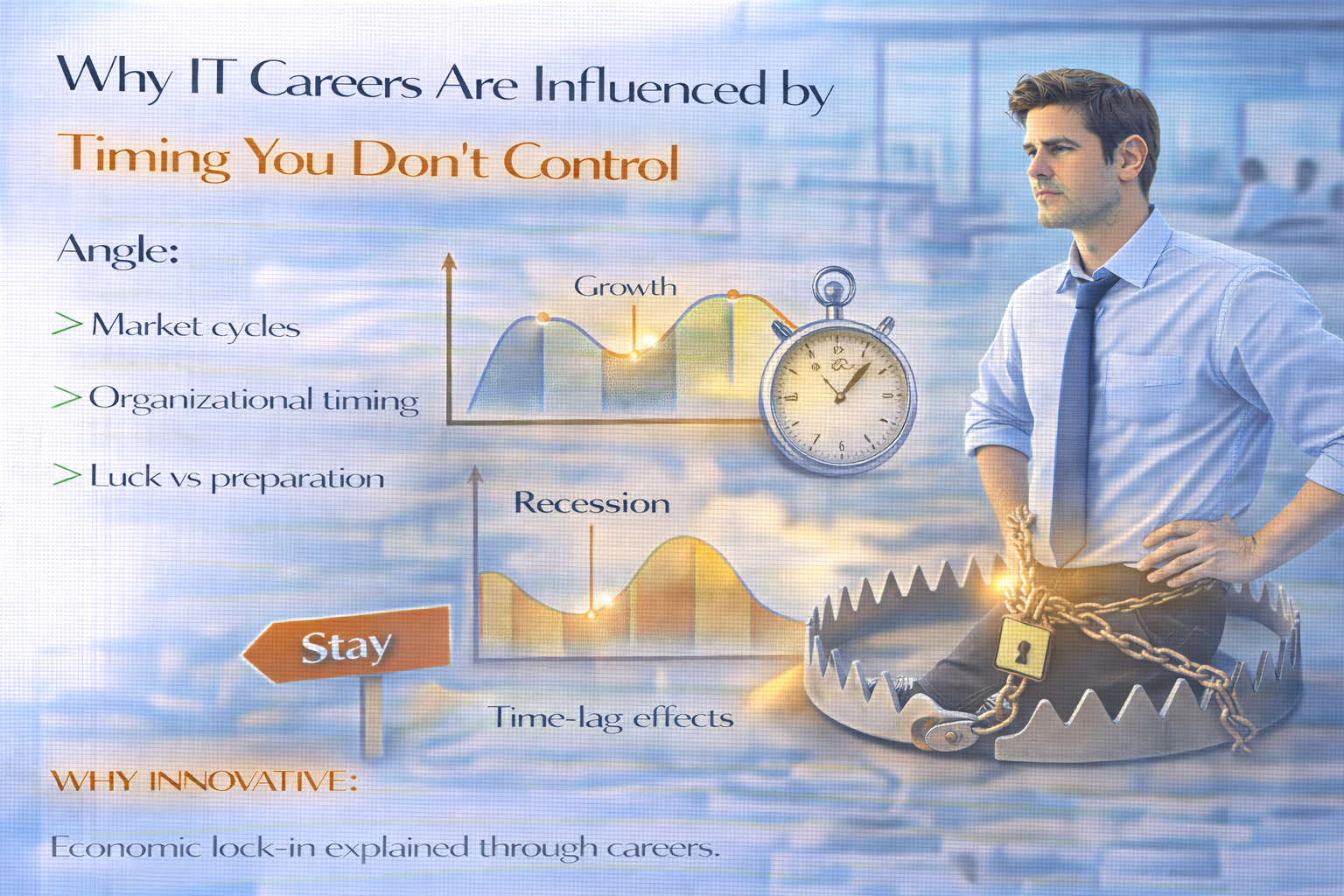
IT professionals like to believe careers are built purely on skill, effort, and smart decisions.
While these matter, they are not the full story.
A powerful — and often uncomfortable — truth is this:
Timing shapes IT careers far more than most professionals admit.
Not because effort is irrelevant, but because many forces operate outside individual control.
The Myth of Total Control in IT Careers
Career narratives often highlight merit:
- “They worked harder”
- “They learned faster”
- “They made better choices”
These stories ignore timing.
The same skill, applied at different moments, can produce radically different outcomes.
Market Cycles and Career Outcomes
Technology markets move in cycles:
- Skills surge in demand
- Saturation follows
- Demand stabilizes or collapses
Professionals entering a skill early often benefit disproportionately.
Those entering late may struggle — even if equally capable.
The difference is timing, not intelligence.
Organizational Timing Effects
Inside companies, timing matters just as much:
- Joining before growth vs after peak
- Promotion cycles aligning with expansion or contraction
- Leadership changes that redefine opportunity
Two professionals with identical performance can see opposite outcomes depending on when events occur.
Luck vs Preparation: A False Conflict
Luck makes people uncomfortable.
So they deny it.
But denying luck prevents learning.
The truth:
- You can’t control timing
- You can control preparation
Preparation determines whether timing helps or passes unnoticed.
Why Timing Is Often Misattributed
When timing helps, success is attributed to skill.
When timing hurts, failure is blamed on self.
This creates distorted self-assessment:
- Overconfidence after favorable timing
- Unnecessary self-doubt after bad timing
Both are dangerous.
Making Better Decisions in an Uncontrollable World
You can’t control cycles.
But you can design for uncertainty:
- Avoid single-point career dependencies
- Build transferable skills
- Preserve optionality
- Recognize when outcomes are timing-driven, not ability-driven
This reduces emotional overreaction to events you didn’t cause.
The Strategic Advantage of Timing Awareness
Professionals who understand timing:
- Take fewer failures personally
- Avoid false confidence during booms
- Make calmer decisions during downturns
They don’t chase narratives.
They manage exposure.
Final Thought
IT careers are shaped by a mix of skill, effort, and timing.
Ignoring timing creates arrogance during good periods — and despair during bad ones.
Acknowledging timing creates humility, resilience, and better long-term strategy.
You don’t control the clock.
But you control how prepared you are when it strikes.