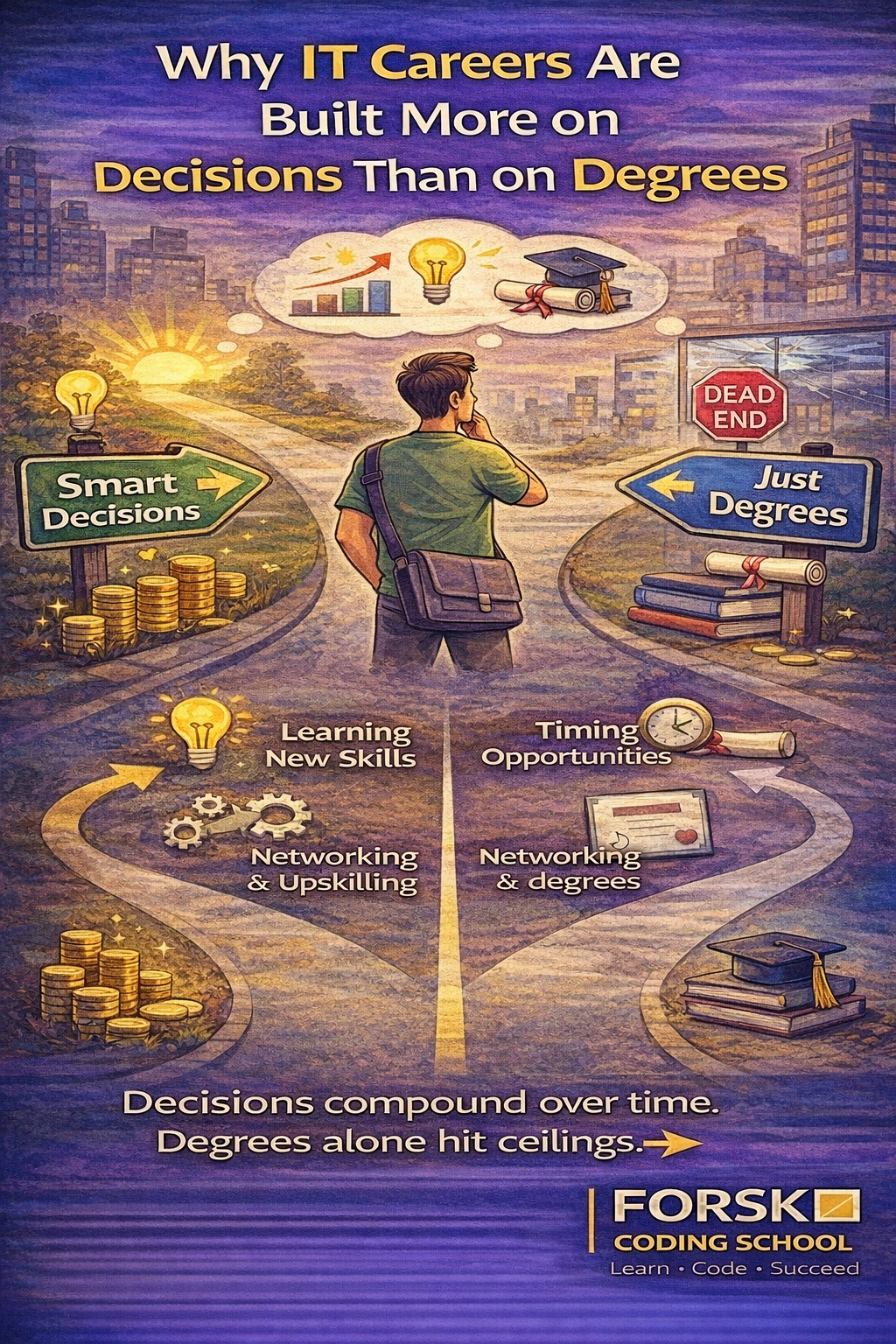
For years, IT careers have been marketed as degree-driven: get the right college, the right branch, and the right certificate, and success will follow. But real-world IT careers don’t grow that way. They grow through decisions—small, repeated choices that compound over time.
In reality, degrees open doors, but decisions decide direction, speed, and ceiling. This blog explains how decision-making shapes IT careers more than formal education, why timing mistakes slow growth, and how choice awareness separates fast-growing professionals from stagnant ones.
The Myth: Degrees Decide IT Careers
Degrees matter—but only at the entry point. After your first role, your career trajectory is influenced far more by:
- What you choose to learn next
- Which roles you accept or reject
- How long you stay in comfort zones
- When you switch, specialize, or explore
Two professionals with the same degree often end up at very different levels within five years. The difference is decision quality, not qualification.
Decision Compounding in IT Careers
Just like financial compounding, career decisions compound silently.
Small Decisions, Big Outcomes
Examples of compounding decisions:
- Choosing hands-on projects over passive roles
- Saying yes to learning opportunities early
- Asking questions instead of staying silent
- Picking learning environments over brand names
Each decision seems small, but together they shape expertise, confidence, and visibility.
Timing Mistakes That Slow IT Careers
1. Waiting Too Long to Skill Up
Many professionals delay learning because:
- “I’ll learn after promotion”
- “I’m too busy right now”
In IT, delayed learning means missed relevance.
2. Switching Too Late
Staying too long in:
- Outdated tech
- Low-learning roles
- Non-growing teams
Causes skill stagnation. Timing matters as much as skill.
3. Chasing Degrees Instead of Direction
Additional degrees without clarity often:
- Add credentials, not competence
- Delay real-world exposure
- Create false confidence
Decisions without direction waste time.
Choice Awareness: The Real Career Skill
High-growth IT professionals consistently ask:
- What will this role teach me in 12 months?
- Does this decision increase or reduce future options?
- Am I choosing comfort or growth?
This awareness turns careers proactive instead of reactive.
Why Degrees Lose Power Over Time
Degrees don’t update—but technology does.
After a few years, what matters more is:
- Problem-solving ability
- Adaptability
- Learning speed
- Decision clarity
Hiring managers evaluate outcomes, not academic paths.
How to Build a Decision-Driven IT Career
You don’t need perfect decisions—just better ones, consistently:
- Choose learning-heavy roles early
- Optimize for exposure, not titles
- Review decisions every 6–12 months
- Course-correct without ego
Careers break not from bad starts, but from unexamined choices.
Final Takeaway
IT careers are not built in classrooms alone. They are built at decision points—often invisible, often uncomfortable.
Degrees may get you started.
Decisions decide how far you go.
Those who grow fastest are not the most qualified—but the most intentional.
In IT, success compounds from choices, not certificates.