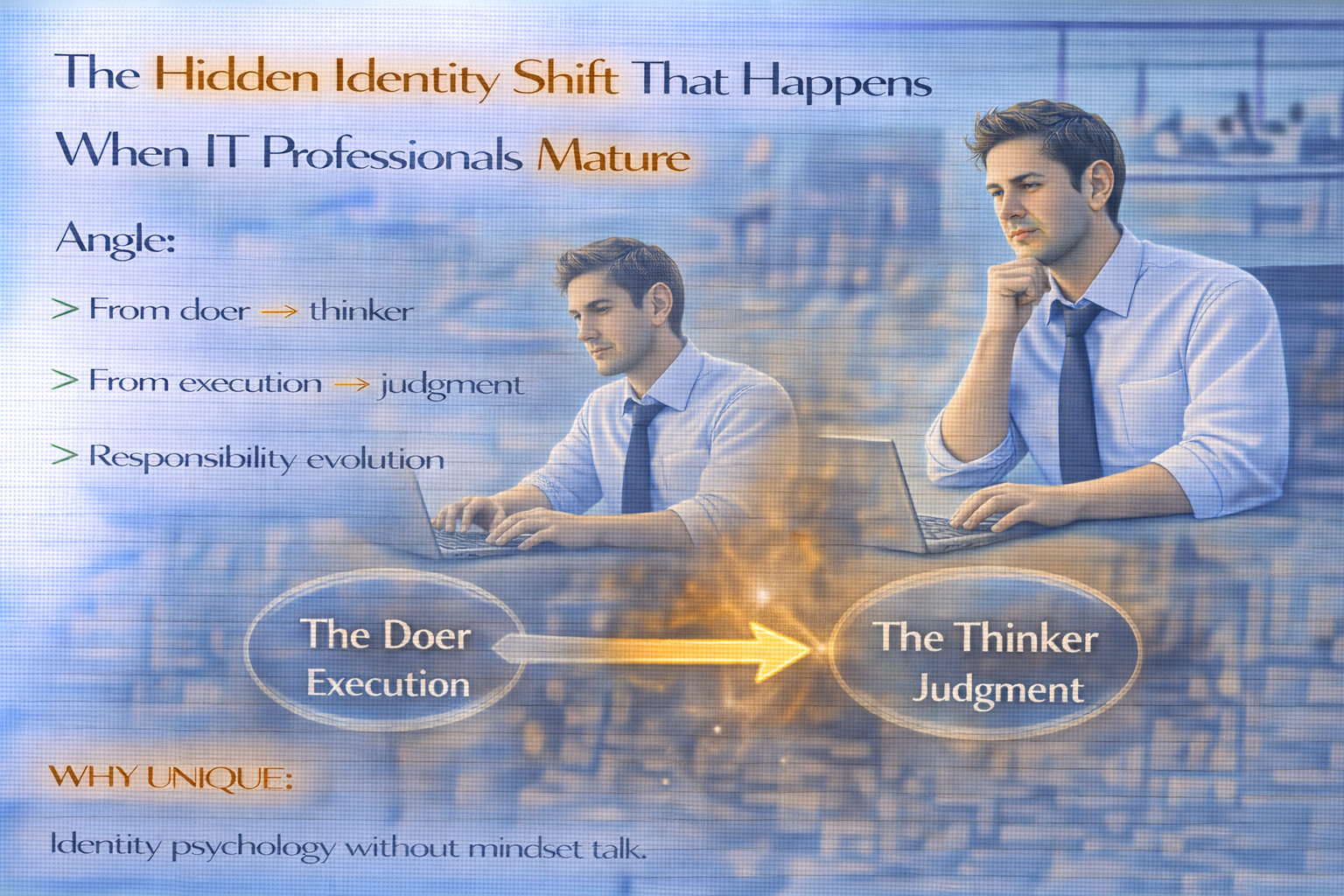
Early in an IT career, identity is simple.
You are valued for what you do.
You write code.
You fix bugs.
You deliver features.
As careers mature, something subtle but powerful changes.
The value shifts — not visibly, but fundamentally.
From Doer to Thinker
In the early years, success comes from execution speed:
- How fast you solve problems
- How reliably you deliver output
- How well you follow technical direction
Over time, execution alone stops being enough.
Mature IT professionals are expected to:
- Decide what problems matter
- Anticipate downstream impact
- Prevent issues instead of reacting to them
The work moves from doing to thinking.
From Execution to Judgment
Judgment is not louder work.
It is quieter — and harder to measure.
It includes:
- Knowing when not to build
- Choosing trade-offs under uncertainty
- Balancing technical purity with business reality
This is where many professionals feel disoriented.
They are working more thoughtfully — yet producing less visible output.
Responsibility Evolves Before Titles Do
Identity shifts often happen before formal recognition.
Professionals begin to:
- Influence decisions without authority
- Carry responsibility beyond assigned tasks
- Be consulted instead of instructed
But titles and job descriptions lag behind.
This gap creates confusion:
“Am I doing less, or doing something different?”
Why This Shift Feels Uncomfortable
Execution gives immediate feedback.
Judgment does not.
- Success is often invisible
- Mistakes are more costly
- Accountability increases
Many professionals subconsciously resist this shift — and retreat back to execution, where identity feels safer.
The Cost of Resisting Maturity
Professionals who refuse this identity transition:
- Stay productive but less influential
- Become execution-heavy specialists
- Feel sidelined in strategic conversations
Their skills remain strong.
Their relevance slowly narrows.
Learning to Own the New Identity
Mature IT careers require accepting a new self-concept:
- Your value is judgment, not output volume
- Your impact is indirect, not always visible
- Your responsibility extends beyond code
Practical ways to adapt:
- Practice explaining reasoning, not just results
- Learn to evaluate trade-offs explicitly
- Become comfortable with slower, higher-stakes work
Final Thought
Career maturity in IT is not about becoming less technical.
It is about becoming more accountable for consequences.
Those who accept this identity shift continue to grow.
Those who don’t often feel stuck — even while working harder than ever.