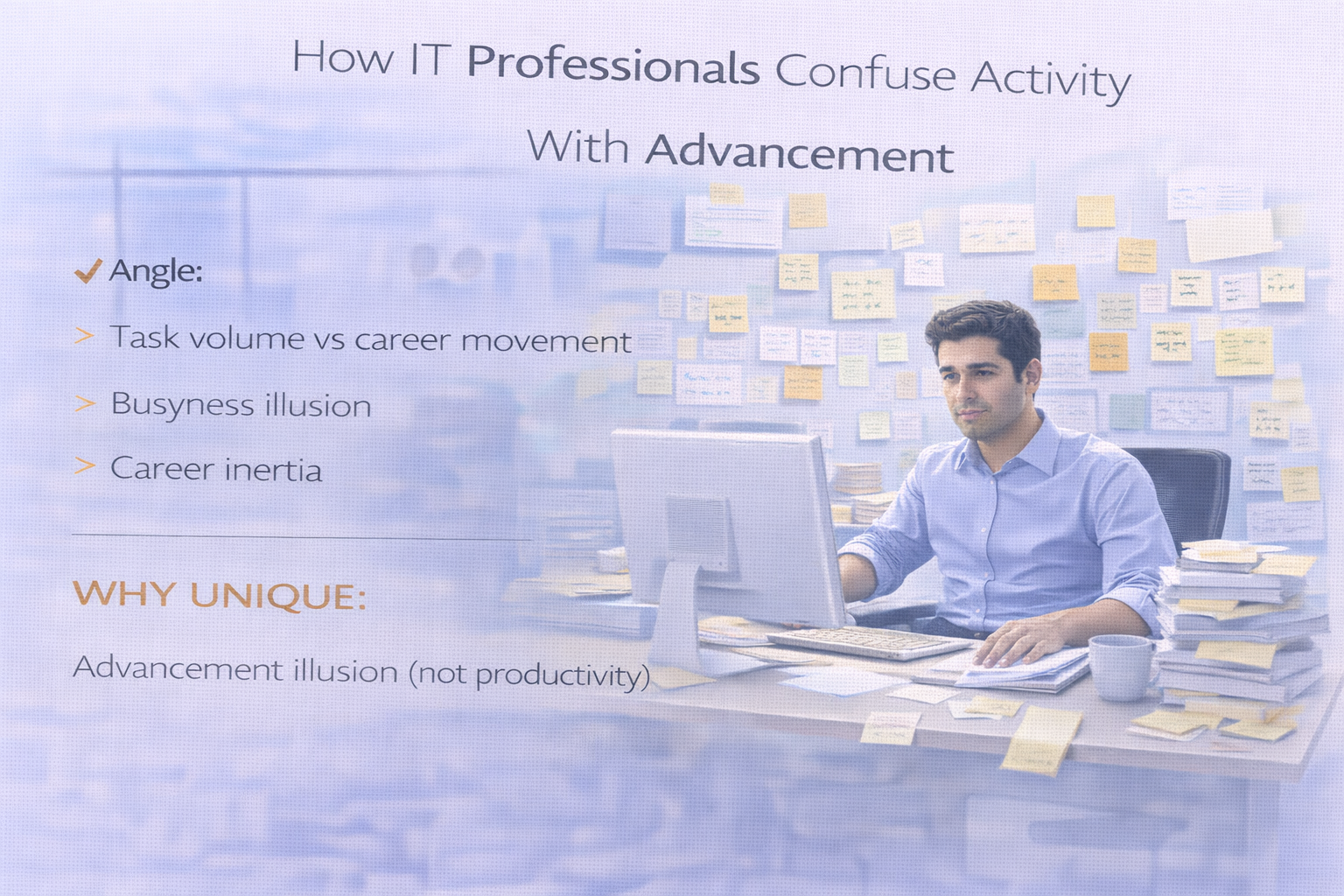
In many IT careers, being busy is treated as proof of progress. Long task lists, packed calendars, constant messages, and visible effort create the feeling of forward movement.
But activity and advancement are not the same.
This blog explains how IT professionals mistake busyness for career growth — and how task volume, advancement illusion, and career inertia quietly slow long-term progress.
Task Volume vs Career Movement
Activity is easy to measure.
IT professionals stay busy by:
- Closing tickets
- Attending meetings
- Fixing recurring issues
- Delivering incremental features
While these actions keep systems running, they do not automatically expand responsibility, influence, or future opportunity.
Career movement happens when:
- Problem complexity increases
- Decision-making scope expands
- Ownership deepens
- Impact reaches beyond immediate tasks
Many professionals work harder each year — without moving forward.
The Busyness Illusion: Motion Without Direction
Busyness creates a powerful illusion of progress.
When days are full:
- Reflection disappears
- Strategic thinking is postponed
- Career planning feels unnecessary
Professionals assume that staying active will eventually be noticed and rewarded.
In reality, organizations often reward outcomes and leverage, not visible effort. Constant motion without direction leads to exhaustion — not advancement.
Career Inertia: When Movement Stops Without Being Noticed
Career inertia sets in quietly.
Warning signs include:
- Similar work year after year
- No change in scope despite high output
- Praise without new responsibility
- Learning that stays operational, not strategic
Because professionals are busy, stagnation is easy to ignore.
Time passes. Titles remain the same. Options narrow.
Why This Is Not a Productivity Problem
This is not about working less.
It is about aligning effort with growth.
Advancement requires:
- Choosing high-leverage work
- Saying no to low-impact repetition
- Creating visibility around outcomes, not tasks
- Periodically reassessing direction
Without this alignment, activity becomes a distraction from progress.
Final Insight
Being busy feels productive.
But IT careers advance through leverage, ownership, and expanded scope — not task completion alone.
The real danger is not inactivity, but motion that leads nowhere.