Many IT professionals—especially freshers and early-career engineers—ask the same question silently:
“Why do some people get real, meaningful work early, while others stay stuck with support tasks?”
The answer is rarely pure talent.
This blog explains IT manager expectations, the real meaning of trust in IT teams, and the psychology managers use when deciding who gets responsibility and who doesn’t. This is not about student behavior—it’s about how managers think.
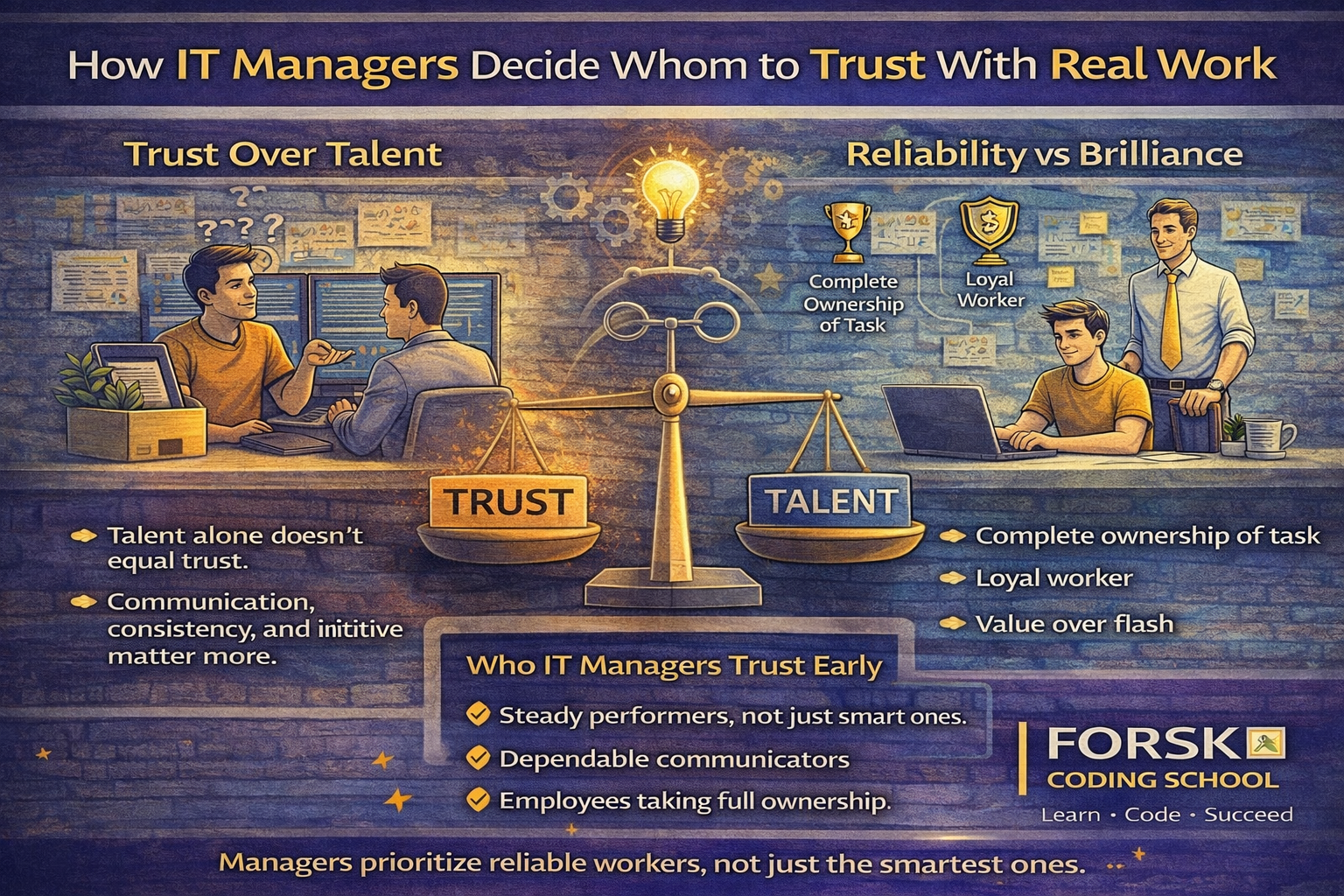
Trust vs Talent: The Real Decision Factor
Most IT managers already assume a baseline level of technical ability.
What they actually evaluate is:
- Can I rely on this person?
- Will they reduce my risk?
- Will they handle uncertainty without panic?
Talent may impress.
Trust protects managers.
That’s why trust almost always beats raw brilliance when it comes to assigning real work.
What “Real Work” Means to a Manager
From a manager’s perspective, real work is:
- Production-impacting tasks
- Client-facing responsibilities
- Deadline-sensitive deliverables
- Work that can cause damage if mishandled
Assigning such work is not generosity—it’s risk delegation.
Managers don’t delegate risk to the smartest person. They delegate it to the most dependable one.
Why Some Freshers Get Real Tasks Early
It’s not luck. It’s signal clarity.
Freshers who get trusted early usually show:
- Consistent follow-through
- Clear communication
- Willingness to ask questions early
- Calm response to feedback
They make managers feel safe, not impressed.
Reliability Beats Brilliance (Every Time)
Brilliant but unreliable engineers:
- Miss deadlines
- Overpromise
- Go silent during issues
- Require constant follow-ups
Reliable engineers:
- Deliver predictably
- Flag risks early
- Ask for help before problems explode
- Close loops consistently
Managers can work with average skills.
They cannot work with uncertainty.
This is a core IT manager expectation most professionals misunderstand.
Communication Is a Trust Multiplier
Trust grows faster through communication than coding.
Managers notice:
- Status updates without reminders
- Honest progress reporting
- Clear articulation of blockers
Silence is interpreted as risk.
Over-communication is interpreted as control.
Ownership Signals Managers Look For
Managers trust people who:
- Take responsibility beyond assigned tasks
- Think in terms of outcomes, not tickets
- Care about impact, not just completion
Ownership doesn’t mean doing more work.
It means thinking like the work matters.
Why “Smart” People Often Get Ignored
Many capable engineers fail to get trust because they:
- Focus only on correctness, not delivery
- Avoid responsibility to stay safe
- Assume managers will notice effort automatically
Managers don’t reward invisible effort.
They reward predictable outcomes.
The Manager’s Mental Model (Very Important)
Every manager asks subconsciously:
“If something goes wrong at 2 AM, can I trust this person to handle it?”
Those who pass this test—get real work.
Those who don’t—stay on the sidelines.
How to Build Trust in IT Teams (Practically)
If you want managers to trust you with real work:
- Be consistent before being clever
- Communicate before being perfect
- Deliver small wins repeatedly
- Own mistakes early
Trust compounds.
Talent alone does not.
Final Thoughts: Think Like a Manager, Not a Candidate
If you want real work, stop asking:
“How do I show I’m smart?”
Start asking:
“How do I make my manager feel safe trusting me?”
Understanding trust in IT teams and IT manager expectations is one of the fastest ways to accelerate your career—yet it’s rarely taught.
Key Takeaway
In IT teams:
- Talent gets noticed
- Reliability gets trusted
- Trust gets responsibility
And responsibility builds careers.