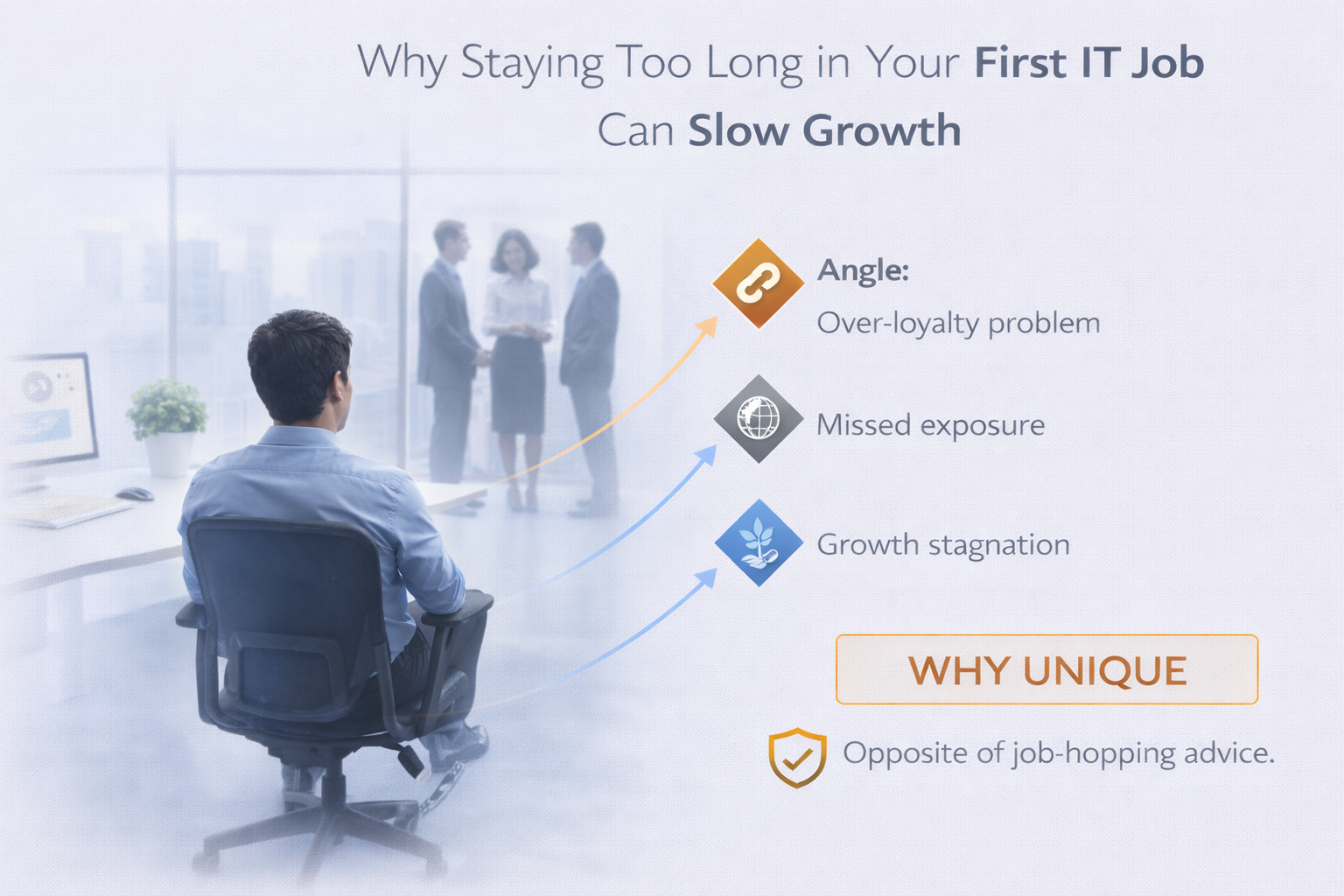
Conventional career advice often warns IT professionals against changing jobs too early. Loyalty, stability, and patience are praised as virtues. While commitment has value, over-staying in your first IT job can quietly slow long-term growth.
This blog explores the lesser-discussed downside of over-loyalty, missed exposure, and growth stagnation — offering a counterbalance to both blind loyalty and reckless job-hopping.
The Over-Loyalty Problem: When Stability Turns Into Stagnation
First jobs feel safe:
- Familiar systems and people
- Predictable expectations
- Low risk of failure
- Gradual comfort and confidence
Over time, however, loyalty can morph into inertia.
When professionals stay too long:
- Responsibilities stop expanding
- Learning becomes incremental
- Promotions are capped by original role design
- Growth depends on others leaving
What began as stability slowly becomes a ceiling.
Missed Exposure: The Cost of a Narrow Career Start
Early career years are high-leverage years.
Staying too long in one environment often means missing exposure to:
- Different engineering cultures
- New system architectures
- Alternate problem-solving approaches
- Faster or more demanding teams
Exposure accelerates judgment.
Without it, professionals may become excellent within one context — but fragile outside it.
Growth Stagnation: When Time Stops Compounding
Growth stagnation is subtle.
You still perform well.
You still deliver.
But your rate of learning slows.
Warning signs include:
- Repeating the same type of work year after year
- Fewer new challenges
- Limited visibility beyond your team
- Skills that don’t translate easily elsewhere
Years of experience stop compounding when the environment no longer stretches you.
Why This Is Not Job-Hopping Advice
This is not an argument for frequent switching.
Growth slows not because of loyalty, but because of unchanging scope.
Healthy early-career progression includes:
- Expanding responsibility
- Increasing complexity
- Broader exposure
- Measurable learning
If your first job provides these, staying can be powerful.
If it doesn’t, time becomes the hidden cost.
Final Insight
Staying is not a virtue by default.
Leaving is not a failure by default.
IT career growth depends on whether your environment is still expanding your capability.
The risk is not staying too long — it’s staying while growth has already stopped.