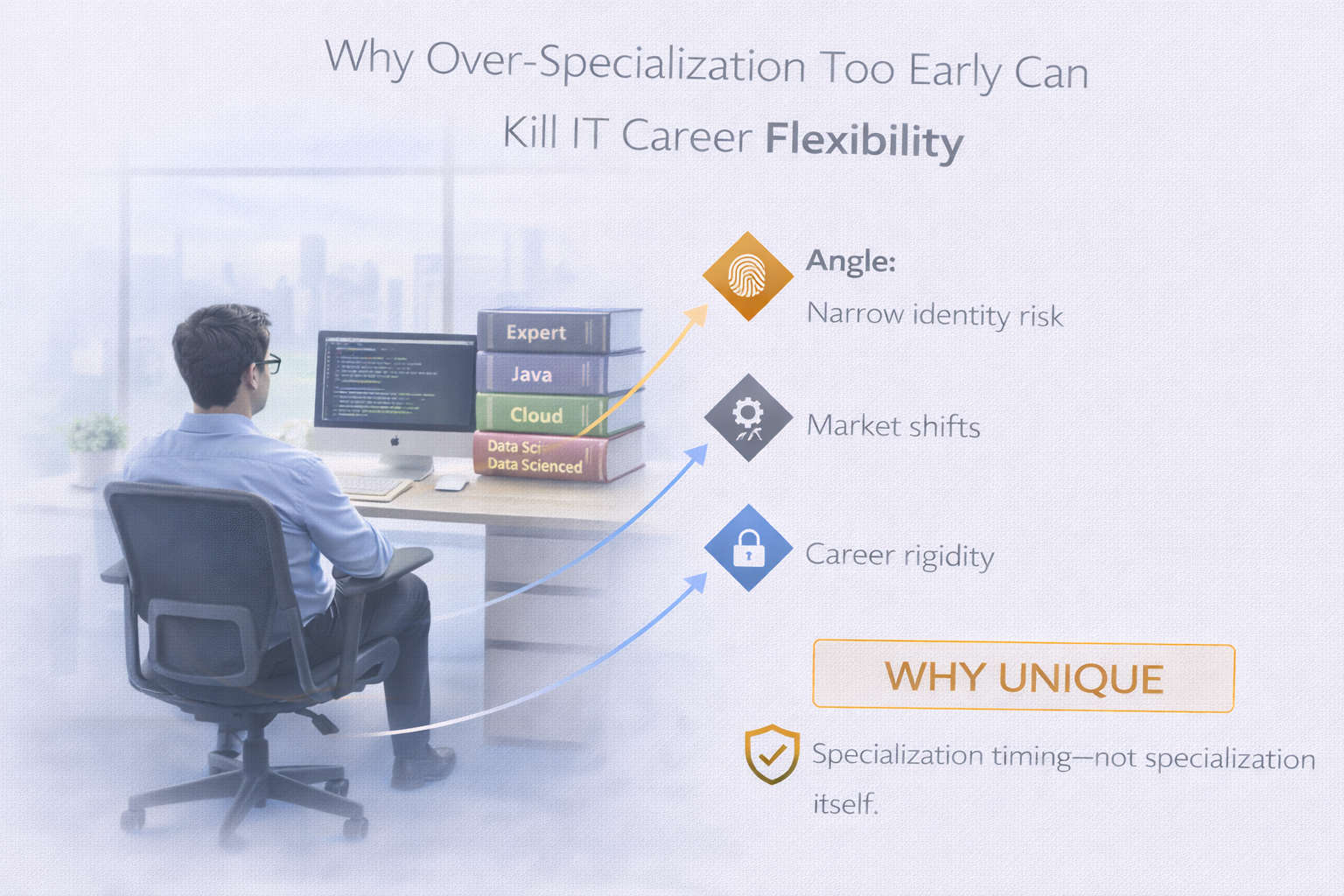
Specialization is often presented as the fastest path to success in IT careers. Pick a niche, go deep, and become the expert. While specialization does create value, doing it too early can quietly reduce long-term career flexibility.
This blog is not anti-specialization. It focuses on specialization timing — how narrowing your identity before building range can increase rigidity, weaken adaptability, and expose careers to market shifts.
Narrow Identity Risk: When Your Role Becomes Your Label
Early over-specialization often turns a skill into an identity.
Examples include:
- Being known only for a single framework
- Owning one narrow tool or platform
- Working exclusively on one system type
When this happens:
- Opportunities are filtered before they reach you
- Managers associate you with limited problem types
- Your perceived range shrinks faster than your actual ability
A narrow identity may feel strong — until the market changes.
Market Shifts: When Demand Moves Faster Than You Can
Technology markets shift continuously:
- Tools rise and fall
- Architectures evolve
- Business priorities change
Professionals who specialize too early face a mismatch:
- Experience is deep but narrow
- Transition costs are high
- Repositioning feels like starting over
In contrast, professionals who first build broad foundations adapt faster when demand shifts.
Flexibility is not about knowing everything — it is about moving efficiently when change arrives.
Career Rigidity: The Cost of Early Lock-In
Career rigidity shows up as:
- Fewer role options
- Higher anxiety during transitions
- Dependence on a shrinking niche
- Resistance to adjacent opportunities
Ironically, early specialists often work harder to stay relevant because their margin for error is smaller.
Depth without range creates fragility.
The Right Timing for Specialization
Strong IT careers follow a sequence:
- Range first – exposure to systems, domains, and problem types
- Judgment second – understanding trade-offs and context
- Specialization third – choosing depth that compounds
Late specialization is usually more durable because it is informed by experience, not trend-following.
Final Insight
Specialization is powerful — at the right time.
Over-specializing too early limits optionality, increases rigidity, and magnifies market risk.
The most flexible IT careers build range before depth, and choose specialization when it can compound instead of constrain.