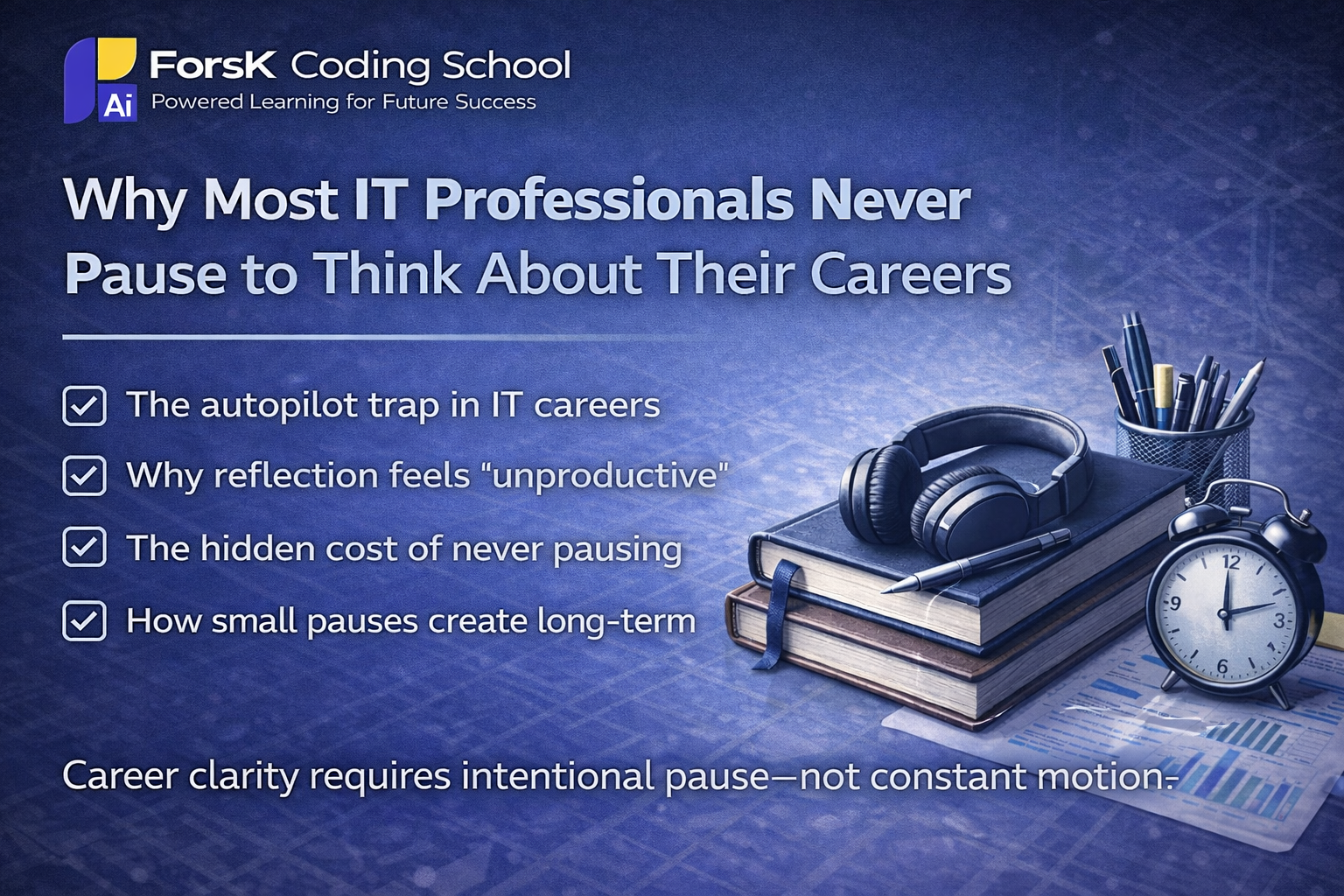
Why Most IT Professionals Never Pause to Think About Their Careers
In the IT industry, motion is constant.
Projects move. Technologies evolve. Deadlines stack. Promotions rotate. And in the middle of all this activity, something quietly disappears—reflection.
Most IT professionals rarely pause to think deeply about their careers. Not because they don’t care, but because the system rewards execution, not contemplation.
This blog explores why career autopilot is common—and how conscious pauses create long-term advantage.
The Autopilot Trap
Early in a career, direction is usually predefined:
- Learn the stack
- Deliver tasks
- Get promoted
Because the next step always exists, questioning direction feels unnecessary.
Years pass. Momentum replaces intention.
Routine Becomes Identity
Daily repetition builds competence—but it can also build unconscious habits.
Professionals become known for:
- A specific module
- A certain role
- A familiar responsibility
Without pause, identity narrows. Optionality shrinks.
Why Reflection Feels Unproductive
Thinking does not produce visible output.
Reflection:
- Doesn’t close tickets
- Doesn’t increase sprint velocity
- Doesn’t appear in performance dashboards
So it gets postponed.
The Cost of Never Pausing
Without reflection:
- Skill relevance drifts
- Energy misalignment grows
- Long-term strategy disappears
- Mid-career confusion increases
Autopilot is efficient—but not directional.
Pause as a Career Skill
High-performing long-term professionals treat pause as a discipline.
They regularly ask:
- Is this work building future leverage?
- Am I growing in judgment or just output?
- What direction is forming quietly?
This creates conscious control.
Small Pauses, Large Impact
You don’t need dramatic resets.
- A quarterly review
- A yearly audit
- A mentor conversation
- A written reflection
These small pauses prevent large corrections later.
Final Thoughts
Most IT professionals don’t fail because of incompetence.
They drift because of constant motion.
Pausing to think about your career is not inactivity.
It is strategic alignment.
In a fast-moving industry, conscious reflection is a competitive advantage.