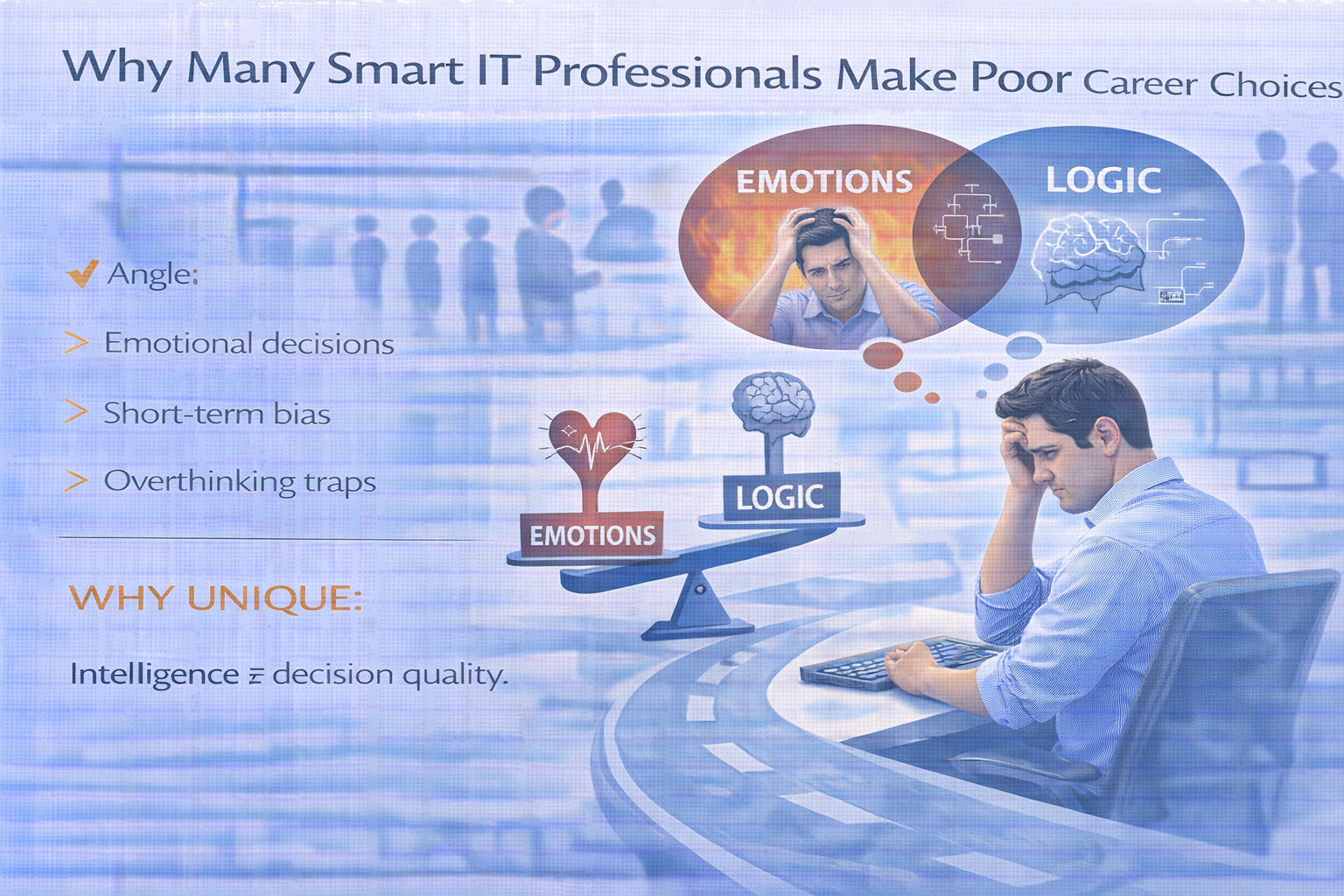
In the IT industry, intelligence is often assumed to guarantee good decisions. Strong analytical skills, logical thinking, and technical expertise are expected to translate naturally into smart career moves.
Yet, reality tells a different story. Many highly intelligent IT professionals repeatedly make career choices that hurt their long-term growth.
This article explores why intelligence does not equal decision quality, especially in complex, emotionally charged career situations.
Intelligence Solves Problems, Careers Create Emotions
Technical intelligence works best in controlled environments:
- Clear problem statements
- Defined constraints
- Logical cause-and-effect
Career decisions rarely look like this. They involve:
- Fear of missing out
- Comparison with peers
- Ego, validation, and insecurity
- Financial and social pressure
When emotions dominate, raw intelligence loses its advantage.
Emotional Decisions Disguised as Logic
Smart professionals are particularly vulnerable to rationalizing emotional choices.
Common patterns include:
- Leaving a role out of frustration but justifying it as “strategic”
- Chasing titles instead of learning opportunities
- Switching jobs for short-term relief rather than long-term alignment
The decision sounds logical, but the driver is emotional discomfort.
Short-Term Bias in High-Pressure Environments
IT careers often operate under intense short-term pressure:
- Deadlines
- Performance reviews
- Rapid tech changes
This pushes even intelligent professionals toward short-term optimization:
- Higher salary over better trajectory
- Immediate comfort over skill depth
- Familiar tech over future relevance
Short-term wins feel safe—but they quietly limit long-term options.
Overthinking Traps
High intelligence increases the risk of overthinking.
Instead of clarity, it can lead to:
- Analysis paralysis
- Endless comparison of paths
- Fear of making the “wrong” move
By trying to optimize every variable, smart professionals delay action—or make reactive choices when pressure peaks.
Why This Repeats Over a Career
Career decisions are not one-time events. They compound.
Small misaligned choices—made for emotional relief or short-term logic—stack over years. Eventually, professionals feel stuck despite being capable, skilled, and intelligent.
The issue was never intelligence. It was decision framing.
Better Career Decisions Require a Different Skill
Good career decisions rely on:
- Emotional awareness
- Long-term thinking
- Acceptance of uncertainty
- Values-based judgment
These are meta-skills, not IQ-based abilities.
Professionals who learn to separate emotions from direction—not from decision-making—tend to choose better paths.
Final Thoughts
Being smart helps you solve technical problems.
But careers are human systems, not logical puzzles.
Until IT professionals learn to manage emotions, resist short-term bias, and avoid overthinking traps, intelligence alone will keep producing poor career choices.
Smart minds don’t fail because they lack ability.
They fail when intelligence is mistaken for wisdom.