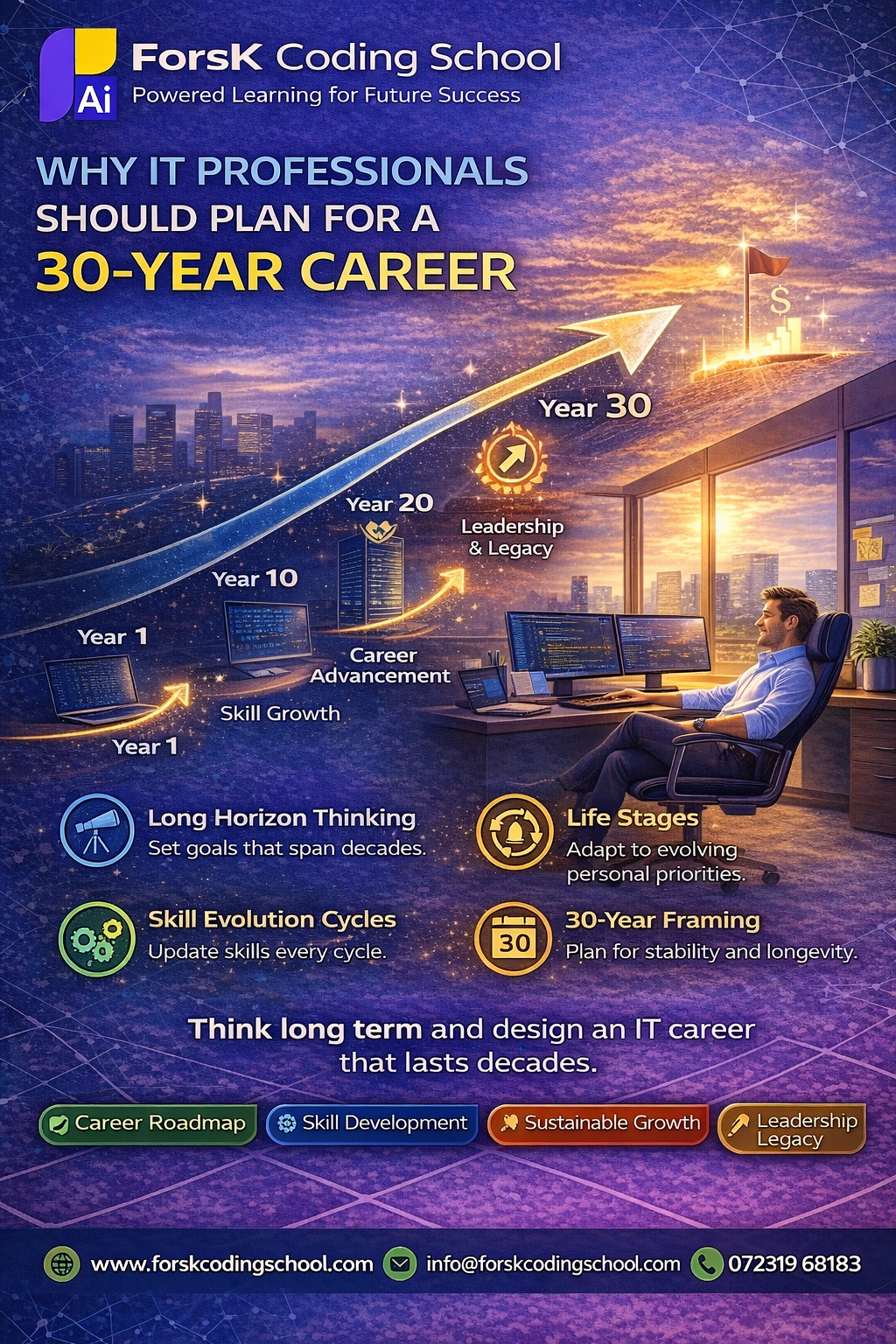
Most IT professionals plan their careers in short bursts—thinking about the next job, next technology, or next salary hike. While short-term planning is important, it is not enough.
An IT career is not a 5-year project.
It is closer to a 30-year journey.
When you start viewing your career through a long-horizon lens, your decisions change. You stop chasing only quick wins and start building something durable, adaptable, and meaningful.
The Power of Long Horizon Thinking
Long horizon thinking means asking:
- Where do I want to be 10, 20, or 30 years from now?
- What kind of professional do I want to become?
- What skills will still matter decades ahead?
Instead of reacting to trends, you design a path.
This mindset reduces anxiety and creates direction.
IT Careers Move in Skill Evolution Cycles
Technology does not move in straight lines. It moves in cycles.
Examples of cycles:
- Learning fundamentals
- Applying fundamentals with new tools
- Deepening system-level understanding
- Mentoring or leading others
Frameworks change.
Languages change.
But fundamentals remain.
When you understand this, you stop panicking about every new technology and start focusing on building transferable skills.
The Three Major Life Stages of an IT Career
1. Foundation Stage (0–8 Years)
Focus on:
- Programming fundamentals
- Data structures & algorithms
- Debugging and problem-solving
- Exposure to different domains
Goal: Build strong technical base.
2. Expansion Stage (8–18 Years)
Focus on:
- System design
- Architecture thinking
- Specialization or leadership
- Mentoring juniors
Goal: Increase impact and responsibility.
3. Leverage Stage (18–30 Years)
Focus on:
- Strategic roles
- Consulting or leadership
- High-level decision making
- Knowledge leverage
Goal: Multiply value, not just effort.
Why Short-Term Thinking Is Dangerous
Short-term thinking leads to:
- Chasing hype skills
- Frequent burnout
- Shallow knowledge
- Career instability
Long-term thinking creates:
- Depth
- Confidence
- Options
- Sustainability
Health and Energy Are Career Assets
A 30-year career requires energy management.
Ignoring sleep, exercise, and mental health may work for a few years—but not for decades.
Your body and mind are part of your professional toolkit.
Build Skills That Age Well
Skills that survive decades:
- Problem-solving
- System thinking
- Communication
- Learning how to learn
Tools are temporary.
These skills are permanent.
Design With Flexibility
Your interests will evolve.
Your responsibilities will change.
A 30-year plan is not a rigid roadmap.
It is a flexible direction.
Final Thoughts
Most people fail not because they lack talent, but because they never planned beyond the next step.
If you want a strong, stable, and satisfying IT career, start thinking in decades—not months.
Plan for a 30-year career.
Future you will be grateful.