Most IT professionals choose problems that are safe, well-defined, and familiar. These problems are easier to estimate, easier to explain, and carry less visible risk. However, they also offer limited career acceleration.
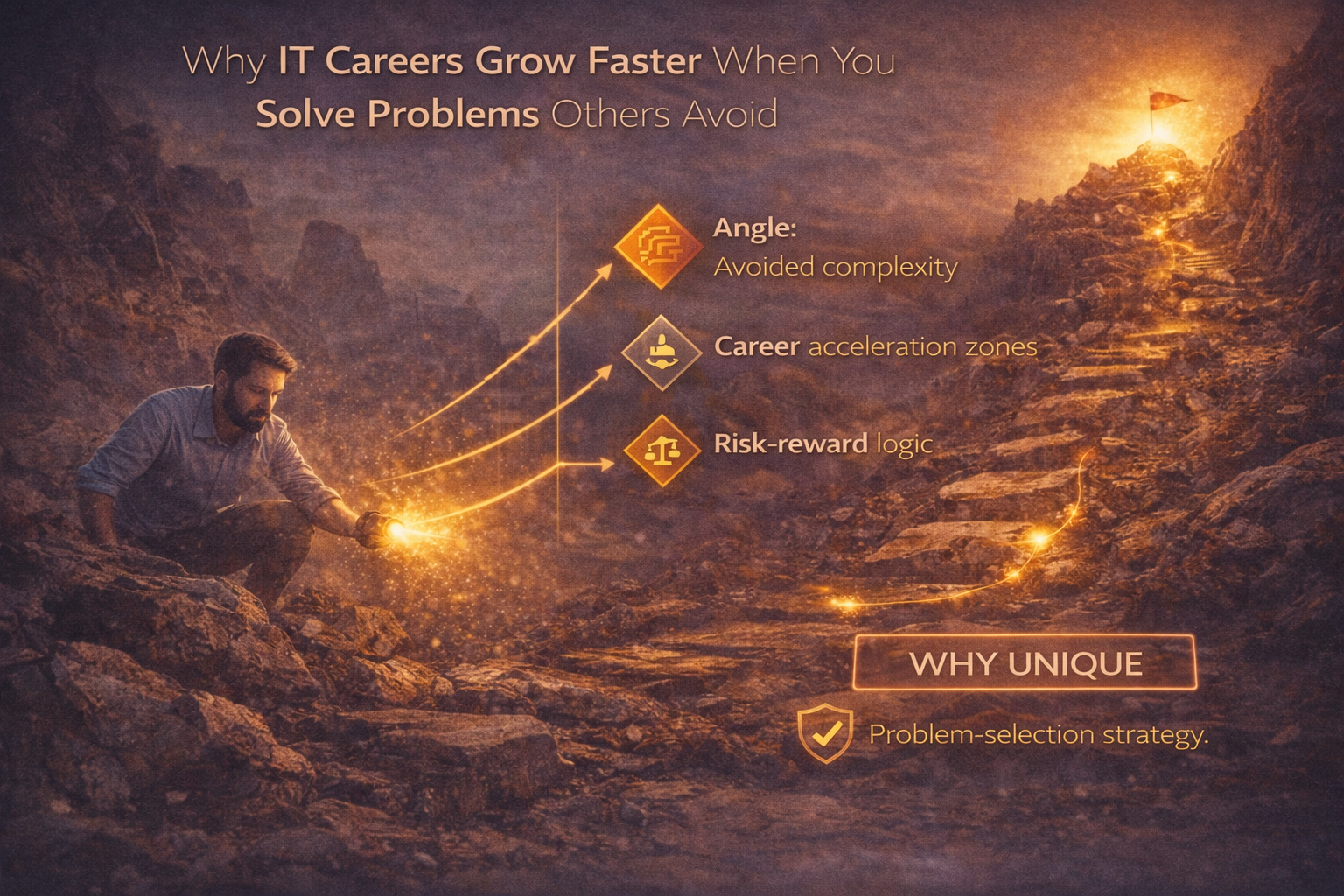
The fastest career growth in IT often comes from a different strategy: consistently solving problems others avoid. This blog explains how avoided complexity creates career acceleration zones, and how risk–reward logic shapes long-term growth.
Avoided Complexity: Where Opportunity Hides
Avoided problems usually share common traits:
- Unclear requirements
- High uncertainty or legacy constraints
- Cross-team dependencies
- Risk of visible failure
Because these problems are uncomfortable, most professionals stay away from them. That avoidance creates scarcity.
When few people are willing to engage with complex, messy problems, those who do automatically stand out. Visibility increases not because of self-promotion, but because progress in hard areas is noticeable.
Career Acceleration Zones: High Signal, Low Competition
Career acceleration zones exist where:
- Impact is high
- Ownership is unclear
- Accountability is avoided
Solving problems in these zones creates strong career signals:
- Decision-making under uncertainty
- Systems-level thinking
- Risk management
- Ownership beyond task lists
These signals are difficult to fake and hard to measure with standard metrics, which makes them powerful differentiators.
Risk–Reward Logic: Why the Trade-Off Works
Avoided problems carry higher short-term risk, but they also offer asymmetric rewards.
The downside:
- More responsibility
- Greater visibility if things go wrong
- Steeper learning curves
The upside:
- Faster trust accumulation
- Stronger influence
- Unique experience that compounds
When successful, the reward often outweighs the risk because the learning and credibility gained cannot be replicated through routine work.
Problem Selection as a Career Strategy
Career growth is not only about how well you execute, but also about which problems you choose to work on.
Professionals who accelerate faster tend to:
- Volunteer for unclear or risky initiatives
- Fix broken systems instead of polishing stable ones
- Take responsibility where others hesitate
Over time, they become associated with progress in difficult situations — a powerful professional identity.
Final Insight
Safe problems create steady output.
Avoided problems create accelerated growth.
IT careers grow fastest when professionals intentionally choose complexity, understand the risk–reward balance, and consistently deliver progress where others opt out.
Career acceleration is not accidental. It begins with deliberate problem selection.