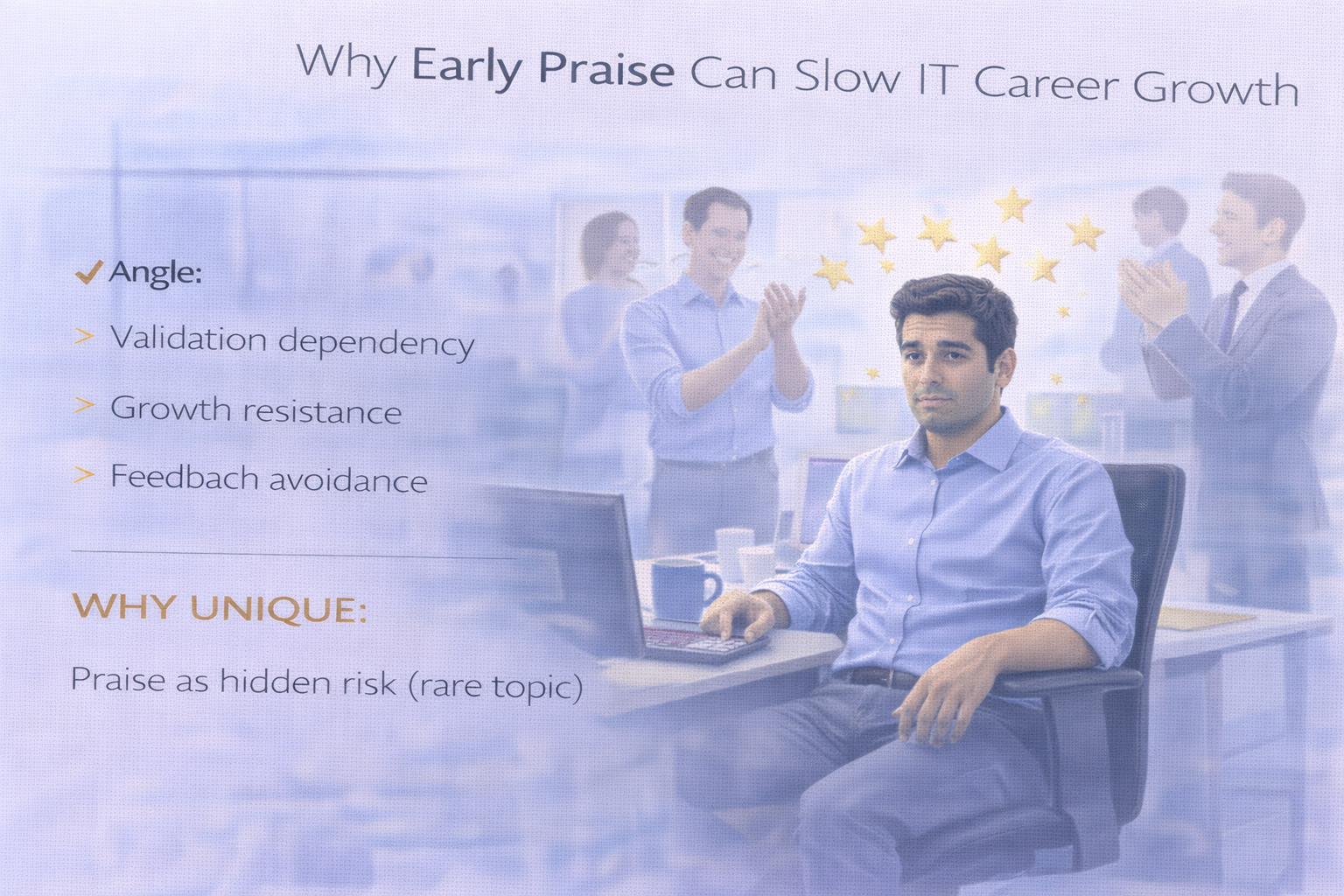
Why Early Praise Can Slow IT Career Growth
Early in an IT career, praise feels powerful. Recognition from managers, appreciation from teammates, and positive feedback create confidence and motivation. On the surface, praise appears to accelerate growth.
But when praise arrives too early or too easily, it can quietly slow long-term career development.
This blog explores praise as a hidden risk — how validation dependency, growth resistance, and feedback avoidance can form long before professionals realize it.
Validation Dependency: When Approval Replaces Progress
Early praise often becomes a reference point.
Professionals begin to associate success with:
- Positive comments
- Public recognition
- Manager approval
Over time, motivation shifts from learning to validation.
When growth requires uncomfortable change, risk-taking declines because it might threaten the praise loop. Professionals unconsciously choose actions that preserve approval rather than expand capability.
Growth Resistance: Protecting a Fragile Identity
Praise creates identity.
Being known as “the fast learner,” “the reliable one,” or “the smart developer” feels good — but it can become fragile.
As roles grow more complex, maintaining this identity requires avoiding:
- Situations where you might struggle
- Projects outside your comfort zone
- Environments with stronger peers
Instead of stretching, professionals protect the image created by early praise. Growth slows not from lack of ability, but from fear of losing status.
Feedback Avoidance: When Praise Drowns Out Truth
Early praise can reduce exposure to honest feedback.
Managers may soften critique to avoid discouraging high performers. Peers may hesitate to challenge someone seen as “doing well.”
Without corrective feedback:
- Blind spots grow
- Weak foundations persist
- Small issues compound
By the time tougher feedback arrives, adjustment becomes harder.
Why This Is Not Anti-Praise
Praise is not the enemy.
The risk lies in unbalanced praise without challenge.
Healthy growth combines:
- Recognition with rising standards
- Encouragement with discomfort
- Validation with accountability
Praise should signal momentum — not completion.
Final Insight
Early praise feels like success.
But unchecked praise can freeze growth by encouraging comfort, identity protection, and feedback avoidance.
The strongest IT careers treat praise as a checkpoint — not a destination.