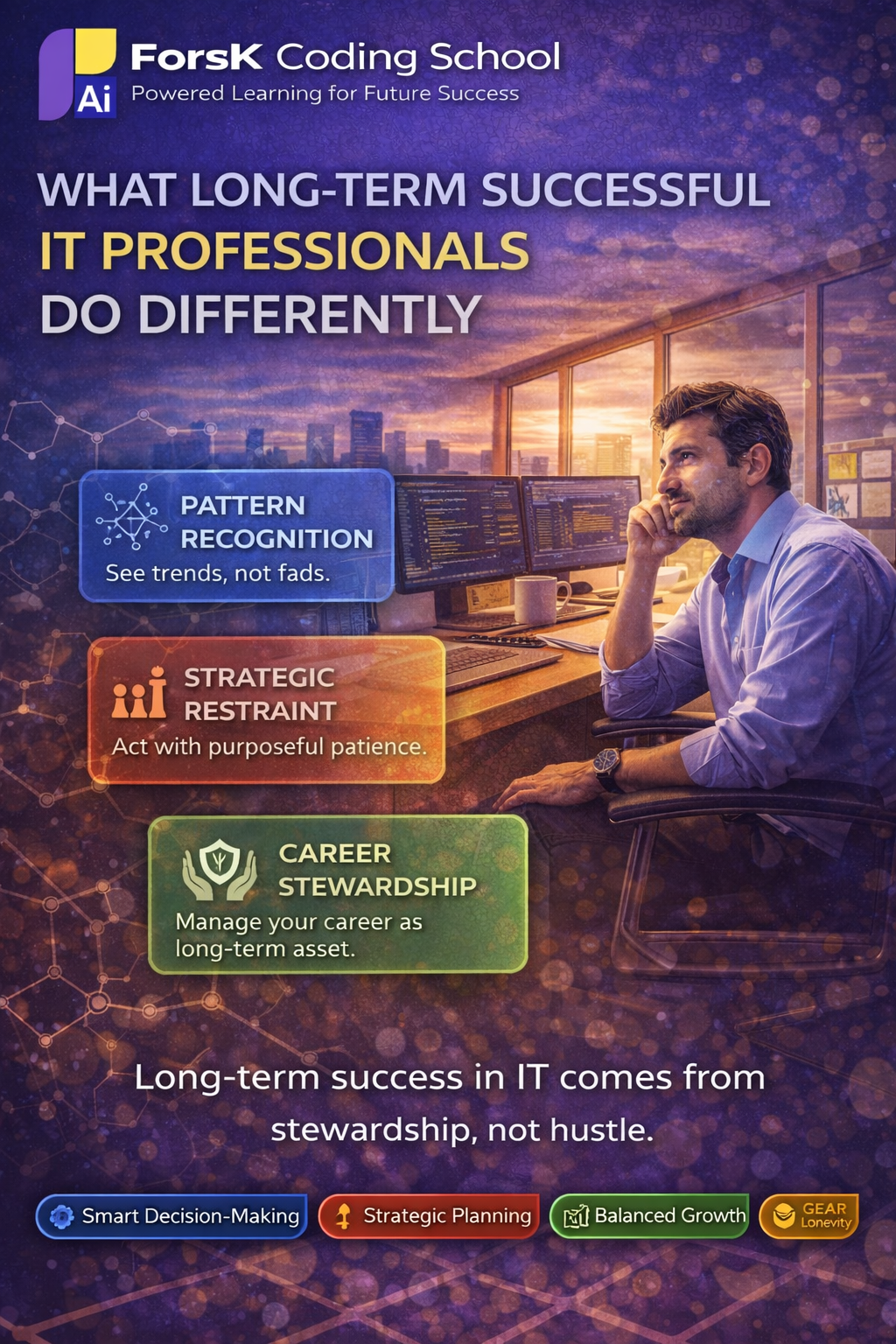
What Long-Term Successful IT Professionals Do Differently
In the IT industry, short-term success is common. Long-term success is rare.
Many professionals achieve good salaries, strong roles, or technical recognition early in their careers—but only a smaller group sustains growth, relevance, and satisfaction over decades.
What separates them is not intelligence or luck.
It is career stewardship.
Long-term successful IT professionals treat their careers as assets to be managed, not resources to be exhausted.
Pattern Recognition Over Trend Chasing
Successful professionals develop the ability to recognize patterns instead of reacting to every new trend.
They notice:
- Technologies come and go
- Core principles repeat
- Fundamentals resurface in new forms
Because of this, they:
- Invest deeply in foundations
- Adopt tools selectively
- Avoid panic-driven learning
Pattern recognition allows calm, confident decisions.
Strategic Restraint Is a Strength
Long-term professionals say “no” more often than “yes”.
They practice restraint in:
- Job switching
- Skill hopping
- Overcommitment
Strategic restraint protects focus and energy.
They understand that not every opportunity is worth pursuing.
Career Stewardship Mindset
Stewardship means caring for something so it remains valuable over time.
Career stewards:
- Protect their health
- Maintain learning rhythms
- Avoid unsustainable workloads
- Think in decades, not quarters
They ask:
“Will this decision strengthen or weaken my career five years from now?”
Depth Over Visibility
Long-term success favors depth.
These professionals:
- Master systems, not just tools
- Understand trade-offs
- Build reliable judgment
They may be less visible on social platforms—but highly trusted in real work environments.
Intentional Skill Evolution
Instead of constant growth, they follow cycles:
- Learn
- Apply
- Stabilize
- Rebuild
They allow plateaus because they know mastery happens there.
Calm Relationship With Change
Change does not threaten them.
Because their identity is not tied to a single technology, they adapt without fear.
This emotional stability is a competitive advantage.
Measuring Success Differently
They measure success by:
- Longevity
- Stability
- Optionality
- Mental clarity
Not just titles or compensation.
Final Thoughts
Long-term successful IT professionals do not run harder.
They run wiser.
Through pattern recognition, strategic restraint, and career stewardship, they build careers that stay strong, relevant, and fulfilling for decades.
That is the real benchmark of success.