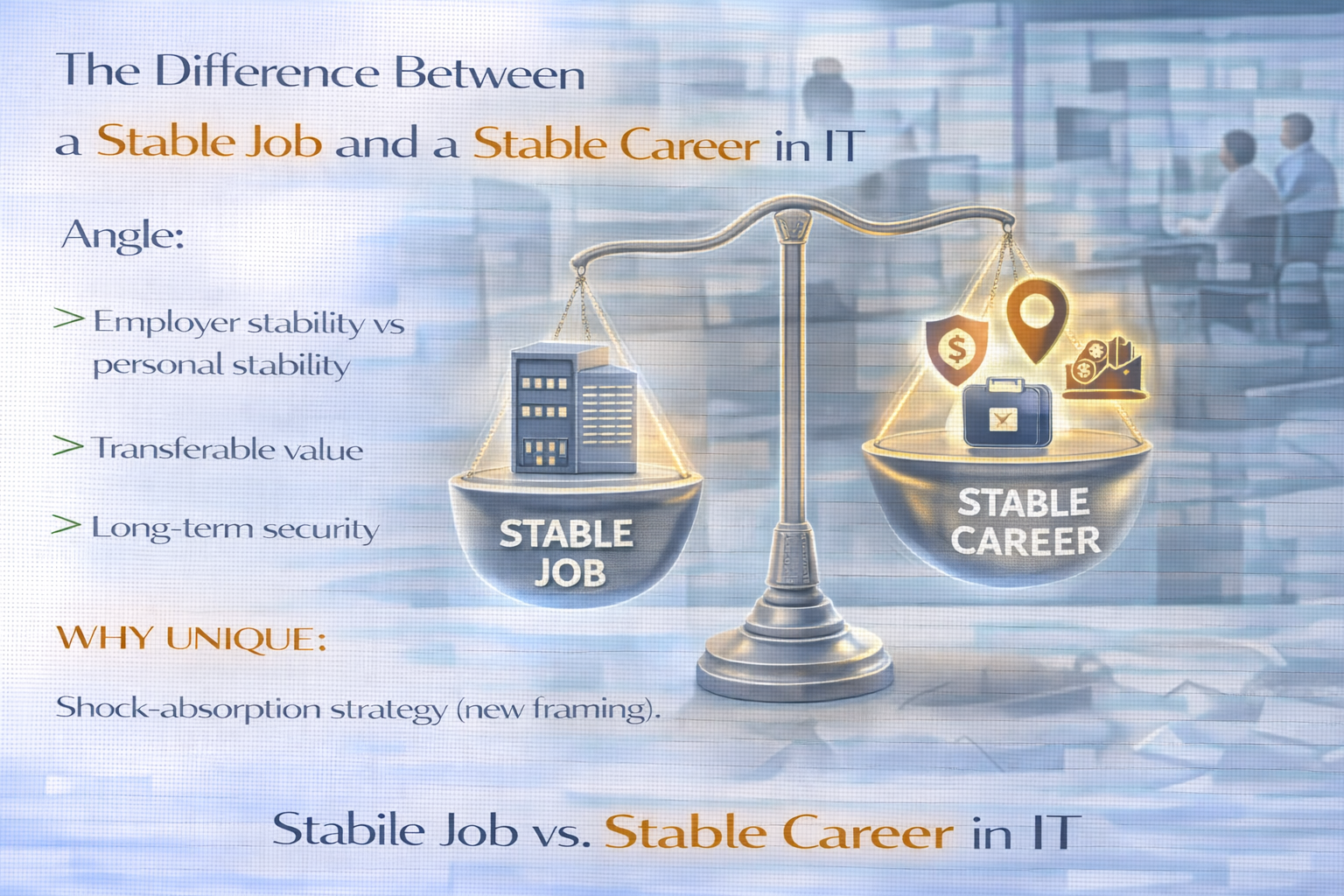
Most IT professionals say they want stability. But very few stop to ask an important question:
Are you building a stable job — or a stable career?
These two sound similar, but they are fundamentally different. Confusing them is one of the most common reasons IT careers quietly collapse after years of apparent success.
What a Stable Job Really Means
A stable job is externally stable.
It depends on factors mostly outside your control:
- A profitable company
- A long-term client or project
- A popular technology stack
- A supportive manager or team
As long as these conditions remain intact, your job feels safe. The salary comes on time, the workload is predictable, and the future appears secure.
But this stability is conditional.
When the company restructures, the client leaves, the tech stack loses relevance, or leadership changes — the stability disappears overnight.
A stable job is calm, but fragile.
What a Stable Career Actually Is
A stable career is internally stable.
It is built around what you carry, not where you work.
A stable IT career is defined by:
- Transferable skills that work across companies
- Problem-solving ability, not tool dependency
- Industry understanding beyond a single domain
- Professional reputation that travels with you
- The ability to learn new systems quickly
Even if your job ends, your career continues.
This is the kind of stability that survives layoffs, market shifts, and technology cycles.
The Core Difference: Dependency vs Portability
The real difference comes down to where your value lives.
- In a stable job, your value is tied to one environment.
- In a stable career, your value is portable across environments.
If your expertise only works inside your current company, team, or product — you have job stability, not career stability.
Why Stable Jobs Often Create a False Sense of Security
Stable jobs are dangerous because they rarely feel risky.
Long tenures, steady promotions, and familiarity can slowly narrow your exposure:
- You stop learning new patterns
- You become dependent on internal systems
- Your external market relevance fades quietly
When disruption finally arrives, the gap between your job identity and market reality becomes visible — often too late.
How to Convert Job Stability Into Career Stability
You don’t need to quit a stable job to build a stable career. You need to extract career value from the job.
Key shifts:
- Learn why systems work, not just how
- Build skills that apply beyond your current stack
- Maintain external visibility (network, writing, mentoring)
- Periodically test your market relevance
- Avoid becoming indispensable only to one internal process
The goal is simple: if this job ends, your momentum should not.
Long-Term Security Is Not About Salary
High pay can mask career weakness.
True career stability is about:
- Continuity of opportunity
- Speed of recovery after disruption
- Confidence in navigating change
A stable career gives you options. A stable job gives you comfort.
In IT, comfort without adaptability is temporary.
Final Thought
A stable job protects your present.
A stable career protects your future.
The smartest IT professionals learn to build both — but they never confuse one for the other.