Many IT professionals believe career safety and career growth are opposites.
Play safe — and you stagnate.
Push hard — and you risk collapse.
This false trade-off causes poor decisions on both ends.
In reality, the strongest IT careers grow fast because they manage risk well — not because they ignore it.
The Myth: Risk Reduction Slows Careers
Risk is often misunderstood.
Avoiding risk feels cautious, but unmanaged risk is what actually destroys momentum.
When professionals ignore risk:
- Growth becomes fragile
- Setbacks become catastrophic
- Recovery becomes slow and expensive
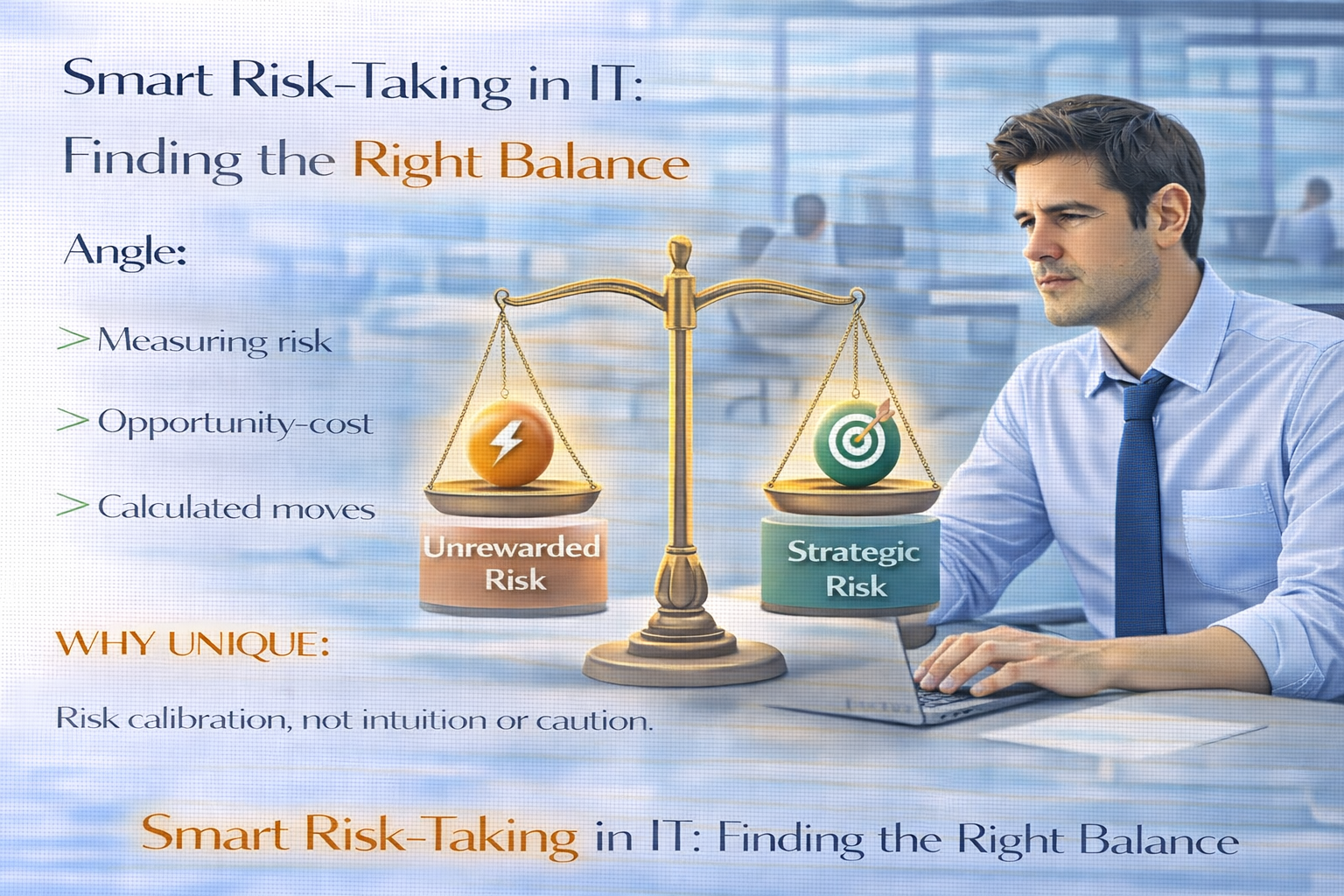
Risk-aware growth is not conservative. It is controlled exposure.
Growth Fails When Risk Is Unpriced
In finance, returns are evaluated after adjusting for risk.
Careers work the same way.
A role that pays more but narrows skills may have high short-term return and poor long-term value.
A technology that grows fast but lacks portability may increase downside exposure.
Unpriced risk creates the illusion of progress.
The Concept of Risk-Adjusted Career Growth
Risk-adjusted growth focuses on three questions:
- Does this opportunity expand or narrow my future options?
- If this path fails, how fast can I recover?
- What skills or reputation do I keep even if the role ends?
Growth that improves optionality is safer — even if it feels challenging.
How High Performers Reduce Risk While Growing Faster
1. Balanced Skill Portfolios
They combine:
- One or two deep specializations
- Multiple transferable fundamentals
This allows growth in strong markets while preserving mobility.
2. Controlled Exposure to Volatility
They take calculated risks:
- High-growth roles when buffers exist
- Stable roles when rebuilding strength
Timing and context matter more than bravery.
3. Optionality Over Optimization
Instead of optimizing for a single outcome, they:
- Preserve exit paths
- Build parallel capabilities
- Maintain market visibility
Options compound career value.
Why Slow Growth Is Often Riskier
Stagnation increases hidden risk:
- Skills decay
- Market relevance fades
- Confidence erodes
The goal is not to slow down — it is to grow intelligently.
Practical Ways to Apply Risk-Adjusted Growth
- Periodically assess downside exposure
- Avoid roles that trap skills internally
- Invest in fundamentals alongside trends
- Maintain financial and reputation buffers
- Say no to growth that eliminates future choice
Smart growth feels uncomfortable — but not reckless.
Final Thought
The best IT careers are not built by avoiding risk.
They are built by taking the right risks, at the right time, with the right protection.
Growth and safety are not enemies.
Unmanaged risk is.