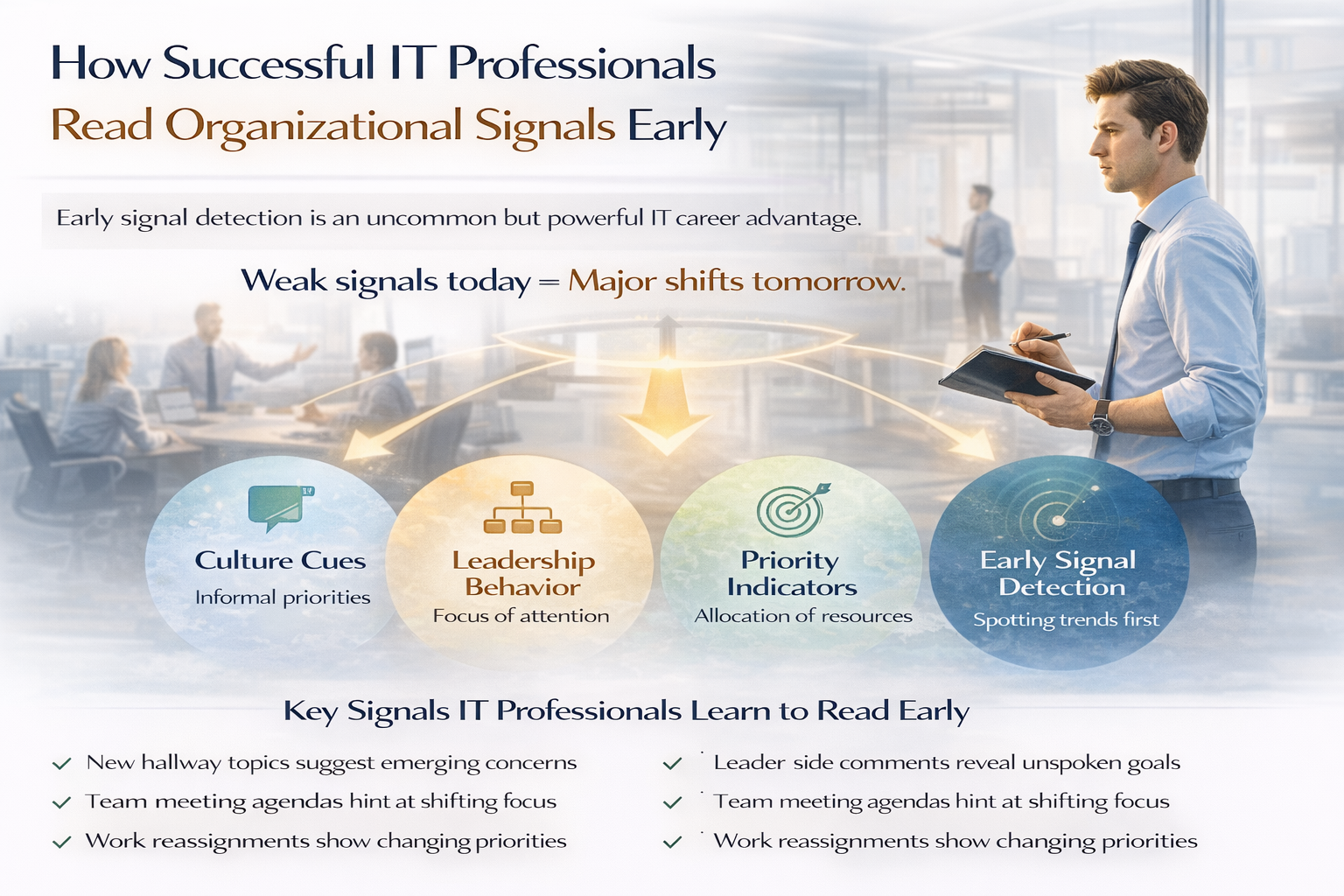
In IT organizations, opportunities rarely arrive as announcements.
They appear as signals.
A change in tone.
A shift in attention.
A pattern of behavior repeated quietly.
Successful IT professionals advance not because they are luckier — but because they detect these signals earlier than others.
Why Early Signal Detection Matters
Signals compound.
Those who notice them early:
- Align effort with real priorities
- Avoid investing in declining paths
- Position themselves before competition appears
Those who notice late often believe opportunities were “sudden” or “unfair.”
In reality, the signal was present — just unread.
Culture Cues Speak Louder Than Values
Organizations describe themselves through value statements.
But culture is revealed through behavior.
Watch for:
- What gets praised repeatedly
- What mistakes are forgiven — and which are not
- Who is promoted versus who is merely appreciated
These cues tell you what the organization actually values.
Leadership Behavior as a Signal System
Leaders send signals constantly, often unintentionally:
- Which meetings they attend
- Whose opinions they seek
- What decisions they revisit
What leaders do is more reliable than what they say.
Early readers of leadership behavior adapt faster.
Priority Indicators Hidden in Plain Sight
Official roadmaps rarely reflect true priorities.
Real priorities are revealed by:
- Where time is spent under pressure
- Which projects survive budget cuts
- What work continues despite obstacles
Following visible effort reveals future direction.
Why Many Professionals Miss Early Signals
Signals are subtle by nature.
They don’t feel urgent.
Daily execution noise hides them.
By the time signals become obvious, they are no longer signals — they are outcomes.
Training Yourself to Read Signals Earlier
Signal detection is a learnable skill.
Practical habits:
- Observe patterns across months, not days
- Compare stated priorities with actual behavior
- Notice who gains influence quietly
- Track what work accelerates versus stalls
Early awareness creates strategic calm.
Final Thought
In IT careers, advantage rarely comes from working harder.
It comes from working in the right direction earlier.
Those directions are revealed not by instructions —
But by signals hiding in plain sight.