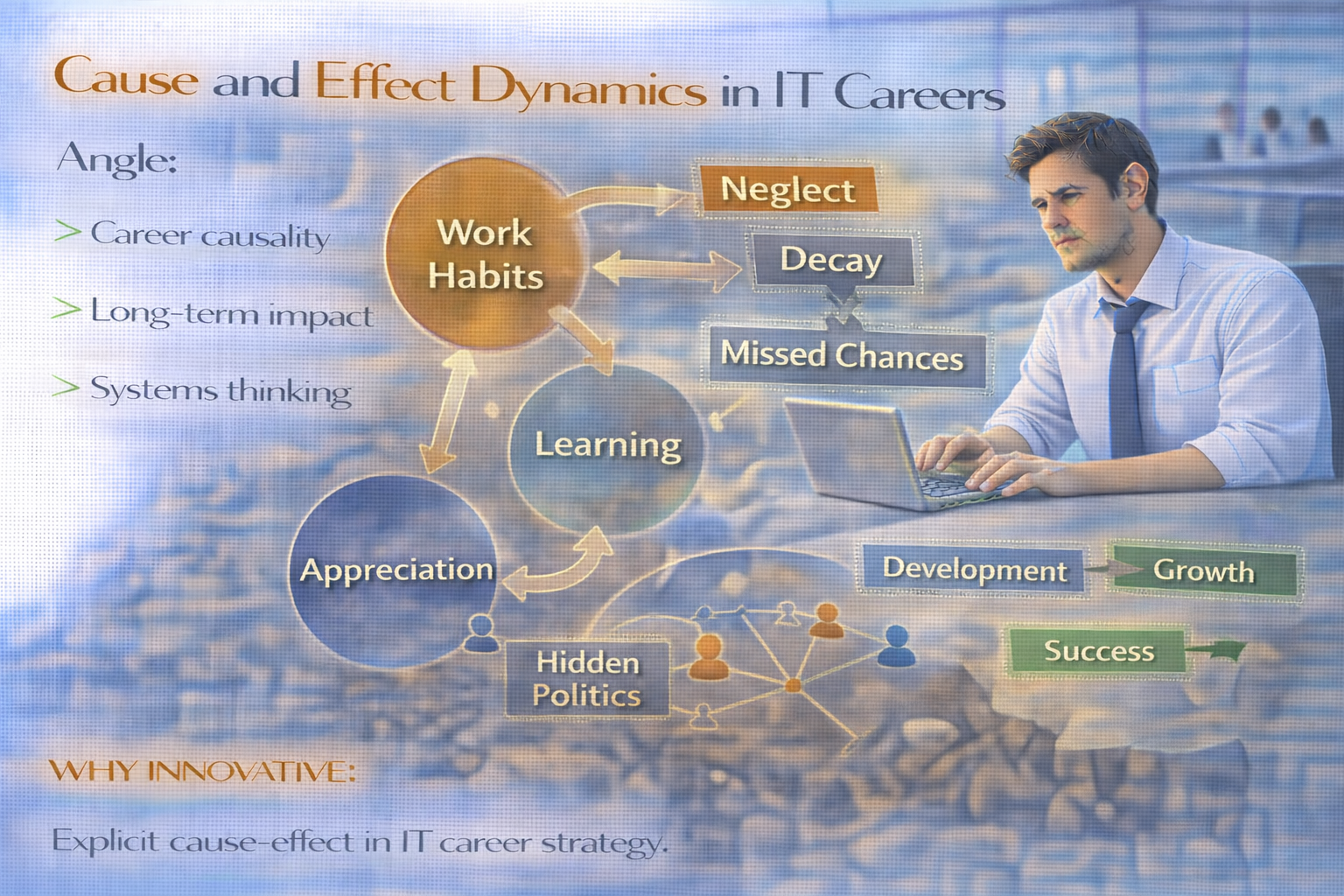
When IT careers stall or decline, professionals usually point to obvious causes.
Bad market.
Wrong timing.
Unfair management.
Sometimes these are true.
But very often, the explanation itself is wrong.
IT professionals frequently misunderstand cause and effect in their careers — and this misunderstanding causes them to repeat the same patterns while expecting different results.
The Attribution Error in IT Careers
Humans are wired to simplify explanations.
We attribute success to skill.
We attribute failure to circumstances.
In IT careers, this creates attribution errors:
- Success is credited to talent, not timing or environment
- Failure is blamed on the market, not earlier decisions
- Patterns are ignored in favor of single explanations
This leads to confidence when luck helped — and confusion when luck disappears.
Why Careers Feel Random When They Are Not
From the inside, careers feel chaotic.
But patterns exist.
The problem is that causes are often:
- Indirect
- Delayed
- Distributed across many small decisions
When effects appear years later, professionals connect them to the wrong causes — usually the most recent event.
Repeating Bad Patterns With Better Effort
Misunderstood cause and effect leads to repetition:
- Switching companies but keeping the same role behavior
- Learning new tools without changing problem scope
- Working harder instead of working differently
The surface changes.
The underlying pattern remains.
This is why some professionals feel like they are “starting over” repeatedly.
Why Immediate Feedback Misleads IT Professionals
IT work provides fast technical feedback.
Careers do not.
A decision that increases comfort today may reduce adaptability later.
A role that feels successful may quietly narrow future options.
Without delayed-feedback awareness, professionals optimize for short-term signals.
How Wrong Conclusions Lock Careers
Once a wrong explanation feels true, behavior adapts around it.
Examples:
- “I just need a better company”
- “This domain is the problem”
- “If I work harder, it will fix itself”
These explanations feel productive — but they often treat symptoms, not causes.
Learning to Think in Career Cause-and-Effect Chains
Stronger career decisions come from tracing chains, not events:
- What habits did this role reinforce?
- What skills did I stop developing?
- What options quietly closed?
Careers are systems.
Single events rarely explain outcomes.
Final Thought
Most IT professionals don’t fail because they lack effort or intelligence.
They fail because they keep fixing the wrong causes.
Understanding cause and effect doesn’t make careers predictable —
But it stops professionals from repeating invisible mistakes.