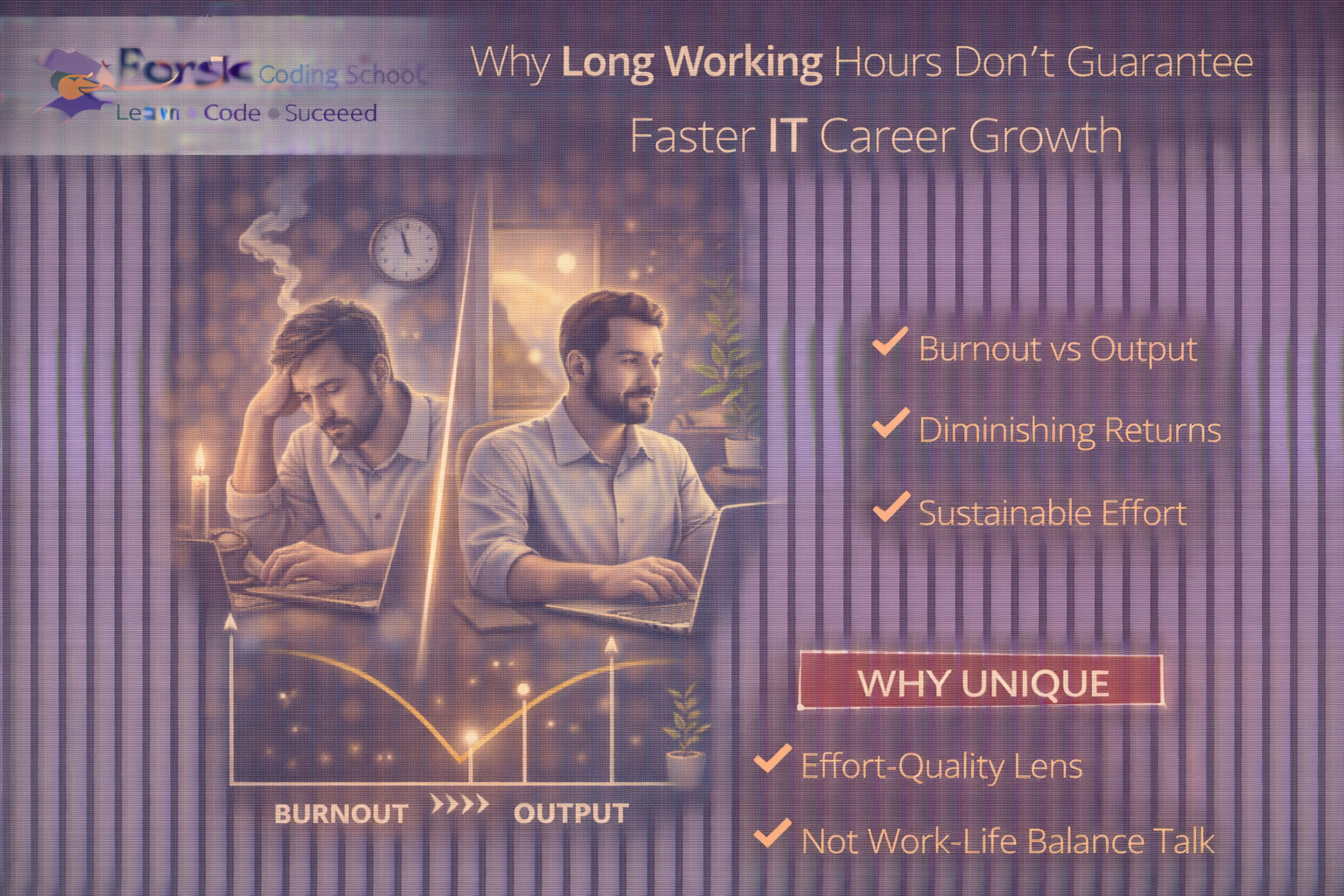
In IT careers, long working hours are often worn as a badge of commitment. Late nights, weekend work, and constant availability are commonly associated with faster growth and success. Yet many professionals who work the longest hours discover that their careers progress far more slowly than expected.
The issue is not effort. It is effort quality.
This blog explains why long working hours do not guarantee faster IT career growth, how burnout reduces real output, why diminishing returns set in, and why sustainable effort matters more than sheer time spent. This is not about work–life balance—it is about how growth actually compounds.
Burnout vs Output: The Invisible Trade-Off
Working longer initially increases output. But only up to a point.
Beyond that point:
- Decision quality drops
- Mistakes increase
- Learning slows
Burnout reduces effective output—the kind of work that improves skill, judgment, and long-term value. Hours remain high, but growth potential declines.
The Law of Diminishing Returns in IT Work
IT work is cognitive, not mechanical.
As hours extend:
- Focus fragments
- Problem-solving depth weakens
- Creativity declines
The first few high-energy hours often produce more growth than many exhausted ones. After a threshold, extra time adds activity—but little capability.
Why More Hours Often Reduce Learning
Learning requires:
- Attention
- Reflection
- Error correction
Long working hours consume the mental energy needed for these processes. Professionals may execute tasks continuously but rarely upgrade how they think or solve problems.
Growth stalls not because of low effort—but because learning capacity is depleted.
Sustainable Effort Builds Career Momentum
Sustainable effort focuses on:
- High-quality focus
- Consistent energy
- Deliberate improvement
Professionals who grow faster often work fewer—but better—hours. They protect mental freshness for learning, system thinking, and decision-making.
Why This Is Not a Work–Life Balance Argument
This is not about reducing ambition or avoiding hard work.
It is about recognizing that:
- Cognitive work has limits
- Growth depends on learning quality
- Effort must compound, not just accumulate
Long hours without recovery flatten progress curves.
How to Convert Effort into Growth
Practical shifts:
- Prioritize high-impact work early
- Stop equating fatigue with productivity
- Reserve energy for learning and reflection
- Measure improvement, not exhaustion
Career growth accelerates when effort improves capability—not when it only fills time.
Final Thoughts
Long working hours do not guarantee faster IT career growth because growth depends on output quality, not time spent.
Burnout hides diminishing returns. Sustainable effort reveals compounding progress.
In IT careers, it is not who works the longest—but who learns and improves the most—that moves ahead.