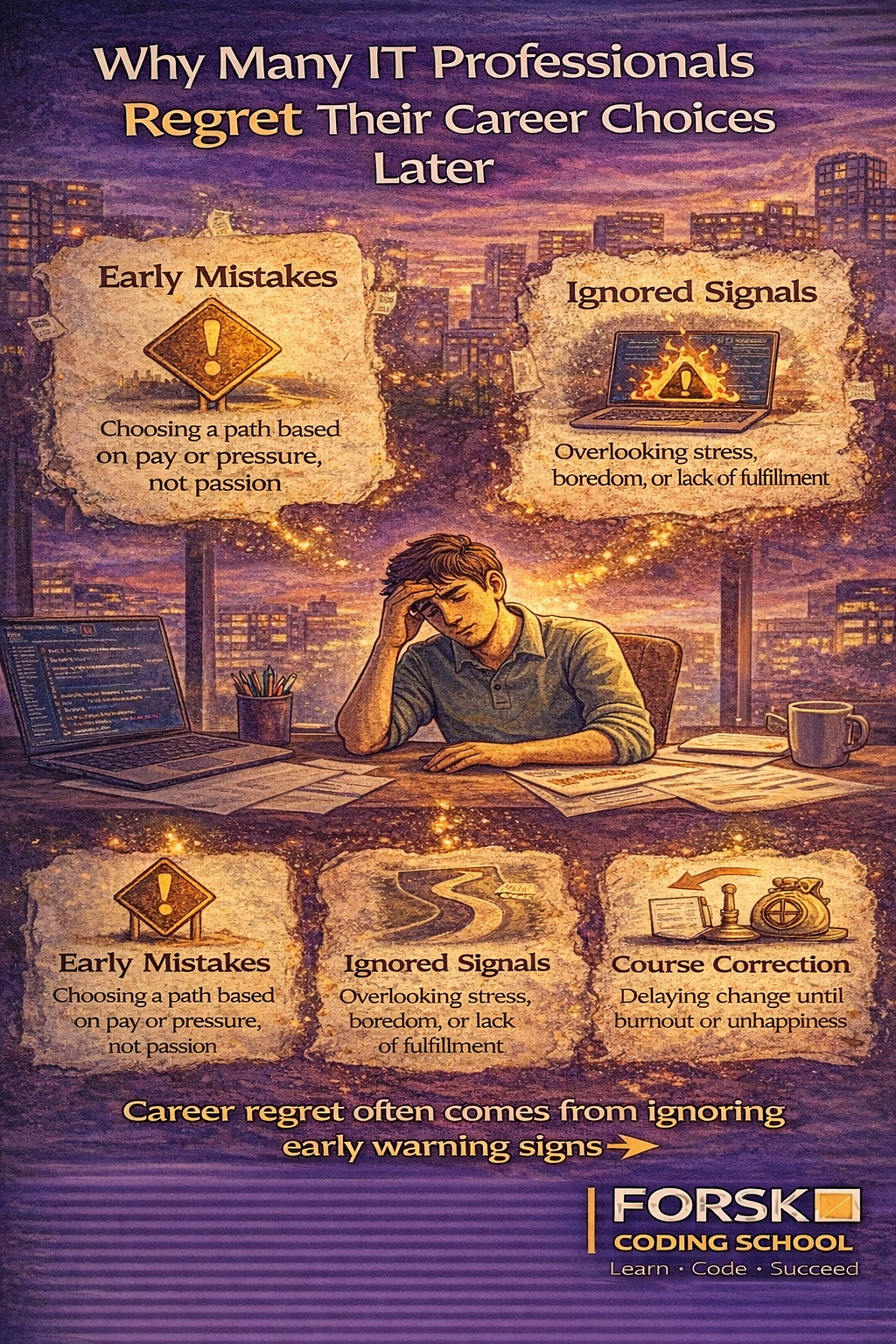
Many IT professionals appear successful on the surface—good salaries, stable jobs, and years of experience. Yet, beneath this stability, a quiet regret often exists. This regret is not about failure. It is about realizing too late that certain career choices were made without clarity, intention, or self-awareness.
This blog explores why IT career regret is so common, how early decisions silently shape long-term dissatisfaction, and why course correction is still possible—even after years in the industry.
IT Career Regret Is a Silent Reality
Most IT professionals do not openly talk about regret. Instead, it shows up indirectly:
- Lack of enthusiasm for work
- Feeling stuck despite experience
- Constant comparison with peers
- Questioning the purpose of daily work
The regret is not always about choosing IT—it is about choosing the wrong direction within IT and staying there too long.
Early Career Decisions That Lead to Regret
Choosing IT for the Wrong Reasons
Many professionals enter IT because it was trending, well-paying, or socially encouraged. Very few took time to understand the nature of the work, the learning curve, or the long-term lifestyle it demands.
Years later, the mismatch between expectations and reality becomes difficult to ignore.
Chasing Courses Without Direction
Certifications and courses are often pursued randomly, driven by trends rather than career strategy. This results in scattered skills, weak confidence, and confusion about professional identity.
Learning without direction rarely leads to fulfillment.
Prioritizing Salary Too Early
Early salary decisions often push professionals into roles they do not enjoy. Financial comfort delays dissatisfaction—but it does not eliminate it.
Over time, the cost of staying in an unfulfilling role becomes emotional rather than financial.
The Warning Signs Most Professionals Ignore
Career regret rarely appears suddenly. It sends signals early:
- No curiosity to learn deeper
- Emotional detachment from work
- Staying only because of comfort or fear
- Dreading routine workdays
These signals are easy to ignore when responsibilities increase, but they intensify over time.
Why IT Professionals Stay on the Wrong Path
Even when dissatisfaction is clear, many professionals continue because of:
- Fear of starting over
- Financial obligations
- Social expectations
- Belief that change is no longer possible
Ironically, staying longer often deepens regret instead of reducing risk.
The Emotional Cost of Wrong Career Choices
Career regret affects more than professional life. It impacts:
- Self-confidence
- Mental health
- Personal relationships
- Sense of purpose
This emotional toll is rarely discussed but deeply felt across mid and late career stages.
Course Correction Is Still Possible
Regret Is Awareness, Not Failure
Regret is a signal that awareness has begun. It means you understand what no longer works—and that clarity can guide better decisions.
How to Course-Correct in IT
Course correction does not require extreme moves. It requires honesty and strategy:
- Reflect on what energizes you
- Identify transferable skills
- Make lateral or gradual shifts
- Redefine success beyond titles and salary
Progress does not require starting from zero—it requires moving in the right direction.
Redefining Career Success in IT
True success is not defined by:
- Years of experience
- Brand names
- Salary figures
It is defined by:
- Meaningful work
- Continuous growth
- Alignment with personal values
A successful IT career should support life—not replace it.
Final Takeaway
Many IT professionals regret their career choices not because they lacked ability, but because they ignored early instincts and delayed correction.
Early mistakes, ignored signals, and fear of change compound over time.
But regret can become clarity.
And clarity can become course correction.
It is never too late to choose a career path that feels right—not just safe.
The most expensive career mistake is staying in a path you already know is wrong.