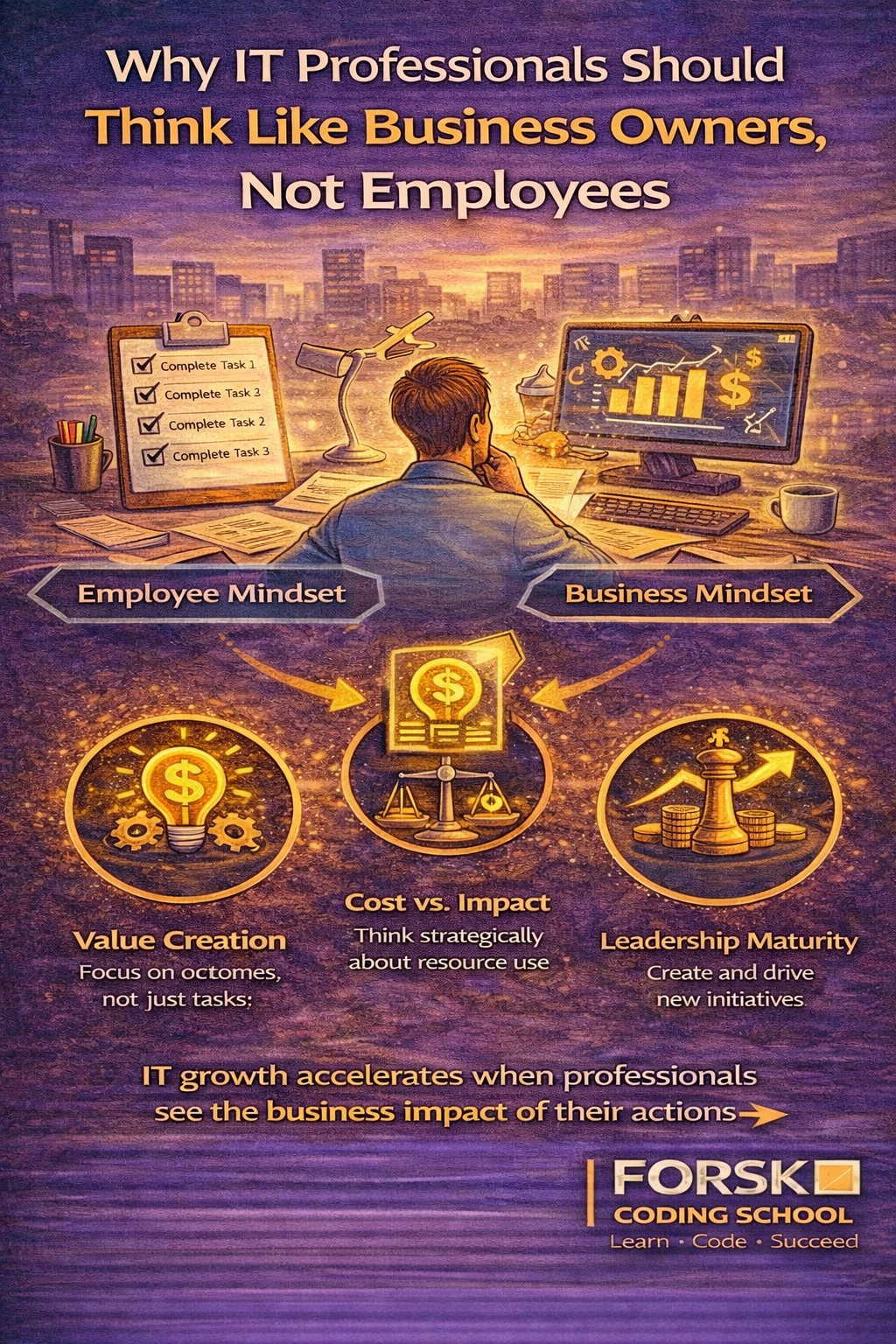
Most IT professionals are trained to think like employees: complete tasks, follow instructions, meet deadlines, and wait for appraisals. This mindset works early in a career, but over time it becomes a growth limiter.
The professionals who grow faster, earn more, and move into leadership roles are those who think like business owners, even while working as employees. They focus on value creation, impact, and long-term outcomes—not just assigned work.
This blog explains why an ownership mindset matters in IT, how business thinking changes career trajectories, and why leadership maturity begins with responsibility, not designation.
The Difference Between an Employee Mindset and a Business Mindset
An employee mindset focuses on:
- Tasks
- Hours worked
- Immediate instructions
A business-owner mindset focuses on:
- Outcomes
- Impact
- Long-term value
Both can coexist—but only one accelerates careers.
Value Creation: The Core of Business Thinking
Employees Deliver Tasks
Most employees ask:
- What is assigned to me?
- When is the deadline?
They measure success by completion.
Business Thinkers Create Value
Business-minded IT professionals ask:
- Why is this needed?
- How does this help the user or company?
- Can this be done better, faster, or cheaper?
They measure success by impact, not effort.
Cost vs Impact Thinking in IT
Understanding Cost Beyond Salary
Every IT decision has a cost:
- Time
- Infrastructure
- Maintenance
- Opportunity
Professionals with ownership mindset consider these factors before proposing solutions.
Maximizing Impact
Instead of building the most complex solution, they aim for:
- The simplest effective solution
- Scalable designs
- Long-term maintainability
This thinking directly improves business outcomes.
Ownership Mindset Builds Leadership Maturity
Leaders Think Beyond Their Role
Leadership in IT is not about titles. It’s about:
- Taking responsibility
- Anticipating problems
- Protecting business interests
Managers trust professionals who think this way.
Why Ownership Attracts Growth
Professionals who think like owners:
- Get high-visibility projects
- Are included in decision-making
- Grow into lead, architect, and managerial roles
They are seen as partners, not resources.
Why Many IT Professionals Avoid Business Thinking
Common reasons include:
- Fear of responsibility
- Belief that “business is management’s job”
- Comfort in staying technical
Unfortunately, avoiding ownership limits growth.
How to Develop a Business Owner Mindset in IT
1. Think in Outcomes, Not Tasks
Ask how your work affects users, revenue, or efficiency.
2. Understand the Business Context
Learn:
- Why the product exists
- Who the customer is
- What success means for the business
3. Take Responsibility Beyond Code
Care about:
- Quality
- Performance
- Long-term impact
Ownership is shown through actions, not titles.
Long-Term Career Impact
IT professionals with business mindset:
- Stay relevant longer
- Move into leadership roles faster
- Command higher compensation
They don’t just work in companies—they help build them.
Final Takeaway
IT careers grow faster when professionals stop thinking like employees and start thinking like business owners.
An ownership mindset turns technical skill into influence, trust, and leadership maturity.
In IT, your value is not defined by how much you work—but by how much impact you create.
Business thinking is not optional for long-term IT success—it’s essential.