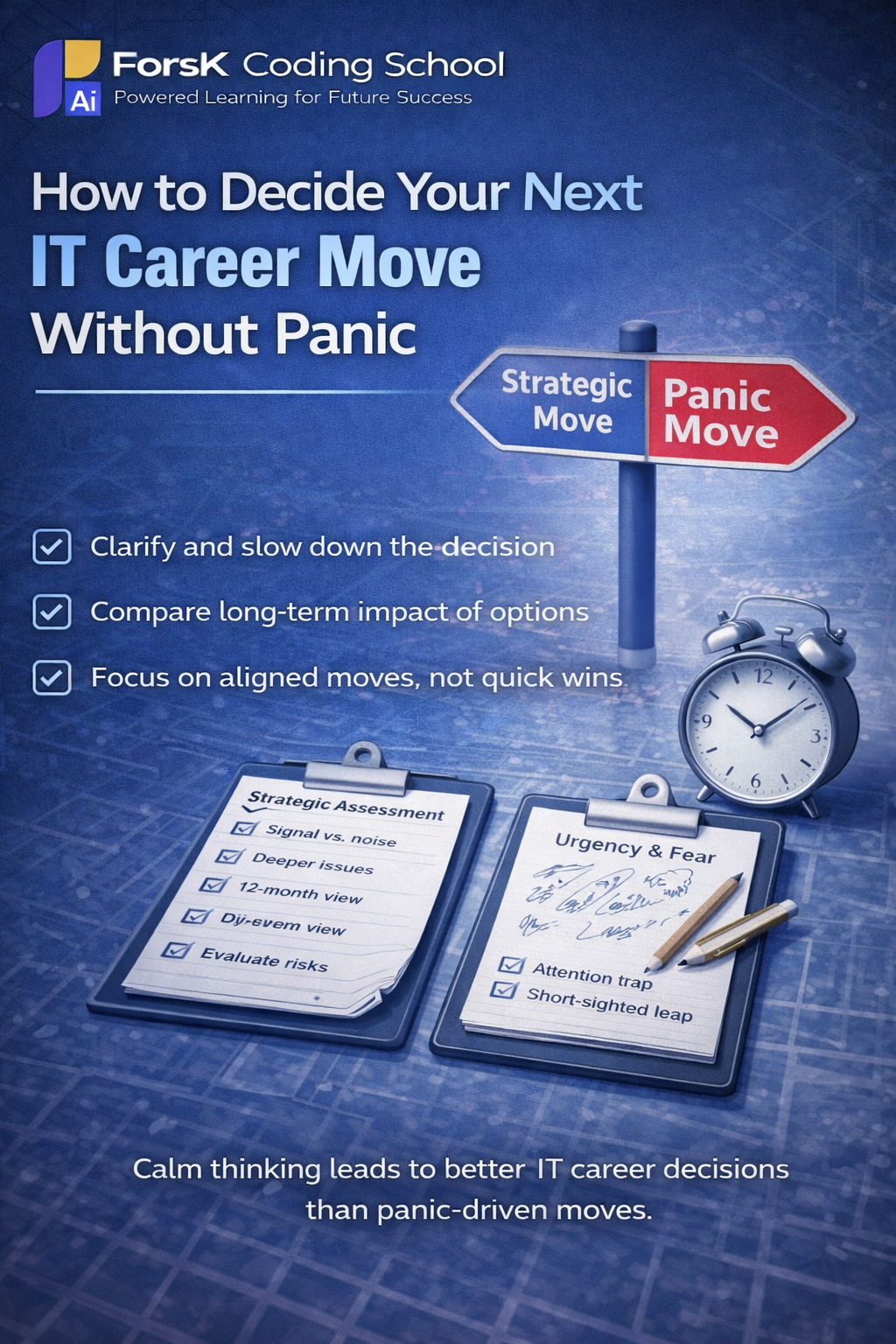
How to Decide Your Next IT Career Move Without Panic
In the IT industry, career decisions are often made under pressure.
A colleague resigns. A new technology trends. A company restructures. Suddenly, you feel behind.
Panic begins to influence choices.
But panic is a poor strategist.
This blog introduces a calm, structured way to decide your next IT career move without reacting to noise, comparison, or temporary fear.
Why Panic Decisions Are So Common in IT
IT moves fast:
- New tools emerge constantly
- Salaries fluctuate
- Layoff news spreads quickly
- Social media amplifies success stories
This environment creates urgency—even when none exists.
Panic narrows thinking.
Step 1: Separate Signal From Noise
Before making a move, ask:
- Is this pressure internal or external?
- Am I reacting to fear or facts?
- Will this matter in three years?
Most panic-triggered decisions fail this test.
Step 2: Define the Real Problem
Often, the urge to change roles or companies masks deeper issues:
- Burnout
- Skill stagnation
- Lack of challenge
- Misaligned expectations
Changing jobs does not automatically solve these.
Clarity about the real problem prevents misdirected moves.
Step 3: Use the 12-Month Lens
Instead of asking, “What should I do immediately?” ask:
- Where do I want to be 12 months from now?
- What one capability would strengthen my position?
- What environment supports that growth?
Short-term panic fades. Strategic direction remains.
Step 4: Evaluate Risk Calmly
Every career move carries risk:
- Learning curve
- Cultural mismatch
- Financial uncertainty
Assess:
- Best-case outcome
- Worst-case outcome
- Recovery path
Clarity reduces emotional bias.
Step 5: Delay the Final Decision
If a move still feels right after reflection, wait a few weeks.
If clarity strengthens over time, it’s strategic.
If urgency fades, it was emotional.
Time filters impulse.
Why Strategic Patience Wins
Many successful IT professionals are not the fastest movers.
They are the calmest decision-makers.
They avoid unnecessary resets and choose changes deliberately.
Final Thoughts
Your next career move should expand clarity—not escape discomfort.
Panic creates motion.
Patience creates direction.
In a fast industry like IT, calm thinking is a competitive advantage.