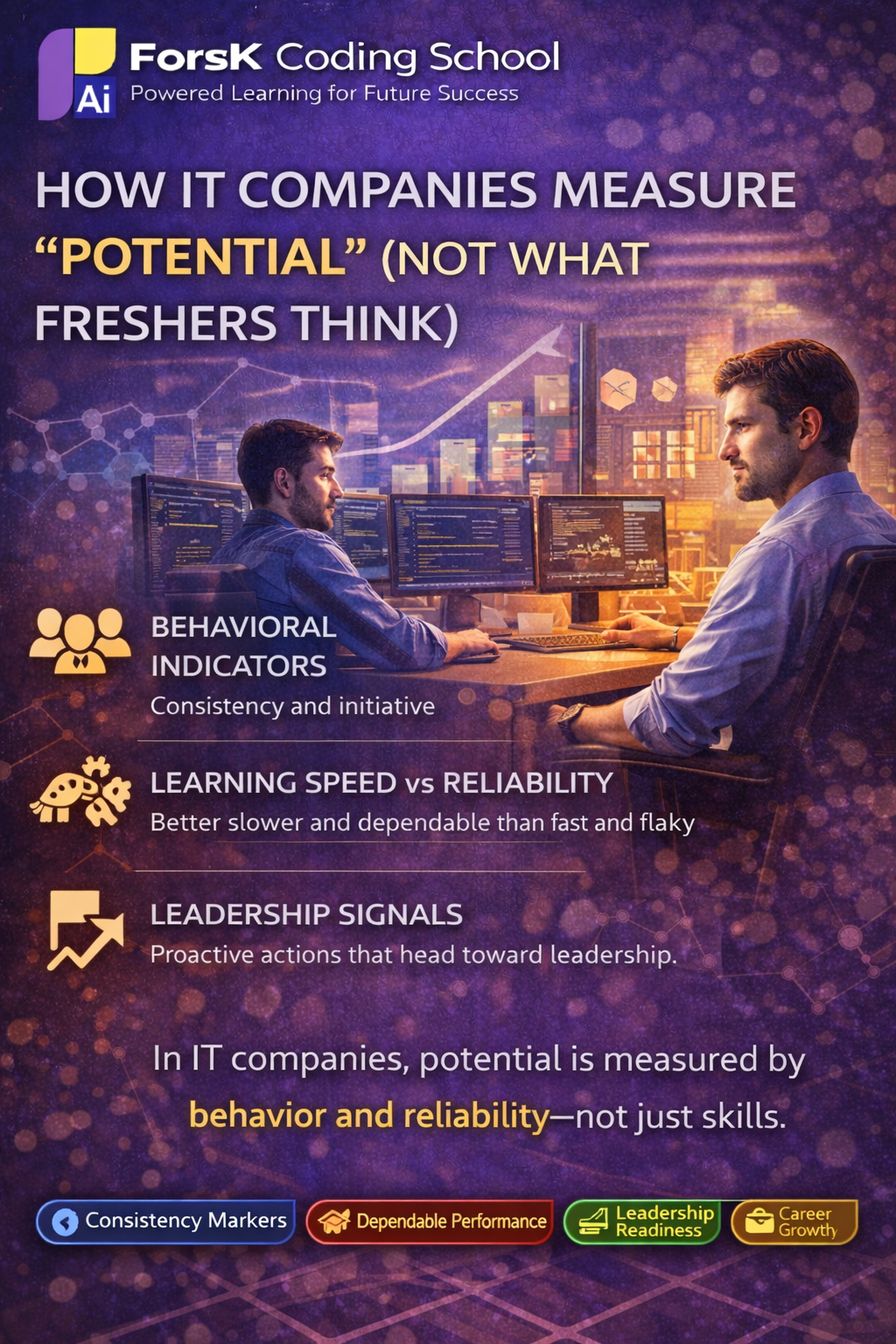
Freshers entering the IT industry often believe potential is measured by marks, certifications, coding speed, or how many technologies they know. While these factors help at the entry level, they are not how companies define real potential.
IT companies look beyond surface skills. Potential, from an employer’s perspective, is about future reliability, growth behavior, and leadership readiness.
This blog explains how companies actually measure potential—from the inside.
Potential Is About Predicting the Future
When companies talk about potential, they are asking:
- Can this person grow into larger responsibility?
- Will they remain reliable as complexity increases?
- Can they be trusted with ambiguity?
Potential is a forward-looking assessment, not a reward for past effort.
Behavioral Indicators Matter More Than Credentials
Degrees and certificates get you noticed.
Behavior decides your future.
Companies closely observe:
- How you react to unclear tasks
- Whether you ask thoughtful questions
- How you handle mistakes
- Whether you take ownership or deflect responsibility
Behavior under pressure reveals potential faster than technical tests.
Learning Speed vs Reliability
Freshers often assume learning fast equals high potential.
Companies see it differently.
They value:
- Steady learning that sticks
- Applying knowledge correctly
- Avoiding repeated mistakes
Fast learners who are unreliable create risk.
Slower learners who are dependable often get more trust.
Consistency Signals Long-Term Value
Potential is strongly linked to consistency.
Companies notice:
- Do you show up prepared regularly?
- Do you deliver similar quality over time?
- Can managers predict your output?
Consistency reduces uncertainty—and uncertainty is expensive.
Early Leadership Signals
Leadership potential does not mean managing people.
It shows up as:
- Helping teammates without being asked
- Thinking beyond your own task
- Communicating risks early
- Taking responsibility for outcomes
These signals indicate readiness for future scope.
Why Marks and Certifications Fade Quickly
Academic performance matters less after joining because:
- Real work is ambiguous
- Mistakes have consequences
- Collaboration matters
Companies recalibrate potential continuously based on real-world behavior.
How Potential Is Re-Evaluated Over Time
Potential is not fixed.
It increases or decreases based on:
- Adaptability
- Judgment quality
- Professional maturity
This is why some average starters become leaders—and some toppers stall.
Final Thoughts
IT companies do not measure potential the way freshers expect.
They measure behavior, reliability, learning depth, and leadership signals.
If you want to be seen as high-potential, focus less on impressing early—and more on becoming dependable, thoughtful, and growth-ready.
From a company’s view, potential is not about how fast you start.
It’s about how well you scale.