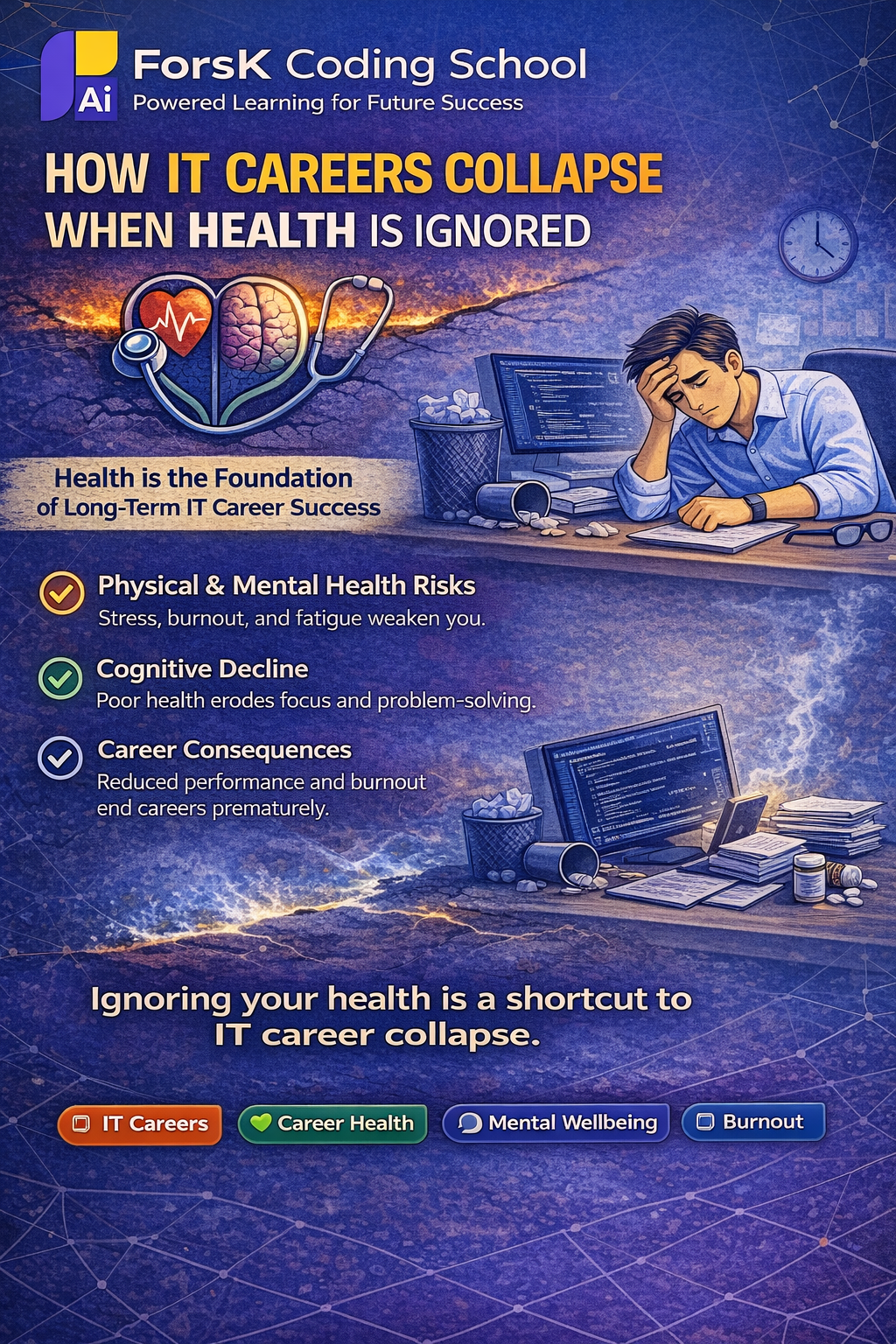
The IT industry rewards problem-solving, speed, and constant learning. But there is an uncomfortable truth many professionals ignore: no career can survive on skills alone if health is collapsing in the background.
Physical and mental health are not personal side topics. They are core career assets. When health deteriorates, thinking quality declines, motivation drops, and professional performance slowly erodes.
This is not a dramatic overnight failure. It is a gradual collapse.
The Hidden Connection Between Health and Career Stability
Most people separate career growth and health as two different areas of life. In reality, they are tightly linked.
- Healthy body → higher energy
- Healthy mind → better decisions
- Better decisions → stronger career outcomes
When health is ignored, every layer above it weakens.
Physical Health Decline in IT Professionals
Common patterns in IT careers:
- Long sitting hours
- Poor posture
- Irregular meals
- Lack of exercise
- Screen-heavy lifestyle
Over time, this leads to:
- Chronic back and neck pain
- Fatigue
- Poor sleep quality
- Weight gain or weakness
These issues reduce daily working capacity even if technical skills remain strong.
Mental Health and Cognitive Decline
Mental exhaustion has a direct impact on cognitive performance.
Ignored mental health often results in:
- Slower thinking
- Reduced focus
- Memory issues
- Increased mistakes
- Poor problem-solving
In IT, where thinking is the main job, this becomes career-threatening.
How Cognitive Decline Affects IT Performance
When cognitive capacity drops:
- Debugging becomes harder
- Learning new technologies takes longer
- System design quality decreases
- Decision-making becomes reactive instead of strategic
The professional may appear “less capable” even though the root problem is health, not intelligence.
The Career Consequences of Ignoring Health
Over time, ignored health leads to:
- Stagnant growth
- Lower confidence
- Missed promotions
- Frequent job changes
- Burnout exits from IT
Many people blame the industry, but the deeper cause is long-term self-neglect.
Why High Performers Are Not Immune
Even talented engineers collapse if they treat their bodies and minds as expendable resources.
Talent without health becomes unreliable.
Consistency disappears.
Health as Career Infrastructure
Think of health like system infrastructure:
- If servers are unstable, applications fail
- If your body and mind are unstable, your career fails
Skills are applications.
Health is the server.
Simple Habits That Protect Both Health and Career
1. Daily Movement
30 minutes of walking or exercise improves energy and focus.
2. Sleep Discipline
7–8 hours of sleep is non-negotiable for cognitive performance.
3. Screen Breaks
Short breaks every hour reduce mental fatigue.
4. Nutritious Eating
Stable blood sugar supports stable thinking.
5. Mental Unloading
Journaling, talking, or quiet time reduces mental clutter.
Long-Term Perspective
A successful IT career is not built by sacrificing health.
It is built by protecting health so that learning, creativity, and performance remain strong for decades.
Final Thoughts
If your health collapses, your career eventually follows.
Protecting your physical and mental well-being is not optional.
It is professional responsibility.
Strong health builds strong careers.