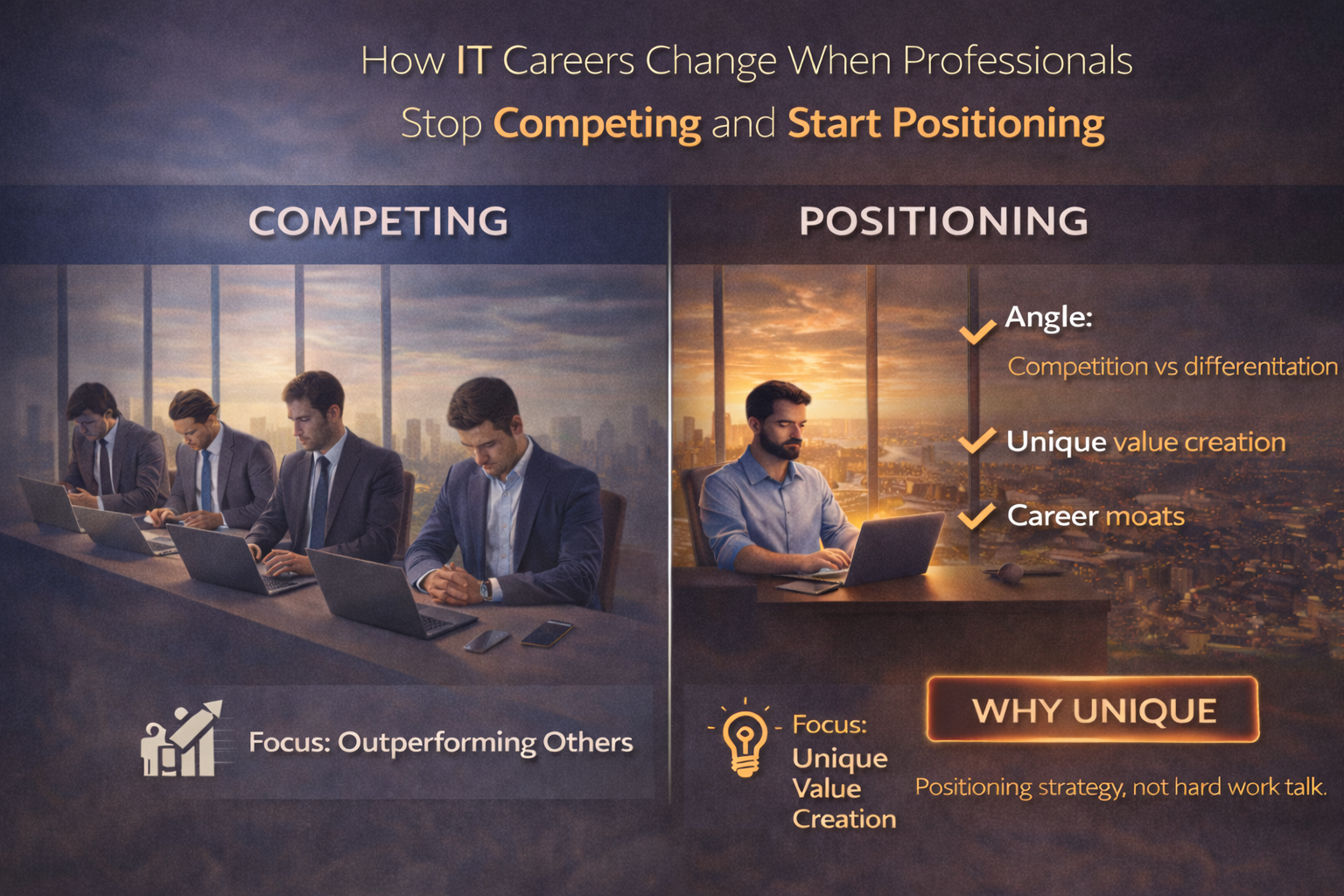
Most IT professionals believe career growth comes from competing harder — learning faster, working longer hours, and trying to outperform peers on the same metrics. While competition can create short-term gains, it rarely builds long-term career stability or influence.
The biggest career shifts happen when professionals stop competing and start positioning themselves uniquely within the ecosystem.
This blog explains how positioning, not hard work alone, creates durable career advantage in IT.
Competition vs Differentiation: The Hidden Trap
Competition pushes professionals into crowded spaces:
- Same tech stack
- Same certifications
- Same job roles
- Same expectations
When everyone competes on the same dimensions, effort increases but individual value decreases. Salaries stagnate, roles become interchangeable, and growth slows.
Positioning works differently.
Instead of asking “How do I beat others?”, positioned professionals ask:
- Where am I difficult to replace?
- What combination of skills do I own?
- What problems do people associate with me?
Differentiation reduces competition automatically.
Unique Value Creation: Where Positioning Begins
Positioning is built by creating value that is not easily comparable.
Examples include:
- Bridging technical and business communication
- Owning a specific system or workflow end-to-end
- Becoming the expert in messy, high-risk problems
- Translating abstract requirements into practical execution
These contributions are hard to benchmark and impossible to compete with directly.
Instead of being “one of many,” positioned professionals become “the only one” for certain problems.
Career Moats: Protection Against Market Noise
A career moat is what protects your role when:
- Hiring slows
- Budgets tighten
- Teams restructure
Hard skills alone are not moats. They are teachable and replaceable.
Career moats come from:
- Deep contextual knowledge
- Trusted decision-making
- System-level understanding
- Long-term ownership
When your presence prevents mistakes, saves time, or reduces risk, your role becomes defensive — not optional.
Why Positioning Beats Hard Work Narratives
Hard work increases output.
Positioning increases leverage.
Positioned professionals:
- Are pulled into important conversations
- Influence direction without authority
- Face less competition for roles
- Experience compounding career growth
They don’t chase opportunities. Opportunities align around them.
Final Insight
Competition keeps you busy.
Positioning makes you indispensable.
The most successful IT careers are not built by running faster on crowded paths, but by standing somewhere others cannot.
Positioning is not about effort. It is about choosing where you matter most — and owning it.