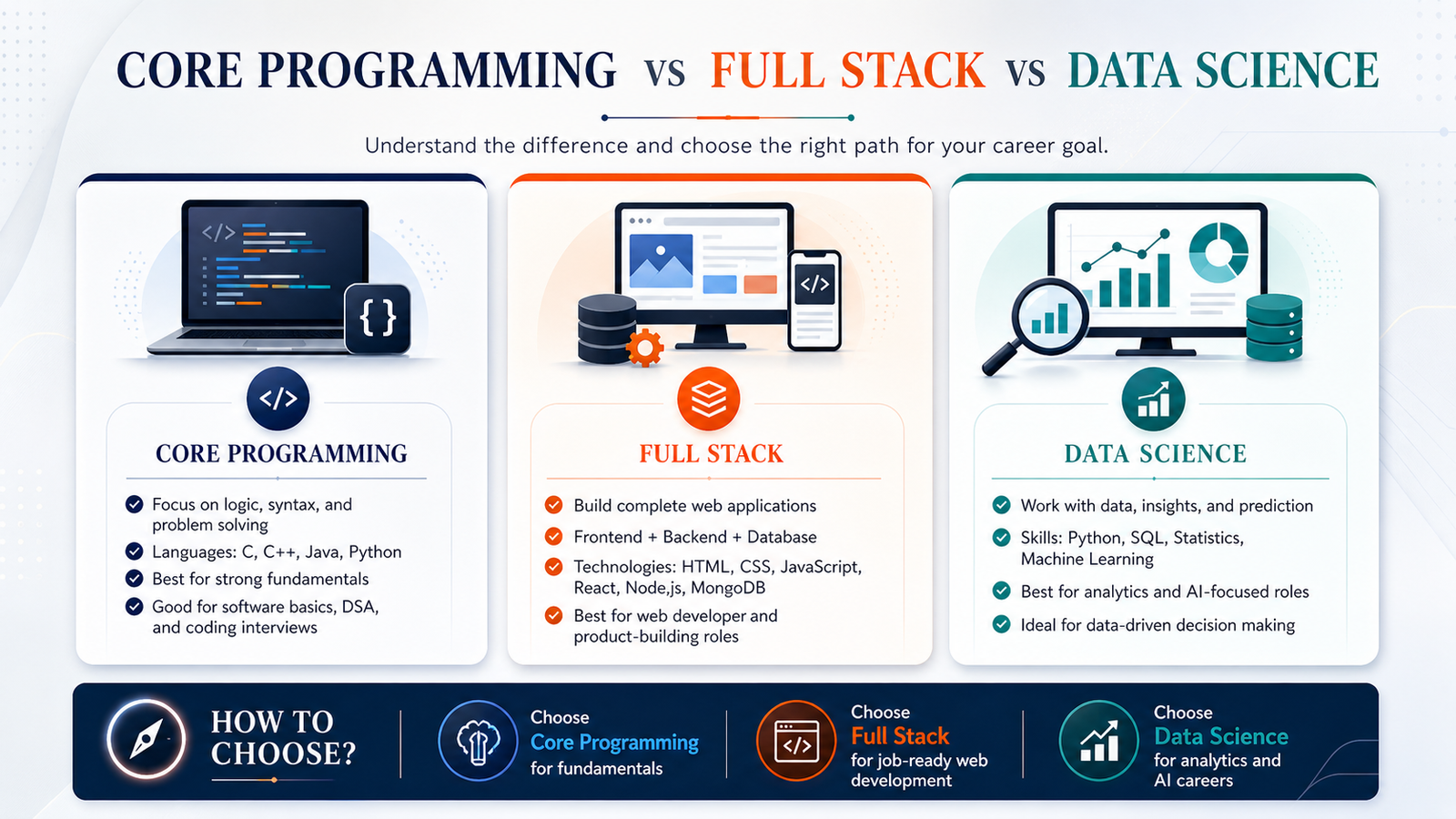
Choosing the right tech career path at the beginning can be confusing. Many students struggle between Core Programming (C, C++, Java), Full Stack Development, and Data Science/AI. If you choose the wrong path without clarity, you may waste months or even years switching between courses without real progress.
This detailed guide will help you clearly understand each field, compare them practically, and follow a structured roadmap to build a successful IT career.
Understanding the Three Career Paths
1. Core Programming (C, C++, Java)
Core programming is the foundation of computer science and software development. It focuses on logic building, problem-solving, and understanding how systems work internally.
When you start with C, C++, and Java, you are not just learning syntax—you are training your brain to think like a developer.
What You Learn:
- C Programming for logic building and memory concepts
- C++ for Data Structures and Algorithms
- Java for Object-Oriented Programming
Why It Matters:
Core programming builds strong fundamentals. It helps you understand how software works behind the scenes, which is critical for advanced fields like backend development, system design, and AI.
Reality Check:
Most students skip this phase because it feels slow. But this is exactly what separates average developers from high-paying professionals.
2. Full Stack Development
Full stack development is about building complete applications—from what users see (frontend) to how systems work behind the scenes (backend).
It is one of the most popular and practical career paths today because you can quickly build real-world projects.
What You Learn:
- Frontend: HTML, CSS, JavaScript, React
- Backend: Node.js, Java, or PHP
- Databases: MongoDB, MySQL
- APIs and deployment
Why It Matters:
You become job-ready faster because you can build projects like websites, dashboards, and business applications.
Reality Check:
Many students jump into full stack without understanding programming fundamentals. This leads to shallow knowledge and difficulty in interviews.
3. Data Science / AI / Machine Learning
Data Science and AI are among the most trending and high-paying fields. They involve working with data, building predictive models, and creating intelligent systems.
What You Learn:
- Python programming
- Statistics and mathematics
- Machine Learning algorithms
- Data visualization tools like Power BI
Why It Matters:
Companies rely heavily on data to make decisions. From startups to large enterprises, data science is driving innovation.
Reality Check:
This field is not beginner-friendly if you don’t have strong programming and logical thinking skills.
Core Comparison (Practical View)
| Factor | Core Programming | Full Stack | Data Science |
|---|---|---|---|
| Learning Difficulty | Medium | Medium | High |
| Job Readiness | Slow | Fast | Medium |
| Long-Term Growth | High | Medium | Very High |
| Fundamentals Strength | Very Strong | Moderate | Strong |
| Project Exposure | Low initially | High | Medium |
Biggest Mistake Beginners Make
The most common mistake students make is directly jumping into advanced technologies like Python, AI, or Machine Learning without learning the basics.
They follow trends instead of following a structured path.
This results in:
- Lack of confidence
- Weak problem-solving skills
- Difficulty in cracking interviews
What Should You Learn First?
If You Are a Complete Beginner
Start with Core Programming. Build your foundation first.
Learn in this order:
- C Programming
- C++ (Data Structures basics)
- Java (OOP concepts)
This will make everything else easier.
If You Want Quick Job or Freelancing
Start with Full Stack Development, but do not ignore programming basics.
At least understand logic building and problem-solving alongside development.
If Your Goal is AI / Data Science
Do not directly jump into machine learning.
Follow this path:
Core Programming → Python → Data Science → Machine Learning
This approach saves time and builds confidence.
Recommended Learning Roadmap
Phase 1: Foundation (2–3 Months)
Focus on building logic and fundamentals:
- C Programming
- C++ basics
- Problem-solving practice
Phase 2: Skill Expansion (2–4 Months)
Choose your direction:
- Full Stack Development
OR - Java Backend Development
Start building real-world projects in this phase.
Phase 3: Specialization (3–6 Months)
Now move into advanced areas:
- Data Science / Machine Learning
OR - Advanced Full Stack (React, APIs, deployment)
Practical Career Strategy
If your goal is fast income:
→ Choose Full Stack Development
If your goal is strong fundamentals and high-paying roles:
→ Start with Core Programming
If your goal is AI career:
→ Combine Core Programming + Python + Machine Learning
Final Verdict
There is no single perfect choice between Core Programming, Full Stack, and Data Science.
The smartest decision is to follow the right sequence instead of choosing only one.
Start with fundamentals, move to development, and then specialize.
This approach ensures:
- Strong problem-solving skills
- Real-world project experience
- Long-term career growth
Call to Action
If you are serious about building a successful career in IT, stop jumping between random courses.
Follow a structured roadmap, build real projects, and learn with proper guidance.
Start your journey with the right direction and turn your skills into a career.