Artificial Intelligence is no longer a futuristic concept—it is now one of the highest-demand career fields in the world. From startups to global tech companies, organizations are actively hiring AI engineers who can build intelligent systems, automate processes, and solve complex real-world problems.
But many students are confused about one thing:
👉 How do you actually become an AI Engineer in 2026?
The biggest mistake beginners make is jumping directly into AI tools without building strong foundations. AI is not just about using libraries—it requires programming knowledge, mathematics, problem-solving skills, and practical project experience.
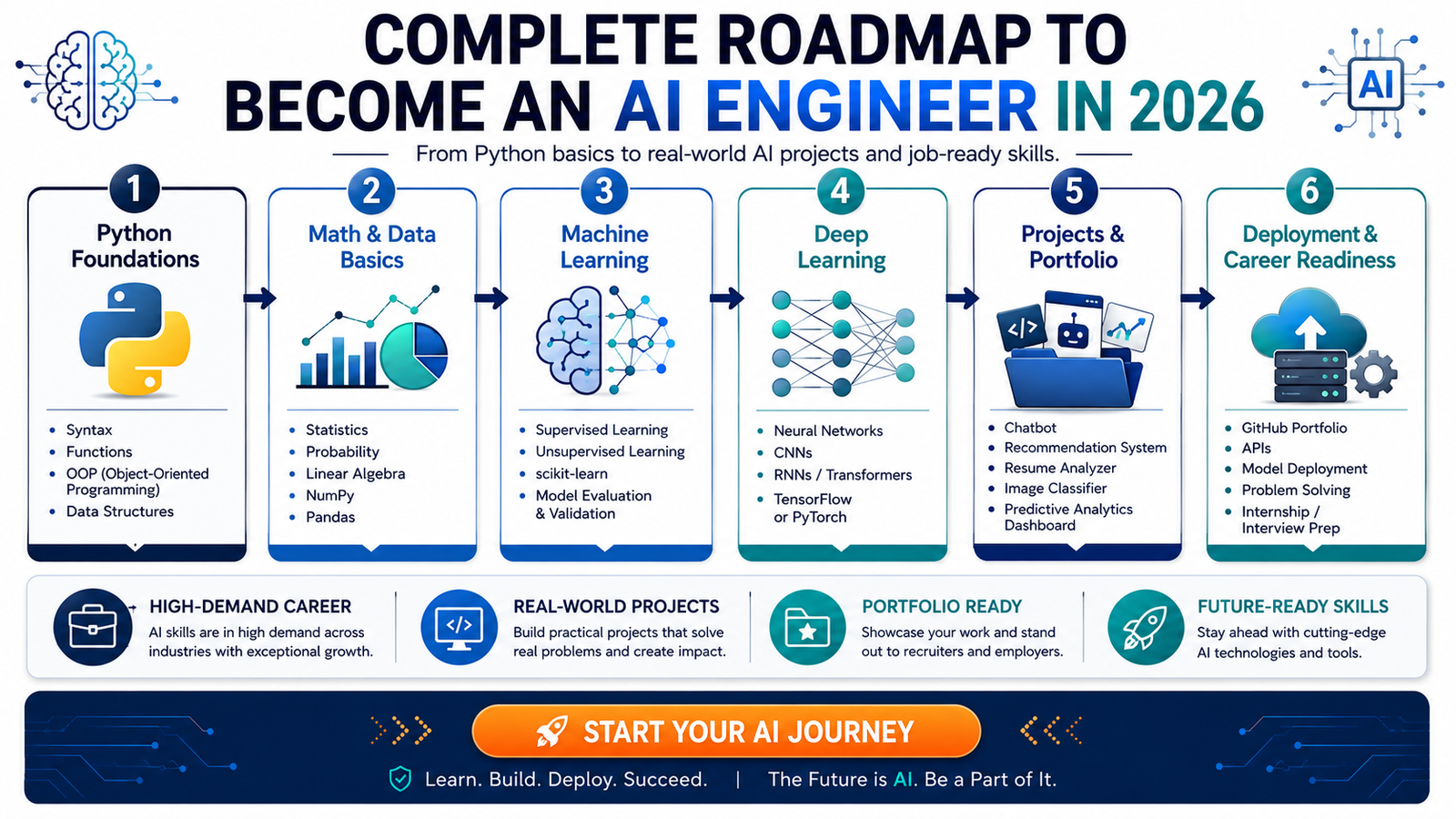
This complete roadmap will guide you step-by-step from beginner to becoming a job-ready AI Engineer.
🚀 Step 1: Learn Programming Fundamentals
Before entering AI, you must become comfortable with programming.
The best language to start with is:
Python
Python is widely used in AI because of its simplicity and powerful ecosystem.
What You Should Learn:
- Variables and data types
- Loops and conditions
- Functions
- Object-Oriented Programming (OOP)
- File handling
- Error handling
Why Python Matters in AI
Most AI frameworks and libraries are built around Python.
Libraries like:
- NumPy
- Pandas
- TensorFlow
- PyTorch
- Scikit-learn
all rely heavily on Python.
👉 Without strong Python basics, AI learning becomes difficult.
📊 Step 2: Learn Mathematics for AI
Many students skip this step, but mathematics is the backbone of machine learning and deep learning.
Important Topics:
- Linear Algebra
- Probability
- Statistics
- Calculus basics
Why It Matters:
Math helps you understand:
- How models work
- Why algorithms make predictions
- How optimization happens
You do not need advanced mathematics initially, but you must understand core concepts.
🤖 Step 3: Learn Machine Learning
Once your Python fundamentals are strong, move to Machine Learning.
Machine Learning is the process where systems learn patterns from data.
Topics You Should Learn:
Supervised Learning
- Linear Regression
- Logistic Regression
- Decision Trees
- Random Forest
Unsupervised Learning
- Clustering
- Dimensionality Reduction
Model Evaluation
- Accuracy
- Precision
- Recall
- Overfitting & Underfitting
Tools & Libraries
- Scikit-learn
- Pandas
- NumPy
- Matplotlib
👉 This stage helps you understand how AI systems make decisions.
🧠 Step 4: Learn Deep Learning
Deep Learning is one of the most exciting parts of AI.
It powers:
- Chatbots
- Image recognition
- Voice assistants
- Recommendation systems
- Generative AI tools
What You Should Learn:
Neural Networks
- Perceptrons
- Activation functions
- Backpropagation
Deep Learning Frameworks
- TensorFlow
- Keras
- PyTorch
Advanced Concepts
- CNN (Computer Vision)
- RNN/LSTM (Sequence models)
- Transformers
👉 Deep learning is where you move from basic AI to advanced intelligent systems.
💻 Step 5: Build Real AI Projects
This is the most important step.
Most students watch tutorials but never build projects.
Recruiters care more about your projects than certificates.
Beginner Projects:
- Spam Email Classifier
- Movie Recommendation System
- Sentiment Analysis
- Chatbot
Intermediate Projects:
- Face Detection System
- Resume Analyzer
- AI Voice Assistant
- Fraud Detection System
Advanced Projects:
- Real-Time Object Detection
- AI Interview System
- AI-based Healthcare Prediction
- ChatGPT-like Conversational Bot
👉 Projects transform learning into real skills.
🌐 Step 6: Learn Deployment & MLOps
A real AI Engineer should know how to deploy AI systems.
Learn:
- Flask / FastAPI
- Docker basics
- APIs
- Cloud platforms (AWS/GCP)
Why This Matters:
Companies don’t just need models—they need working AI applications.
📁 Step 7: Build a Strong Portfolio
Your portfolio should include:
✔ GitHub profile
✔ Real projects
✔ Deployed applications
✔ Project documentation
A strong portfolio increases your chances of getting shortlisted.
💼 Step 8: Prepare for AI Jobs
To become job-ready, prepare for:
- Python coding interviews
- Machine learning concepts
- Problem-solving rounds
- Project explanation
Roles You Can Target:
- AI Engineer
- Machine Learning Engineer
- Data Scientist
- NLP Engineer
- Computer Vision Engineer
⚠️ Common Mistakes Beginners Make
Many students fail because they:
❌ Learn libraries without understanding concepts
❌ Ignore mathematics
❌ Don’t build projects
❌ Jump directly into advanced AI
Avoid these mistakes to grow faster.
🎯 The Best Learning Strategy
The ideal roadmap is:
Python → Mathematics → Machine Learning → Deep Learning → Projects → Deployment
This sequence builds strong foundations and practical expertise.
🚀 Final Thoughts
AI Engineering is one of the most exciting and high-paying career paths in 2026.
But success in AI does not come from shortcuts.
It comes from:
✔ Strong fundamentals
✔ Practical projects
✔ Consistency
✔ Real-world problem solving
If you follow the right roadmap and focus on building skills step by step, you can become a successful AI Engineer.
👉 Don’t just consume AI content
👉 Build real AI systems
🚀 Forsk Coding School – IT Training Institute
Build your career with practical training in coding, AI, and modern technologies. Learn through real projects and industry-focused guidance.
📺 YouTube: https://www.youtube.com/@ForskCodingSchoolJaipur
📘 Facebook: https://www.facebook.com/ForskCodingSchool
📸 Instagram: https://www.instagram.com/forskcodingschool/
💼 LinkedIn: https://www.linkedin.com/company/forskcodingschool
#ITTraining #Coding #ArtificialIntelligence #WebDevelopment #CareerGrowth #Jaipur