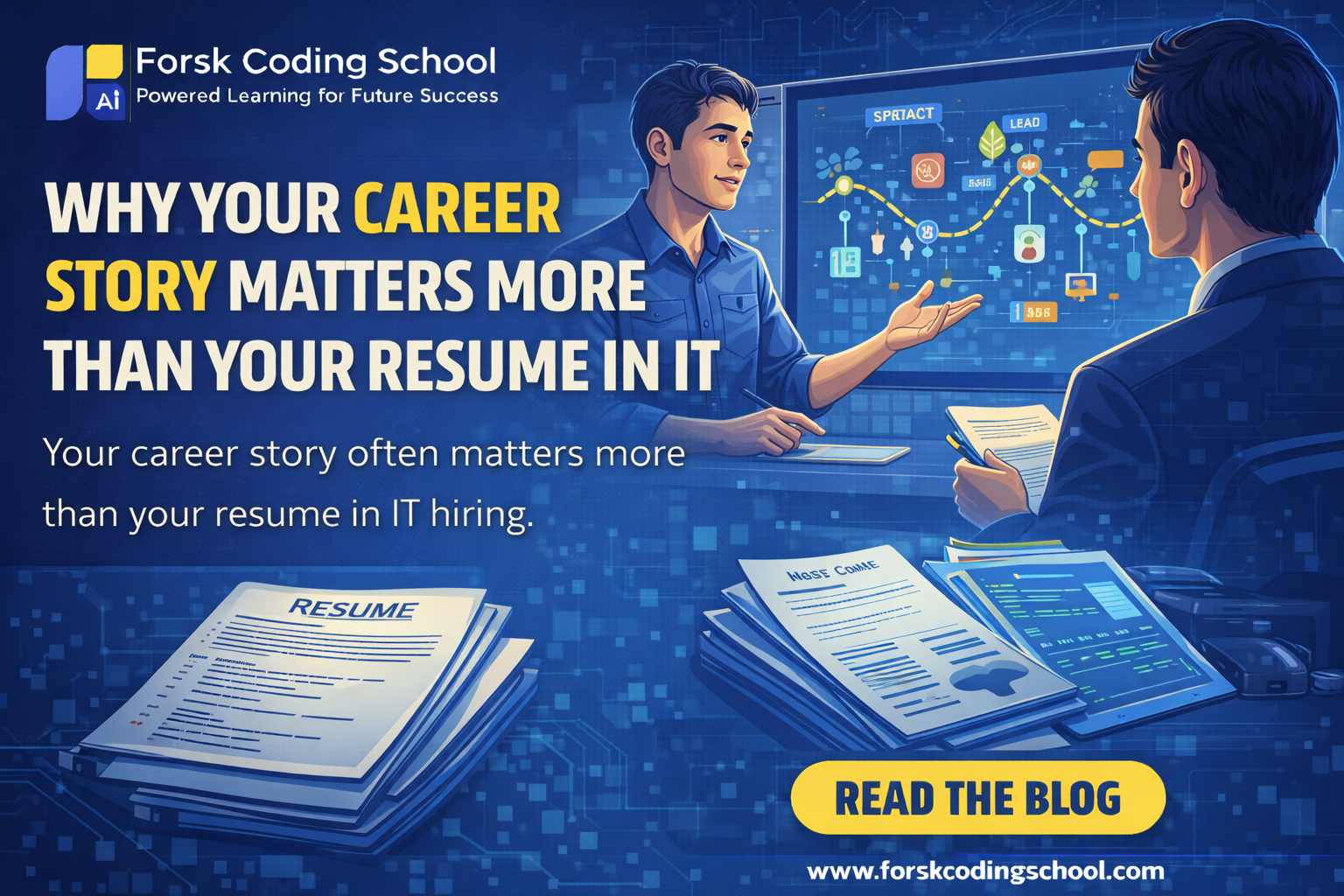
Most IT professionals spend countless hours polishing their resume — adding new technologies, listing certifications, and updating project bullet points. While resumes are important, they are no longer the primary differentiator in today’s competitive tech market.
What increasingly sets candidates apart is their career story.
Recruiters and hiring managers don’t just evaluate what you have done. They try to understand the narrative behind your journey — your direction, decision-making pattern, growth curve, and professional identity.
Resume vs Career Narrative
A resume is a static document. It lists skills, tools, companies, and timelines.
A career story, however, answers deeper questions:
- Why did you choose this path?
- How have you grown over time?
- What problems do you naturally solve?
- Where are you heading next?
Two candidates may have identical technical stacks, but the one with a clearer narrative almost always creates a stronger impression.
How Recruiters Actually Evaluate Profiles
In real hiring scenarios, recruiters scan for patterns — not just keywords.
They subconsciously ask:
- Is this candidate intentional or random?
- Does their experience show progression?
- Is there a clear professional identity?
- Can I confidently position them for this role?
Bullet points alone rarely answer these questions. Story coherence does.
The Memory Advantage of Story-Driven Profiles
Human memory is wired for stories, not lists.
When recruiters review dozens or hundreds of profiles daily, most resumes blur together. But a candidate with a clear, logical career narrative becomes easier to remember and easier to recommend internally.
This creates a powerful advantage in:
- Shortlisting
- Interview recall
- Hiring discussions
- Internal referrals
Your story becomes your mental brand.
What Makes a Strong IT Career Story
A compelling career narrative usually shows three things:
1. Direction
Your choices appear intentional rather than random.
2. Progression
Each role or project builds logically on the previous one.
3. Positioning
It becomes clear what kind of problems you are best suited to solve.
When these elements align, recruiters develop trust faster.
Common Mistake: Resume-Only Thinking
Many IT professionals fall into the resume optimization trap.
They focus on:
- Adding more tools
- Collecting more certificates
- Expanding keyword lists
But they ignore the bigger question:
What story does my career actually tell?
Without narrative clarity, even strong technical profiles can feel scattered.
How to Start Strengthening Your Career Story
You don’t need to reinvent your background. You need to interpret it better.
Practical starting steps:
- Identify your core technical theme
- Connect your projects into a logical arc
- Clarify the problems you repeatedly solve
- Explain transitions with intention
- Align your future direction with your past work
Small narrative improvements can significantly change how your profile is perceived.
Why This Matters More in Today’s IT Market
As AI tools and automation make basic technical screening easier, hiring decisions are increasingly influenced by clarity, positioning, and perceived trajectory.
In crowded talent pools, storytelling creates differentiation.
Professionals who communicate a coherent career narrative often:
- Get shortlisted faster
- Build stronger interviewer trust
- Attract better-fit roles
- Progress more smoothly into senior positions
Final Thoughts
In modern IT careers, your resume opens the door — but your career story determines how far you go.
Professionals who learn to present a clear, intentional narrative create stronger market positioning than those who rely only on skill lists.
At Jaipur Engineers and GrootLearning, we guide students not just in technical skills but in building strong professional positioning from early in their careers.
Because in today’s tech world, clarity of story is a competitive advantage.