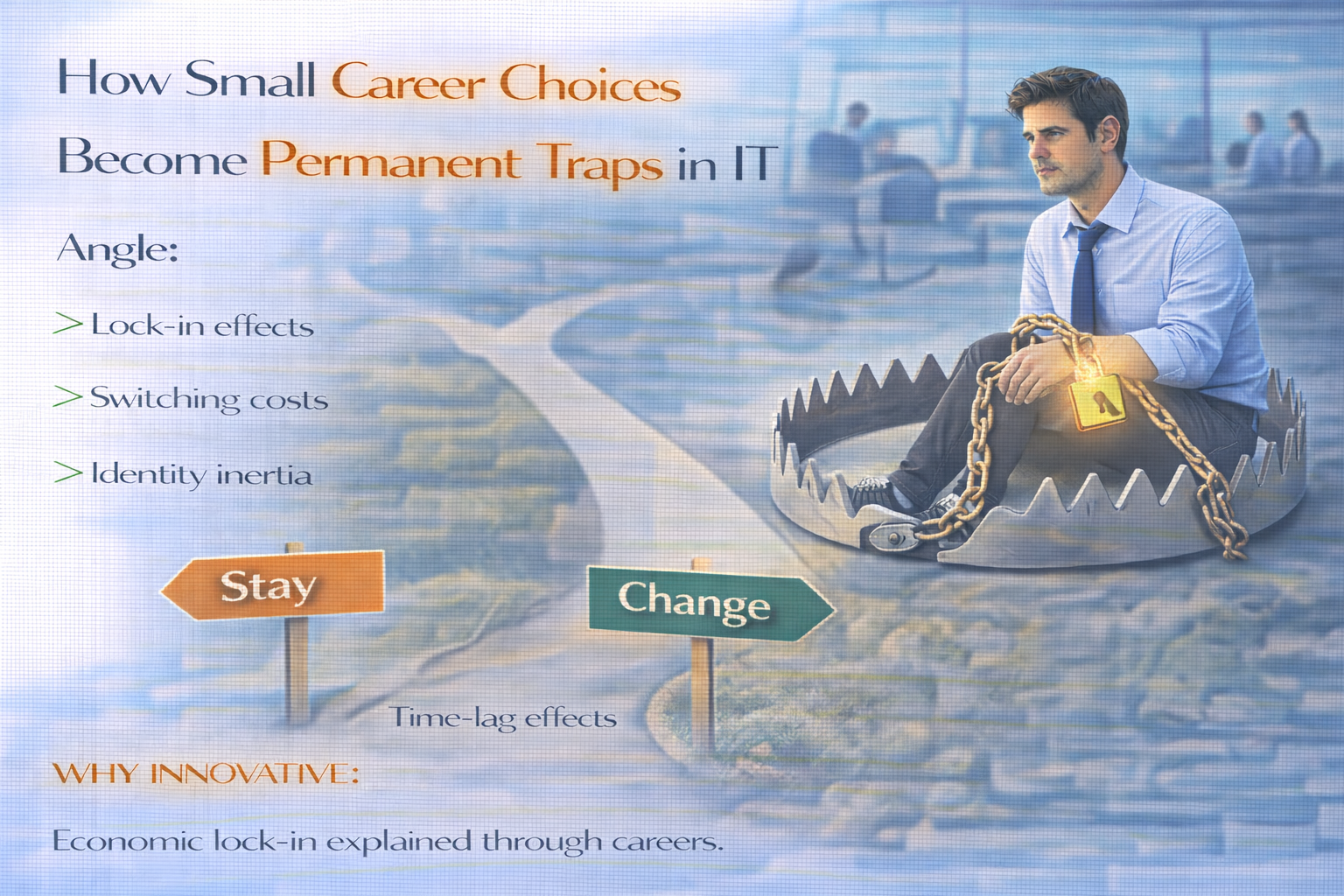
Most IT professionals believe career traps are created by big mistakes.
A wrong company.
A failed startup.
A bad technology bet.
In reality, most career traps in IT are built slowly, through small choices that feel safe, practical, and reversible at the time.
By the time the trap is visible, leaving it feels expensive.
The Nature of Career Lock-In
In economics, lock-in happens when switching costs become higher than staying costs — even when better options exist.
IT careers experience the same effect.
Lock-in forms when:
- Skills become too specific to one environment
- Experience stops translating outside the current role
- Identity becomes tied to a narrow label
Nothing forces you to stay.
But leaving starts to feel irrational.
How Small Choices Create Switching Costs
Career traps are rarely chosen directly.
They are assembled through small, reasonable decisions:
- Saying yes to similar work repeatedly
- Avoiding unfamiliar responsibilities
- Staying because changing feels risky
- Optimizing for short-term comfort
Each choice increases switching cost:
- Learning gaps widen
- Confidence outside the role declines
- External options feel less realistic
Identity Inertia: The Strongest Trap
The deepest lock-in is psychological.
Over time, professionals stop asking:
“What else could I be?”
And start assuming:
“This is what I am.”
When identity hardens:
- Exploration feels threatening
- Beginner roles feel humiliating
- Change feels like loss, not growth
This is identity inertia — and it keeps people stuck longer than skill gaps do.
Why Traps Don’t Feel Like Traps
Career traps are comfortable.
- Work is predictable
- Expectations are clear
- Performance is acceptable
There is no immediate pain.
The cost appears later — when:
- The market shifts
- The role loses demand
- Growth opportunities vanish
The trap only becomes visible when escape is difficult.
Breaking Lock-In Before It Hardens
Career traps are hardest to escape once fully formed.
The goal is early weakening, not dramatic exits.
Practical ways:
- Periodically do work that stretches your identity
- Build skills that translate beyond your role
- Test your market relevance regularly
- Separate who you are from what you do today
Lower switching costs before you need to switch.
Final Thought
Most IT career traps are not built by fear.
They are built by comfort.
Small choices feel harmless.
But repeated over time, they harden into walls.
The earlier you notice lock-in, the easier it is to step away.