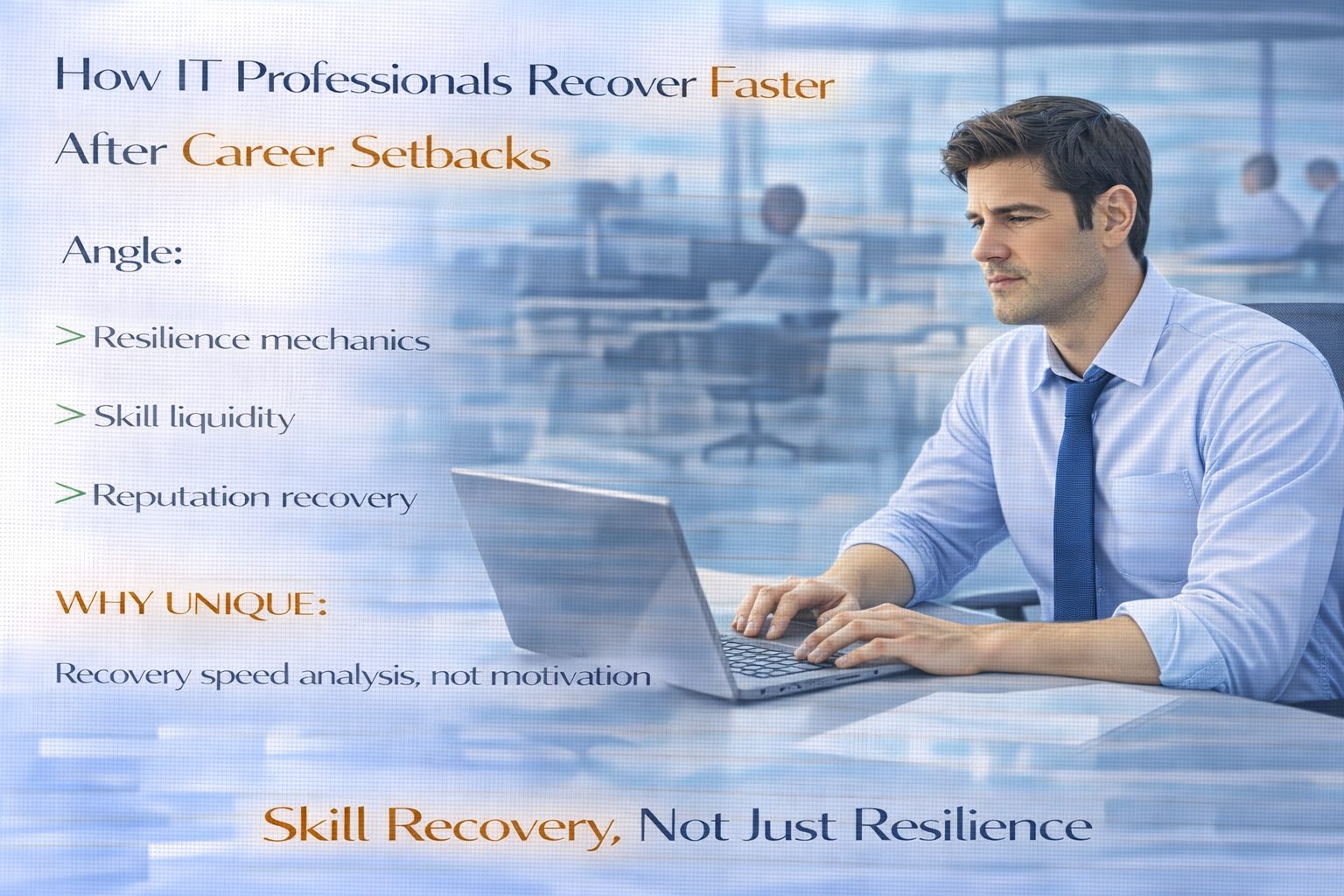
Career setbacks in IT are no longer rare events.
Layoffs, failed startups, stalled growth, technology obsolescence, health issues, or personal constraints can hit even high performers. The real difference between professionals who bounce back and those who struggle is not talent — it is recovery speed.
In modern IT careers, how fast you recover matters more than how badly you fall.
Why Recovery Speed Is the New Career Advantage
Two professionals can face the same setback.
- One regains momentum within months
- The other remains stuck for years
The gap is not intelligence or effort. It is structural.
Fast recovery comes from systems built before disruption, not motivation discovered after it.
The Three Mechanics of Fast Career Recovery
1. Skill Liquidity
Highly liquid skills can be redeployed quickly.
These are skills that:
- Apply across multiple industries
- Transfer between tech stacks
- Solve business problems, not just technical tasks
Examples include system design thinking, debugging complex systems, communication, architectural reasoning, and learning agility.
When your skills are liquid, market re-entry becomes faster and smoother.
2. Reputation Recovery
After setbacks, reputation matters more than resumes.
Professionals who recover faster usually have:
- Visible work or contributions outside their employer
- Strong peer networks
- Credibility that is not tied to one company
A trusted reputation reduces friction when restarting.
3. Psychological Containment
Setbacks damage confidence before they damage careers.
Fast recoverers contain psychological damage by:
- Separating self-worth from job titles
- Avoiding panic-driven decisions
- Maintaining clarity under uncertainty
This emotional control allows rational, strategic moves instead of reactive ones.
Why Slow Recovery Destroys Careers
The danger is rarely the setback itself.
Careers erode during prolonged recovery because:
- Skills decay while waiting
- Confidence compounds downward
- Financial pressure forces poor choices
Slow recovery turns temporary disruption into long-term derailment.
How to Design for Faster Recovery Before You Need It
Recovery speed is engineered, not hoped for.
Practical steps:
- Build transferable skills alongside specialization
- Maintain external professional visibility
- Strengthen peer networks, not just management relationships
- Create financial and role flexibility
- Periodically rehearse worst-case career scenarios
Prepared professionals don’t avoid setbacks — they shorten them.
Recovery Is a Skill, Not a Phase
Most IT professionals treat recovery as an emotional phase.
In reality, it is a career capability.
Those who master recovery speed outlast market cycles, technology shifts, and organizational failures.
Final Thought
Setbacks are inevitable in IT.
Career damage is optional.
The professionals who win long-term are not those who never fall — but those who stand up faster, clearer, and stronger every time.