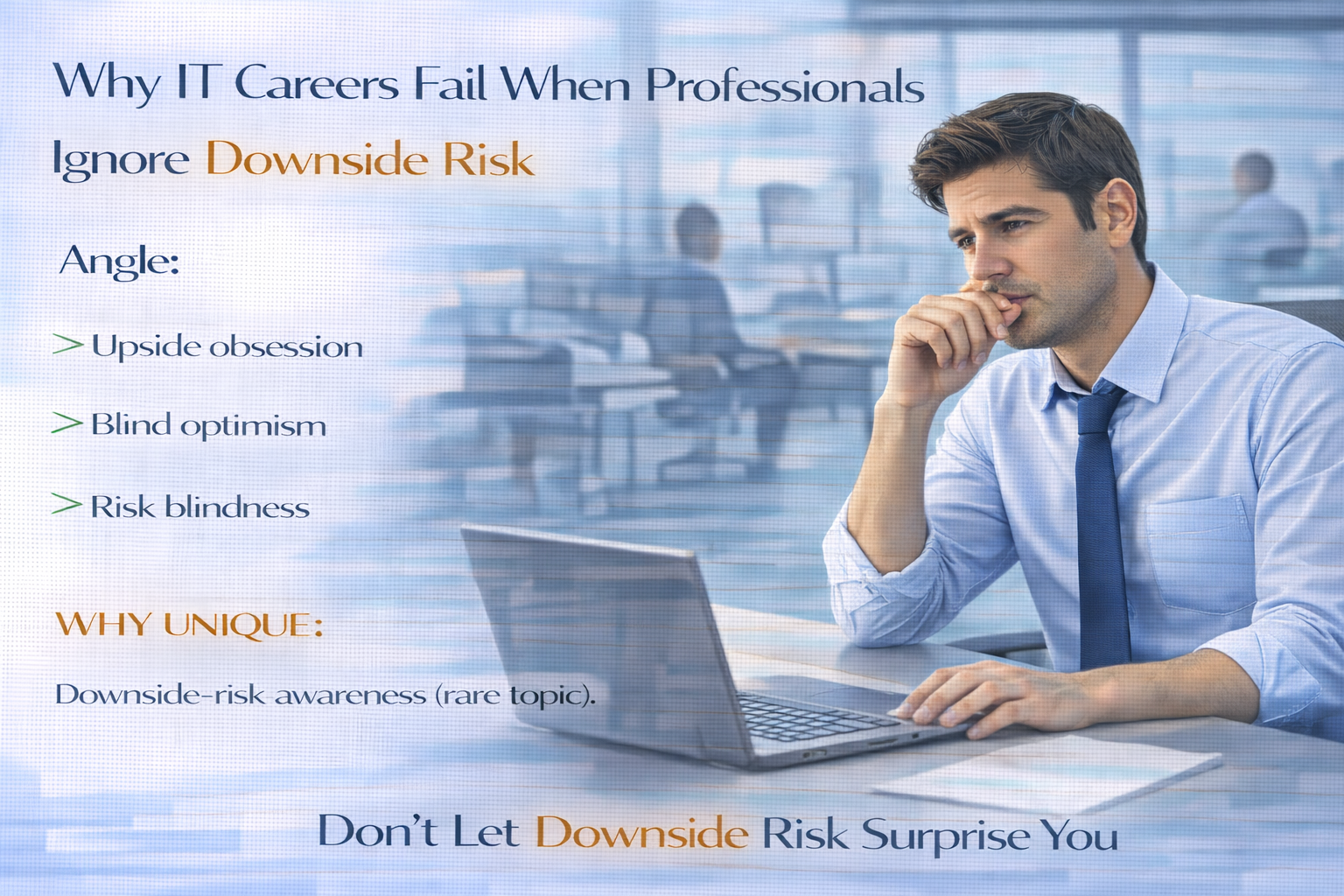
Most IT professionals think about their careers in terms of upside.
Higher salary. Better title. Bigger company. New technology.
Very few think seriously about downside risk — what happens if things don’t go as planned.
This blind spot is one of the biggest reasons IT careers fail unexpectedly.
What Is Downside Risk in an IT Career?
Downside risk is the damage potential when assumptions break.
In IT careers, this includes:
- Sudden job loss
- Technology becoming obsolete
- Health or personal disruptions
- Company or project failure
- Market oversupply of certain skills
Ignoring downside risk doesn’t remove it. It only delays awareness — often until recovery becomes harder.
The Upside Obsession Trap
The IT industry rewards optimism.
Fast growth stories, high packages, startup success narratives, and rapid promotions create a culture where everyone is trained to look upward.
But upside focus without downside thinking creates fragile careers:
- Professionals chase hot skills without understanding lifecycle risk
- High salaries hide declining market relevance
- Comfort replaces preparation
When the upside disappears, there is no protection underneath.
Why Smart Professionals Still Miss Downside Risk
Ignoring downside risk is rarely stupidity. It is psychological.
Common reasons include:
- “This technology will always be in demand”
- “My company is stable”
- “I can always learn later”
- “I’ll figure it out if something happens”
These beliefs feel reasonable — until conditions change faster than expected.
How Downside Risk Quietly Accumulates
Downside risk compounds silently.
It grows when:
- Skills narrow instead of broaden
- Income depends on one source
- Identity locks into one role or stack
- External visibility fades
Nothing feels wrong — until everything changes at once.
Managing Downside Risk Without Killing Growth
Downside awareness does not mean playing small.
It means building protection alongside ambition.
Practical steps include:
- Maintaining transferable skills alongside specialization
- Keeping financial buffers during high-earning phases
- Periodically stress-testing your career against market changes
- Avoiding total dependency on one employer, client, or stack
Growth without protection is gambling. Growth with protection is strategy.
Why Downside Thinkers Last Longer in IT
Long-lasting IT careers are not built by the most aggressive movers.
They are built by professionals who:
- Expect volatility
- Plan for reversals
- Design careers that survive mistakes
These professionals don’t fear risk — they respect it.
Final Thought
Ignoring downside risk doesn’t make your career safer.
It makes failures sharper and recovery slower.
In IT, the goal is not to avoid setbacks — it is to survive them without losing momentum.
Careers fail not because upside disappears, but because downside was never considered.