In the IT industry, talent is often treated as the ultimate differentiator. Skills, intelligence, and hard work are assumed to directly lead to success. Yet, when you observe real career trajectories closely, a less discussed factor emerges again and again:
Timing.
This article explores why when you apply skills often matters more than how talented you are—and why many IT careers are shaped by market timing rather than pure ability.
Talent Is Static, Timing Is Dynamic
Talent develops gradually. Timing, however, is driven by forces outside individual control:
- Market demand
- Technology adoption cycles
- Economic conditions
- Industry hype and decline
A highly skilled professional entering the market at the wrong time can struggle, while an average-skilled professional entering at the right moment can accelerate rapidly.
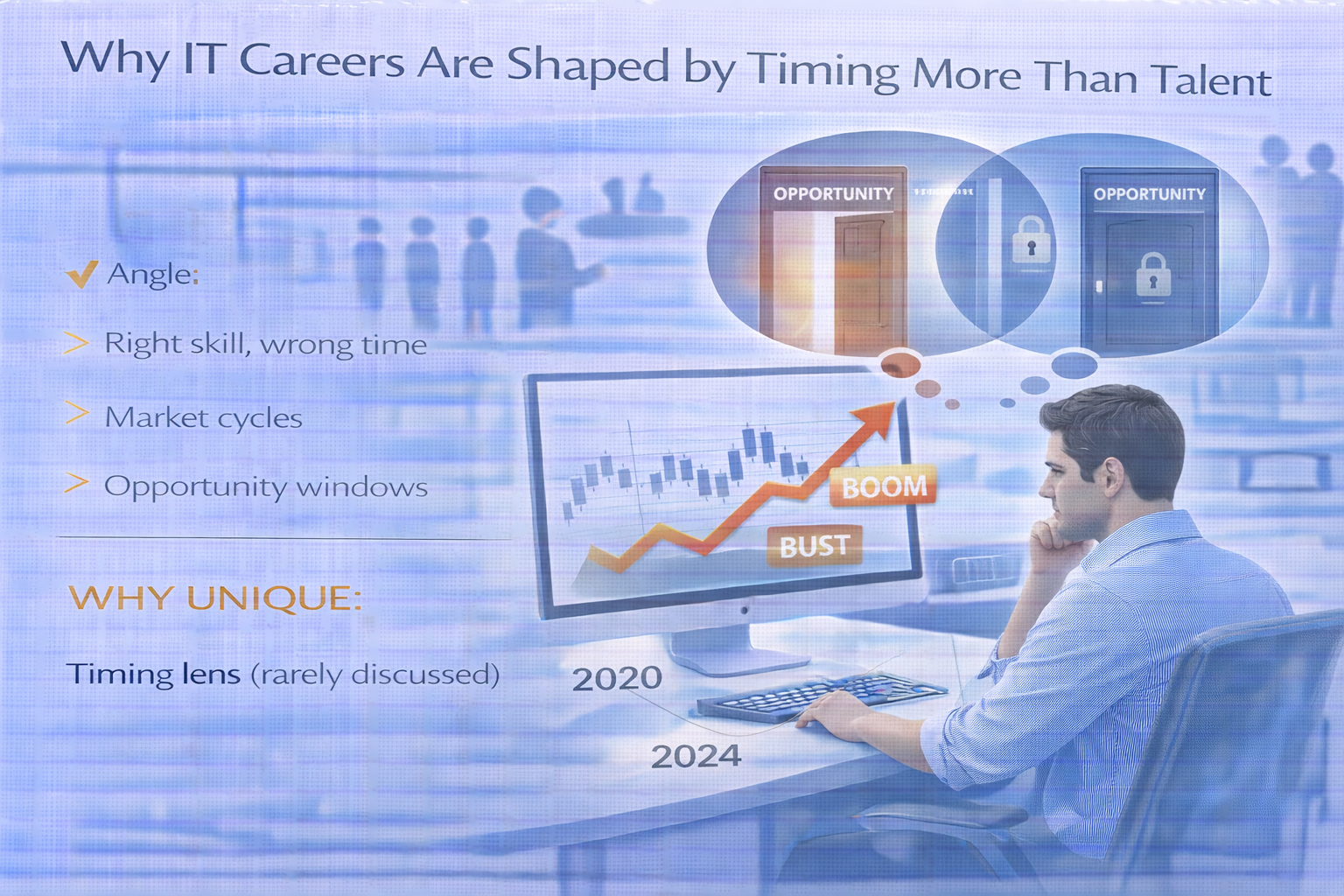
Right Skill, Wrong Time
Many IT professionals experience frustration not because they lack ability, but because their skills arrive early—or too late.
Examples include:
- Learning a niche technology before the market adopts it
- Mastering a framework just as companies move away from it
- Entering a saturated field at peak competition
In these cases, talent exists—but opportunity does not.
Market Cycles Shape Careers
IT operates in visible and invisible cycles:
- Programming language booms
- Startup hiring waves
- Enterprise technology shifts
- AI, cloud, and automation phases
Careers often surge when personal skill growth aligns with these cycles. Those who miss a cycle may feel stuck, even while continuing to improve technically.
This misalignment is rarely acknowledged, leading professionals to blame themselves instead of recognizing timing effects.
Opportunity Windows Are Short
In IT, opportunity windows open and close quickly:
- Early adopters gain outsized advantages
- Late entrants face higher standards
- Mid-cycle professionals must compete harder
Once a window closes, effort alone cannot recreate the same leverage. This is why two equally capable professionals can have vastly different outcomes.
Why Timing Is Rarely Discussed
Timing challenges the merit-based narrative of IT success.
Admitting timing matters means accepting that:
- Careers are partially shaped by luck
- Hard work is not always immediately rewarded
- Some outcomes are unfair
Because this is uncomfortable, the industry prefers talent-only explanations.
What Professionals Can Do About Timing
While timing cannot be controlled, it can be read:
- Track market hiring trends
- Watch technology adoption curves
- Build adaptable, transferable skills
- Avoid over-attachment to single tools
Those who survive long IT careers learn to reposition themselves when cycles shift.
Final Thoughts
Talent builds capability.
Timing determines visibility.
The strongest IT careers are not built by talent alone, but by recognizing when to push, when to wait, and when to pivot.
In technology, success is not just about being good.
It’s about being good at the right time.