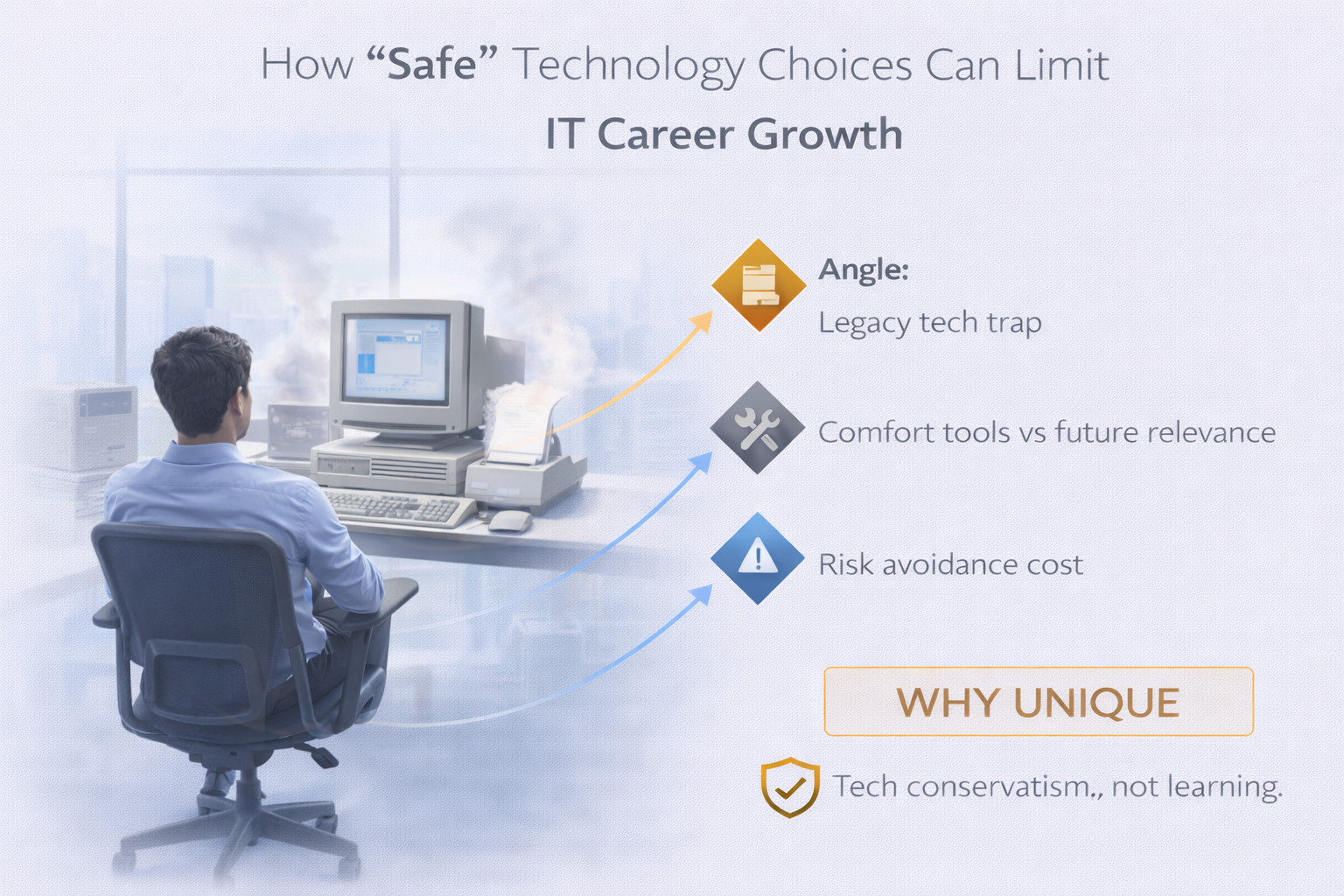
Many IT professionals are advised to stick with “safe” technologies — tools that are stable, widely used, and unlikely to disappear soon. These choices feel practical and responsible, especially in environments that value predictability.
However, over time, technology conservatism can quietly limit career growth. This blog explores how relying too heavily on safe technology choices creates a legacy tech trap, reduces future relevance, and carries hidden risk-avoidance costs.
The Legacy Tech Trap: When Stability Becomes a Ceiling
Legacy technologies persist because they work. They are battle-tested, documented, and familiar.
But long-term reliance on legacy stacks often leads to:
- Maintenance-heavy roles
- Limited system redesign opportunities
- Low exposure to modern patterns
- Shrinking demand outside specific organizations
Professionals can become experts in systems that few companies want to build anymore.
Stability without evolution slowly narrows external opportunity.
Comfort Tools vs Future Relevance
Comfort tools reduce cognitive load:
- Known workflows
- Predictable debugging
- Familiar deployment patterns
But future relevance depends on exposure to:
- Emerging architectures
- New scalability models
- Changing infrastructure paradigms
- Modern development practices
When professionals always choose comfort tools, they optimize for ease today at the cost of adaptability tomorrow.
The problem is not using stable tools — it is never leaving them.
Risk Avoidance Cost: The Invisible Trade-Off
Avoiding risk feels prudent.
But risk avoidance has a cost:
- Slower learning velocity
- Fewer high-impact projects
- Reduced architectural influence
- Lower strategic visibility
Meanwhile, peers who take controlled technical risks accumulate experience faster and become more valuable over time.
The cost of playing it safe is often paid years later, not immediately.
Why This Is Not a Learning Problem
This is not about learning more tools randomly.
It is about where learning happens.
Career growth accelerates when professionals:
- Experiment at the edges of stable systems
- Take ownership of migrations or transitions
- Balance reliability with exploration
Tech conservatism becomes dangerous when it replaces curiosity and calculated experimentation.
Final Insight
Safe technology choices reduce short-term uncertainty.
But long-term IT career growth depends on relevance, adaptability, and exposure to change.
The real risk is not learning new technology — it is building a career that cannot move when technology does.