Salary is one of the most visible signals in an IT career. It is measurable, comparable, and emotionally reassuring. As a result, many professionals make role decisions primarily based on compensation.
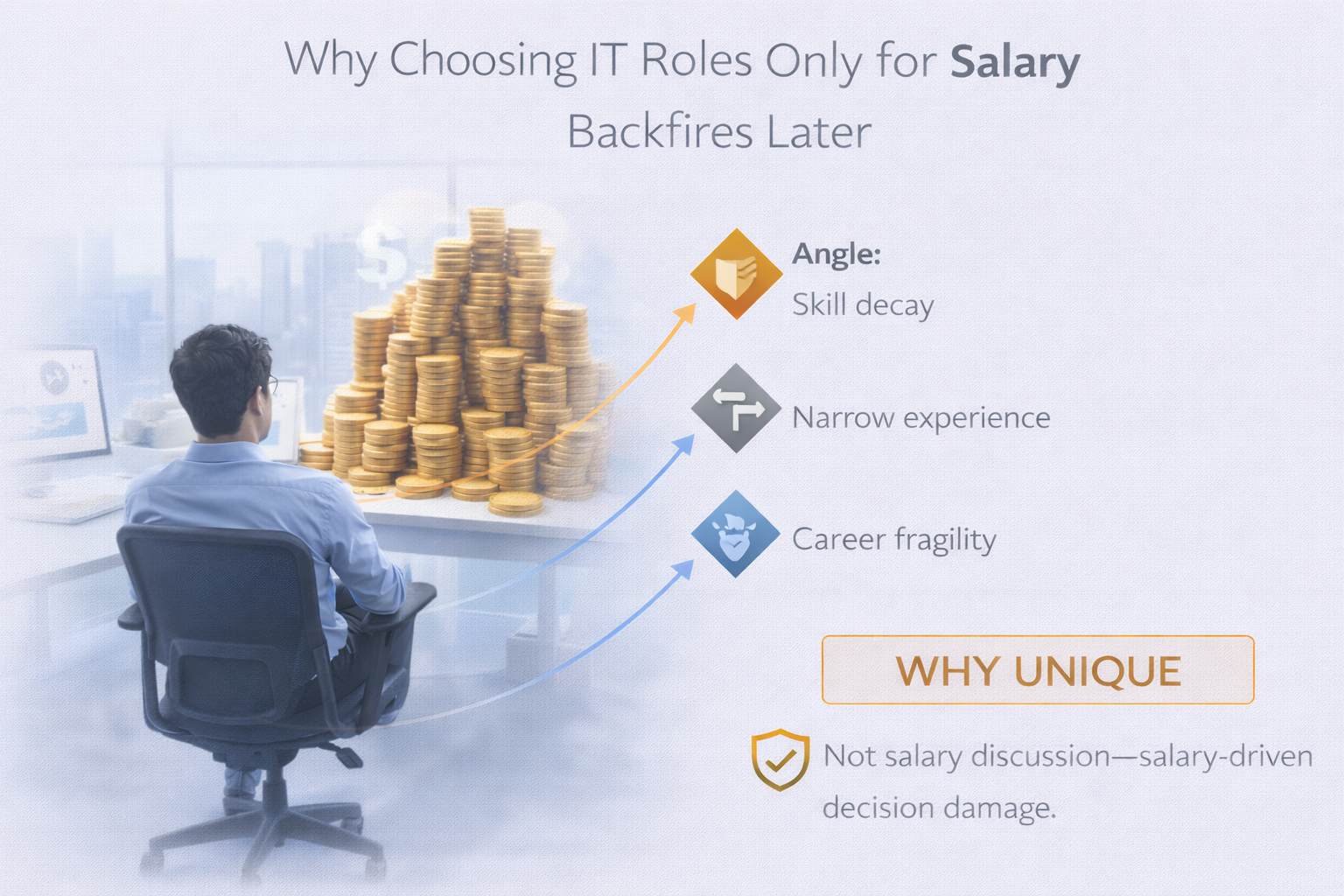
While this approach can work in the short term, choosing IT roles only for salary often creates hidden long-term damage. This blog explains how salary-driven decisions lead to skill decay, narrow experience, and increased career fragility — without turning into a generic salary debate.
Skill Decay: When High Pay Slows Learning
High-paying roles are not always high-learning roles.
In salary-optimized positions:
- Work often becomes repetitive
- Risk-taking is discouraged
- Core systems are already stable
- Learning is incremental, not expansive
Over time, skills decay not because professionals stop working hard, but because their environment no longer demands growth.
When the market shifts, these professionals discover that their compensation outpaced their capability — a dangerous mismatch.
Narrow Experience: Optimizing Income, Limiting Range
Salary-driven roles often trade breadth for specialization.
This can lead to:
- Deep experience in a single context
- Limited exposure to new architectures
- Minimal cross-functional understanding
- Weak adaptability outside the current role
Narrow experience feels efficient — until change arrives.
When technologies, teams, or companies shift, professionals optimized only for salary struggle to reposition themselves.
Career Fragility: When Pay Becomes the Weak Point
Career fragility emerges when:
- Skills do not justify current compensation
- Experience does not transfer easily
- Replacement cost is low relative to salary
In such cases, high pay increases risk instead of security.
Organizations reduce cost by targeting roles where compensation exceeds strategic value. Salary, once a benefit, becomes a liability.
Why This Is Not Anti-Salary Advice
This is not an argument against earning well.
Strong careers align:
- Compensation with capability
- Pay with learning velocity
- Income growth with expanding responsibility
Salary should be a result of value creation — not the sole decision filter.
Final Insight
Short-term salary optimization can quietly undermine long-term career strength.
The most resilient IT careers grow compensation alongside learning, exposure, and adaptability.
The real risk is not earning more — it is earning more while becoming easier to replace.