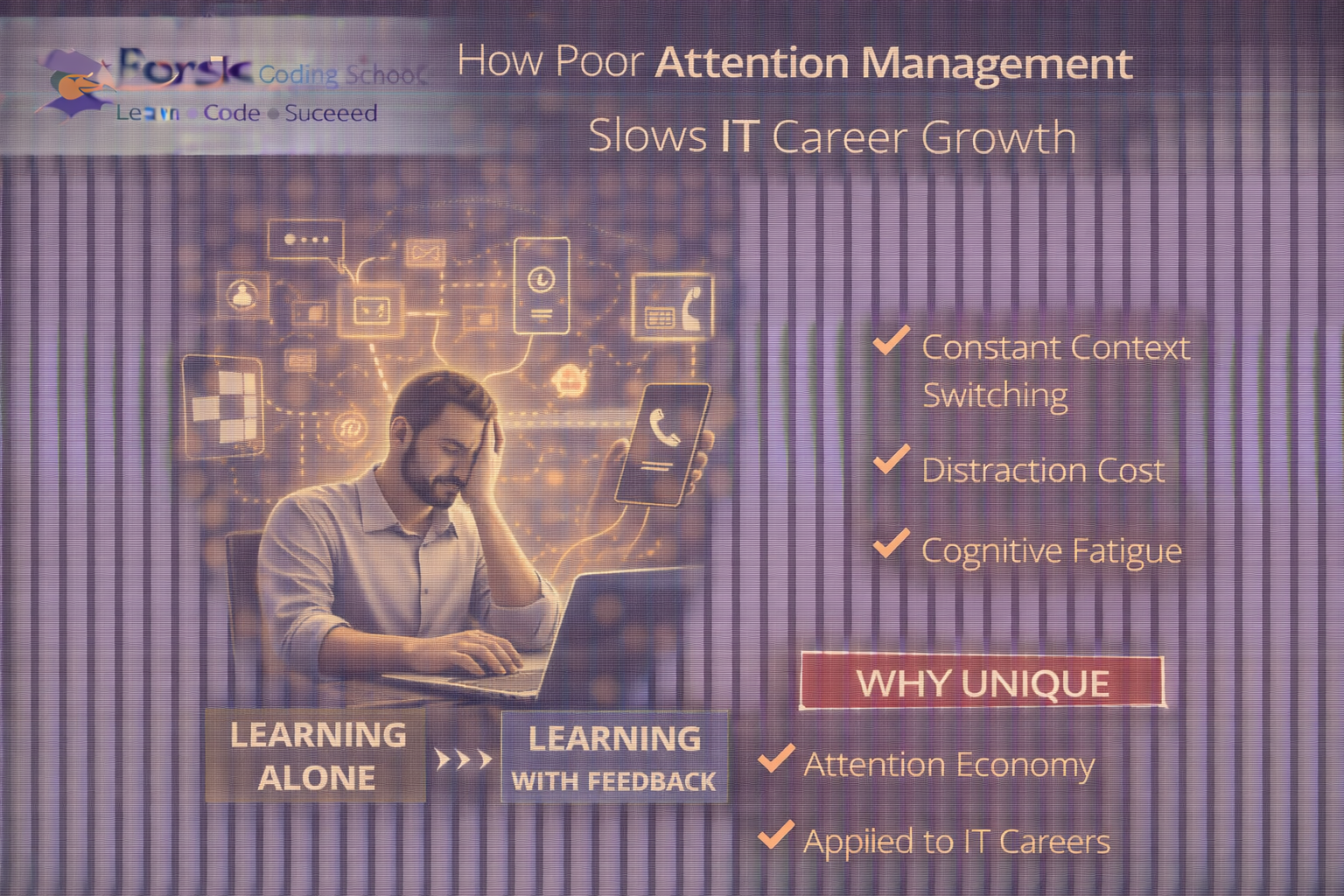
In modern IT careers, information is unlimited and interruptions are constant. Notifications, meetings, chats, dashboards, and learning resources compete for attention all day. Most professionals assume this is normal—and unavoidable.
Yet one of the biggest hidden limiters of IT career growth today is poor attention management.
This blog explains how constant context switching, distraction cost, and cognitive fatigue quietly slow professional growth in IT. This is not about discipline or productivity hacks—it is about the attention economy applied to IT careers.
Attention Is the Real Scarce Resource in IT
Time can be scheduled. Attention cannot.
In IT work, progress depends on:
- Holding complex problems in mind
- Following long reasoning chains
- Maintaining system-level context
When attention is fragmented, learning and problem-solving degrade—even if total work hours remain high.
Constant Context Switching and Its Hidden Cost
Context switching occurs when attention jumps between:
- Code and meetings
- Debugging and messages
- Learning and responding
Each switch carries a cognitive cost:
- Loss of mental state
- Rebuilding context repeatedly
- Increased error rates
Over time, this slows learning and reduces the depth of understanding that IT roles demand.
Distraction Cost: Why Focus Loss Is Expensive
Distractions do more than interrupt—they reset thinking.
Even brief interruptions:
- Break problem-solving flow
- Delay insight formation
- Reduce memory consolidation
The result is shallow progress: tasks get done, but capability does not increase proportionally.
Cognitive Fatigue and Learning Degradation
Poor attention management accelerates cognitive fatigue.
Signs include:
- Difficulty concentrating late in the day
- Avoidance of complex tasks
- Preference for easy or familiar work
When fatigue sets in, learning becomes passive and execution becomes reactive—slowing long-term growth.
Why This Problem Is Often Misdiagnosed
Attention problems are often mistaken for:
- Lack of motivation
- Poor time management
- Skill gaps
In reality, many capable professionals underperform simply because their attention is constantly fragmented.
Attention Management as a Career Skill
Strong IT professionals protect attention intentionally.
They:
- Batch shallow tasks
- Create uninterrupted focus windows
- Align learning with high-energy periods
Attention management improves learning speed, decision quality, and long-term growth—without increasing effort.
How Better Attention Creates Career Leverage
Sustained attention enables:
- Deeper understanding
- Faster pattern recognition
- Stronger problem framing
These advantages compound, separating high-growth professionals from those who stay busy but stagnant.
Final Thoughts
Poor attention management slows IT career growth by draining cognitive energy before real learning can occur.
In an attention economy, career growth belongs to those who protect focus—not those who stay most connected.
In IT, managing attention is no longer optional—it is foundational.