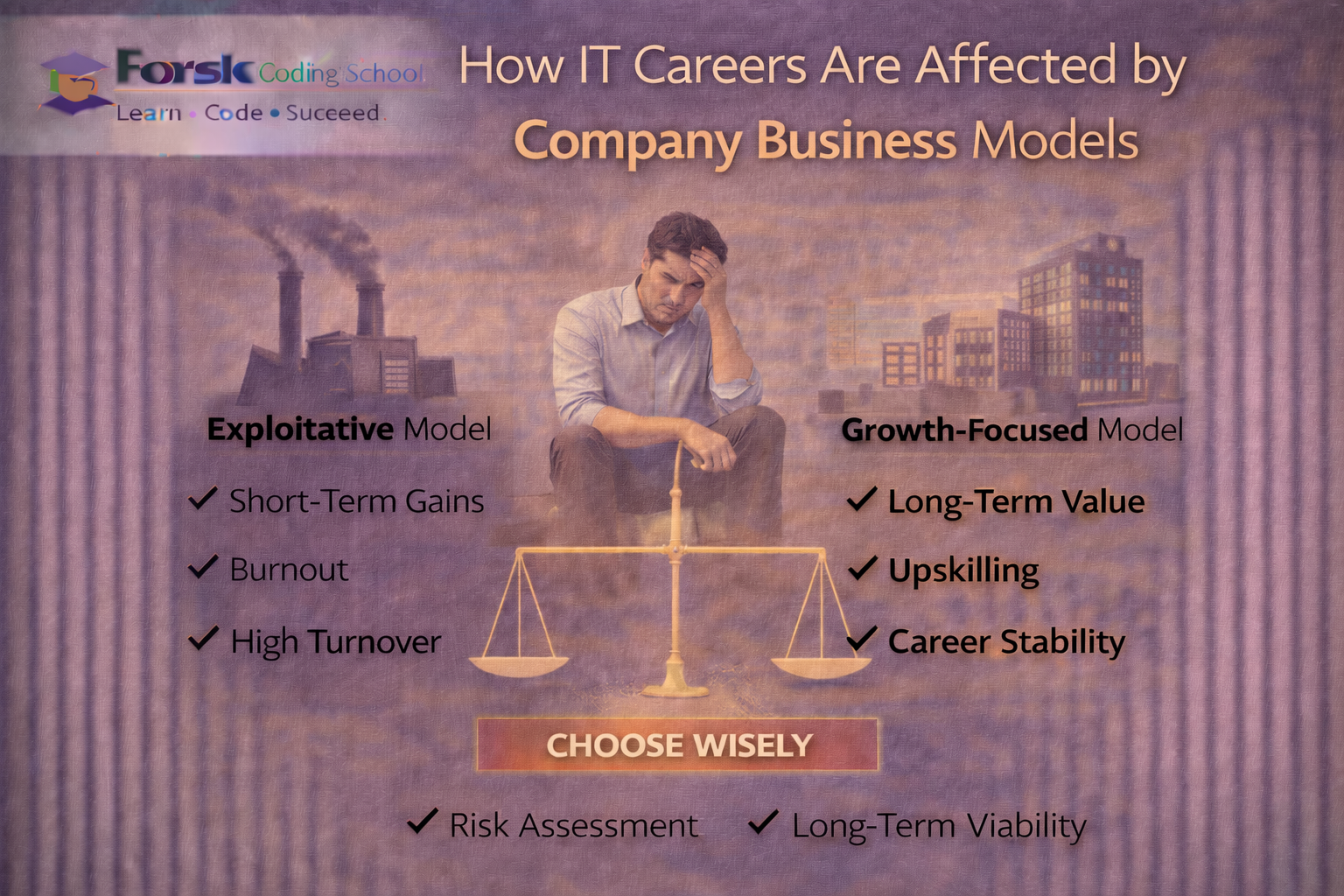
Most IT professionals evaluate jobs based on salary, role title, or technology stack. Very few stop to analyze one critical factor that silently shapes their entire career: the company’s business model. Whether you work in a service company, a product company, or a startup directly affects how you learn, grow, and are valued.
Understanding this early helps professionals make smarter career decisions instead of reacting to frustration later.
Why Business Models Matter More Than You Think
A business model decides how money is made. That revenue flow controls priorities, pressure, timelines, and risk tolerance. As an IT professional, your daily work, learning exposure, and growth opportunities are a direct outcome of this structure.
Same skill, different company model—completely different career experience.
Service-Based Companies: Delivery and Client Dependency
Service companies earn revenue by delivering projects for clients. Growth depends on utilization, timelines, and client satisfaction.
Career Impact:
- Strong exposure to multiple domains and clients
- Fast learning in execution and adaptability
- Emphasis on deadlines, billing hours, and delivery quality
Trade-offs:
- Less control over product direction
- Technology choices driven by client budgets
- Limited long-term ownership of what you build
Service companies are excellent for building execution discipline and client-handling maturity.
Product-Based Companies: Depth and Long-Term Ownership
Product companies earn by selling or subscribing users to their own product. Revenue depends on product stability, innovation, and user retention.
Career Impact:
- Deep understanding of systems and architecture
- Long-term ownership of features and performance
- Strong focus on quality, scalability, and reliability
Trade-offs:
- Slower exposure to variety
- High expectations for depth and consistency
- Fewer chances to hide weak fundamentals
Product companies reward patience, system thinking, and long-term contribution.
Startups: Speed, Risk, and Compressed Learning
Startups operate under survival pressure. Revenue may be uncertain, and roles are fluid.
Career Impact:
- Broad exposure across tech, business, and decision-making
- Faster responsibility and visibility
- High learning velocity in short time
Trade-offs:
- Instability and uncertainty
- Limited formal mentorship
- High stress and rapid context switching
Startups accelerate learning but demand emotional and professional resilience.
Revenue Pressure Shapes Your Role
Where revenue is tight, pressure is high. Where revenue is stable, expectations are deeper. Professionals often mistake pressure for toxicity or comfort for stagnation—without realizing it’s a business model effect.
Understanding revenue logic helps you interpret your work environment correctly.
Choosing the Right Model for Your Career Stage
- Early career: Service or startup for exposure and speed
- Mid-career: Product companies for depth and ownership
- Leadership track: Any model—with business understanding
There is no best model—only the right fit for your current goals.
Final Thought
IT careers are not shaped by technology alone. They are shaped by how companies earn money. Professionals who understand business models make intentional career moves instead of reactive switches. Learn the system behind the company, and your career decisions become strategic—not emotional.