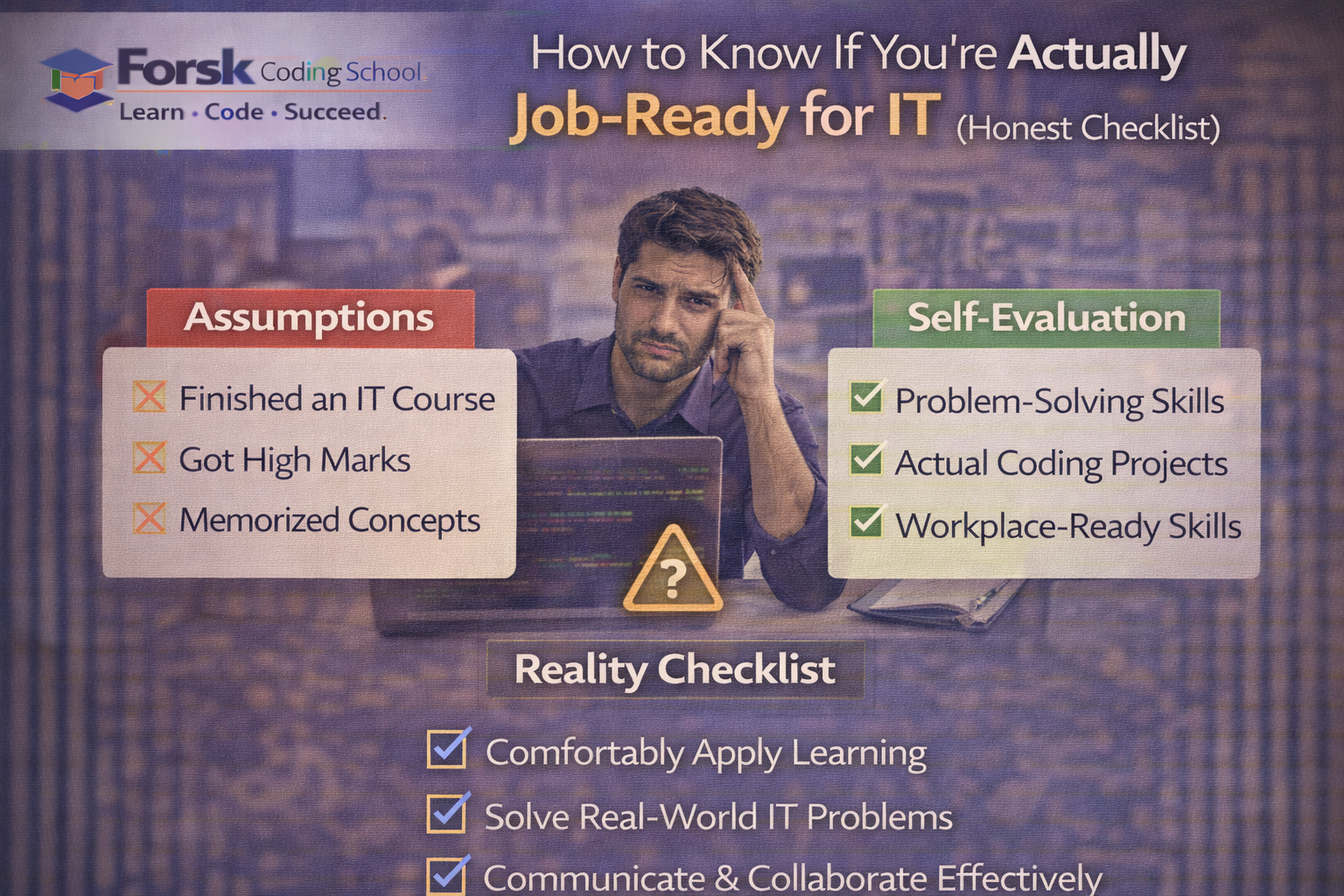
Many IT students and freshers assume they are job‑ready the moment they complete a course, bootcamp, or certification. This assumption is one of the biggest reasons for interview rejections and early job struggles.
Job‑ready and course‑completed are not the same thing.
This blog gives you a clear, honest checklist to evaluate your real IT job readiness—without hype, fear, or false confidence.
The Biggest Myth: “I Finished the Course, So I’m Ready”
Courses teach what exists.
Jobs test how you think.
In real IT roles, no one asks:
- How many videos you watched
- Which institute you joined
They care about:
- Can you handle real problems?
- Can you work with incomplete information?
- Can you learn without constant help?
What Job‑Ready Actually Means in IT
Being job‑ready means you can:
- Understand tasks without spoon‑feeding
- Ask the right questions
- Make reasonable assumptions
- Deliver usable results
It does not mean knowing everything.
Honest IT Job‑Readiness Checklist
1. Can You Explain What You’ve Built?
If you cannot clearly explain:
- How your code works
- Why you chose a solution
You are still learning—not job‑ready.
2. Can You Debug Without Panic?
Job‑ready professionals:
- Read error messages calmly
- Trace logic step by step
- Don’t restart projects blindly
Debugging ability matters more than tool count.
3. Can You Work Without Exact Instructions?
In real projects:
- Requirements are unclear
- Documentation is incomplete
- Context is missing
If you freeze without step‑by‑step guidance, you need more exposure.
4. Can You Learn Independently?
Job‑ready does not mean knowing everything.
It means figuring things out.
Ask yourself:
- Can I read documentation?
- Can I search effectively?
- Can I apply learning quickly?
5. Do You Understand “Why”, Not Just “How”?
Courses teach how to do things.
Jobs expect you to understand why.
Why this approach?
Why this design?
Why this trade‑off?
6. Can You Take Feedback Without Defensiveness?
Job‑ready candidates:
- Accept corrections
- Improve fast
- Don’t argue emotionally
Feedback resistance is a major red flag in interviews.
Signs You Are NOT Job‑Ready Yet (And That’s Okay)
You may not be job‑ready if:
- You memorize code but can’t adapt it
- You avoid real projects
- You panic during interviews
- You expect full training after joining
This is not failure—it’s a preparation gap.
Job‑Ready vs Course‑Completed (Reality Check)
| Course‑Completed | Job‑Ready |
|---|---|
| Knows syntax | Applies logic |
| Follows tutorials | Solves problems |
| Needs guidance | Takes ownership |
| Memorizes | Understands |
What to Do If You’re Not Job‑Ready Yet
- Work on real‑world projects
- Practice explaining your work
- Improve debugging skills
- Learn to ask better questions
Clarity improves readiness faster than motivation.
Final Takeaway
Job readiness is not proven by certificates.
It is built through:
- Practice
- Exposure
- Honest self‑evaluation
If you use this checklist honestly, you’ll know exactly where you stand—and what to fix before applying.
Being honest with yourself today saves rejection tomorrow.