For decades, core technical roles like software developer, tester, and system administrator defined success in the IT industry. Coding depth and technical specialization were the primary growth drivers. But the IT landscape is changing rapidly.
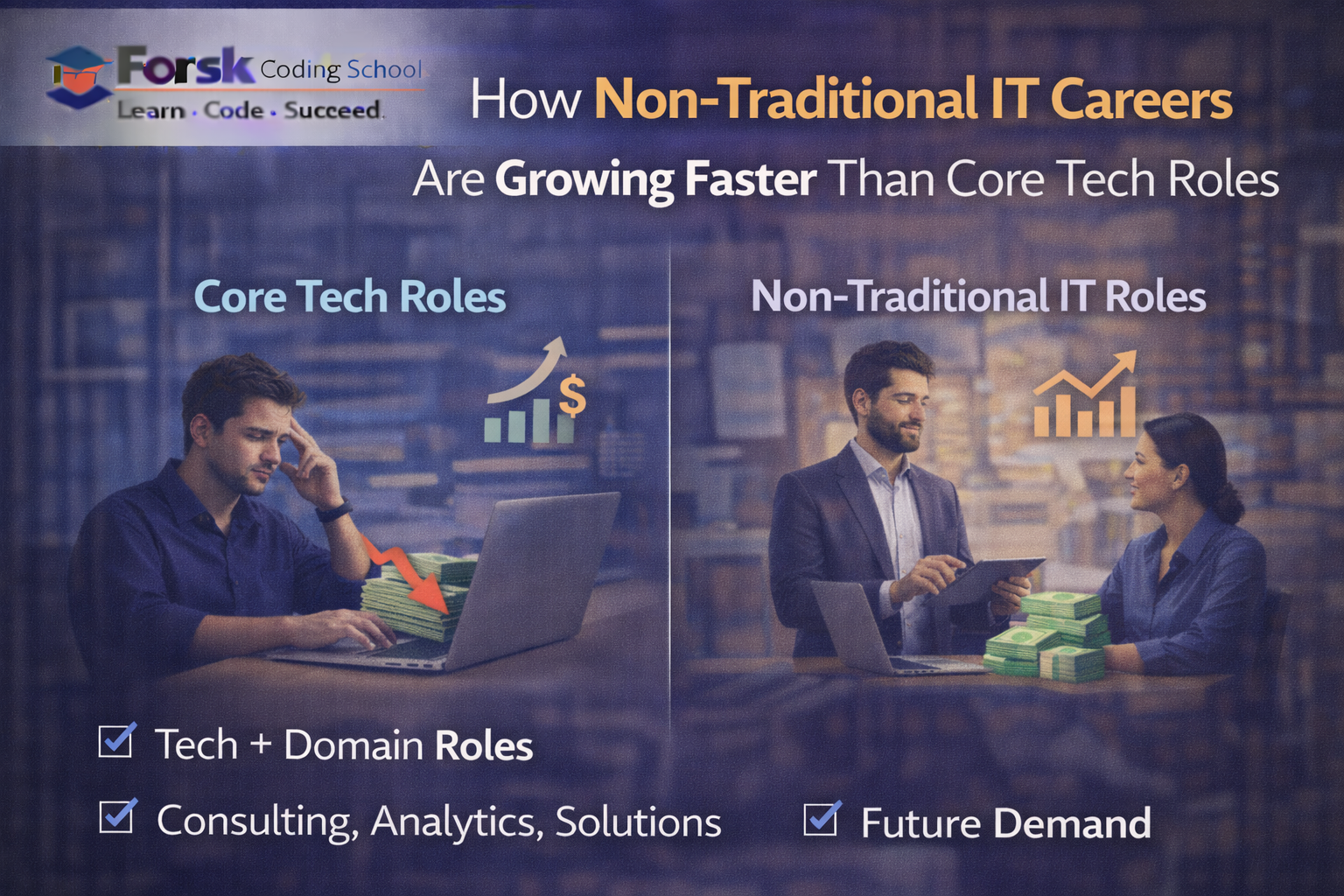
Today, non-traditional IT careers are growing faster than many core tech roles. These roles blend technology with business, analytics, consulting, and domain expertise—creating professionals who solve problems beyond code.
This blog explores why alternative IT career paths are rising, which roles are driving future demand, and why this shift represents a fundamental change in how value is created in IT.
What Are Non-Traditional IT Careers?
Non-traditional IT careers are roles where technology is a tool—not the sole focus.
They typically combine:
- Technical understanding
- Business or domain knowledge
- Communication and decision-making
These professionals translate technology into outcomes.
Why Core Tech Roles Are Slowing Down
Coding Is Becoming a Commodity
With:
- Framework standardization
- AI-assisted development
- Global outsourcing
Pure execution roles are becoming easier to replace.
This doesn’t eliminate developers—but it limits growth for those who remain narrowly focused.
Skill Saturation
Millions of professionals now share similar coding skills. Differentiation through code alone is becoming harder.
Growth now favors context + capability, not just syntax.
Why Non-Traditional IT Careers Are Growing Faster
1. Tech + Domain Roles Create Higher Value
Roles that combine IT with domains like finance, healthcare, operations, or marketing:
- Solve real business problems
- Influence decisions
- Justify technology investments
Examples include:
- Business Analyst
- Product Analyst
- Domain-focused Solution Architect
2. Consulting and Solution Roles Are Expanding
Organizations increasingly need professionals who can:
- Understand client needs
- Design solutions
- Align technology with business goals
Consulting, pre-sales, and solution engineering roles are growing faster than pure development roles.
3. Analytics and Decision Roles Are in High Demand
Data-driven decision-making is now essential.
Roles like:
- Data Analyst
- Business Intelligence Specialist
- Analytics Consultant
Translate raw data into insights—making them critical to leadership.
Future Demand Favors Hybrid Skills
The fastest-growing IT roles require:
- Technical literacy
- Business understanding
- Communication skills
- Strategic thinking
These hybrid roles are harder to automate and outsource.
Why Many IT Professionals Miss These Opportunities
Many professionals:
- Define success only as coding mastery
- Avoid business-facing roles
- Underestimate non-technical skills
As a result, they overlook faster-growing, higher-impact paths.
How to Transition into Non-Traditional IT Roles
You don’t need to abandon tech. You need to expand it:
- Learn business fundamentals
- Understand user and customer needs
- Improve communication skills
- Focus on outcomes, not just tools
This evolution increases relevance.
Redefining Success in IT Careers
Success in modern IT is no longer about writing the most code.
It’s about:
- Creating measurable impact
- Influencing decisions
- Connecting technology to value
Non-traditional IT careers excel here.
Final Takeaway
Non-traditional IT careers are growing faster because they sit at the intersection of technology, business, and decision-making.
As core tech roles become more standardized, hybrid and alternative IT roles are becoming the real growth engines.
The future of IT belongs not just to coders—but to professionals who can turn technology into outcomes.
In tomorrow’s IT world, value creators will grow faster than pure executors.