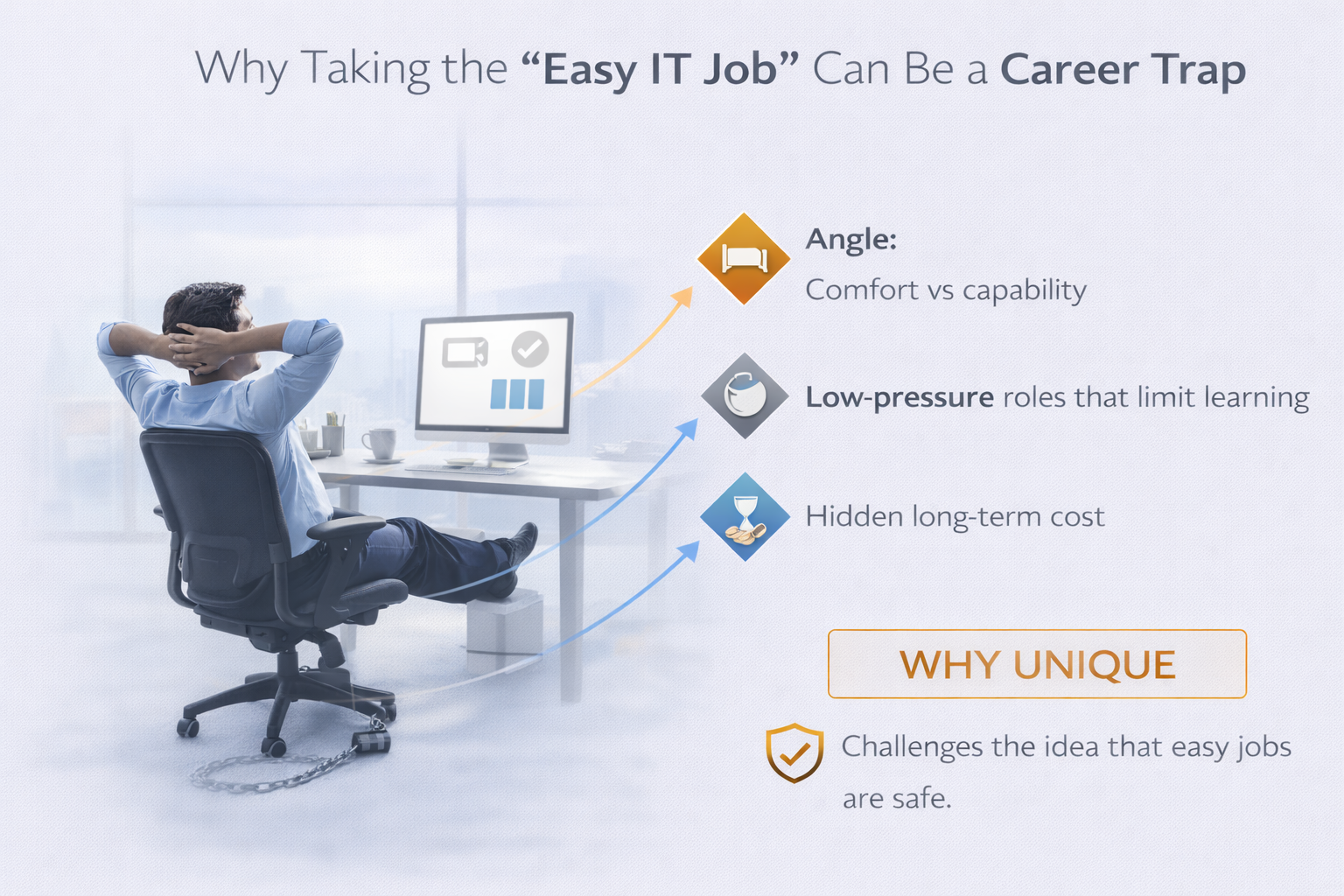
Many IT professionals are advised to look for stability: low pressure, predictable work, and minimal stress. On the surface, an easy IT job feels safe. It pays the bills, preserves work-life balance, and avoids constant firefighting.
But over time, these roles can quietly become a career trap.
This blog challenges the assumption that easy jobs are safe jobs, and explains how comfort, low-pressure environments, and hidden opportunity costs can slow long-term IT career growth.
Comfort vs Capability: The Slow Trade-Off
Easy roles optimize for comfort:
- Familiar tech stacks
- Repetitive tasks
- Limited responsibility
- Low exposure to failure
While this reduces stress, it also limits capability growth.
Capability grows when professionals:
- Make decisions under uncertainty
- Handle incidents and failures
- Own outcomes end-to-end
- Learn from real consequences
Comfort protects you from pressure — but it also shields you from learning.
Low-Pressure Roles and the Learning Ceiling
Low-pressure environments often come with hidden ceilings:
- Few complex problems
- Little architectural ownership
- Minimal cross-team interaction
- Rare exposure to business-critical systems
Over time, skills stagnate.
When market conditions change or better opportunities appear, professionals in easy roles discover that their experience does not transfer well to higher-impact positions.
The cost is not immediate. It is deferred.
The Hidden Long-Term Cost
The biggest risk of easy IT jobs is not boredom — it is option loss.
Hidden costs include:
- Narrower future job options
- Slower salary growth
- Reduced confidence in high-stakes environments
- Increased replaceability
While peers in challenging roles accumulate judgment, context, and credibility, those in easy roles often repeat the same year of experience multiple times.
Why Easy Jobs Feel Safe (But Aren’t)
Easy jobs feel safe because:
- Performance expectations are low
- Mistakes are rarely visible
- Change happens slowly
But safety based on low expectations is fragile.
When restructuring, automation, or outsourcing occurs, roles with limited learning and low strategic value are often the first to disappear.
Final Insight
Easy jobs reduce stress today.
Challenging jobs reduce risk tomorrow.
Strong IT careers are not built by avoiding difficulty, but by choosing environments that stretch capability and expand future options.
Career safety comes from growth, not comfort.