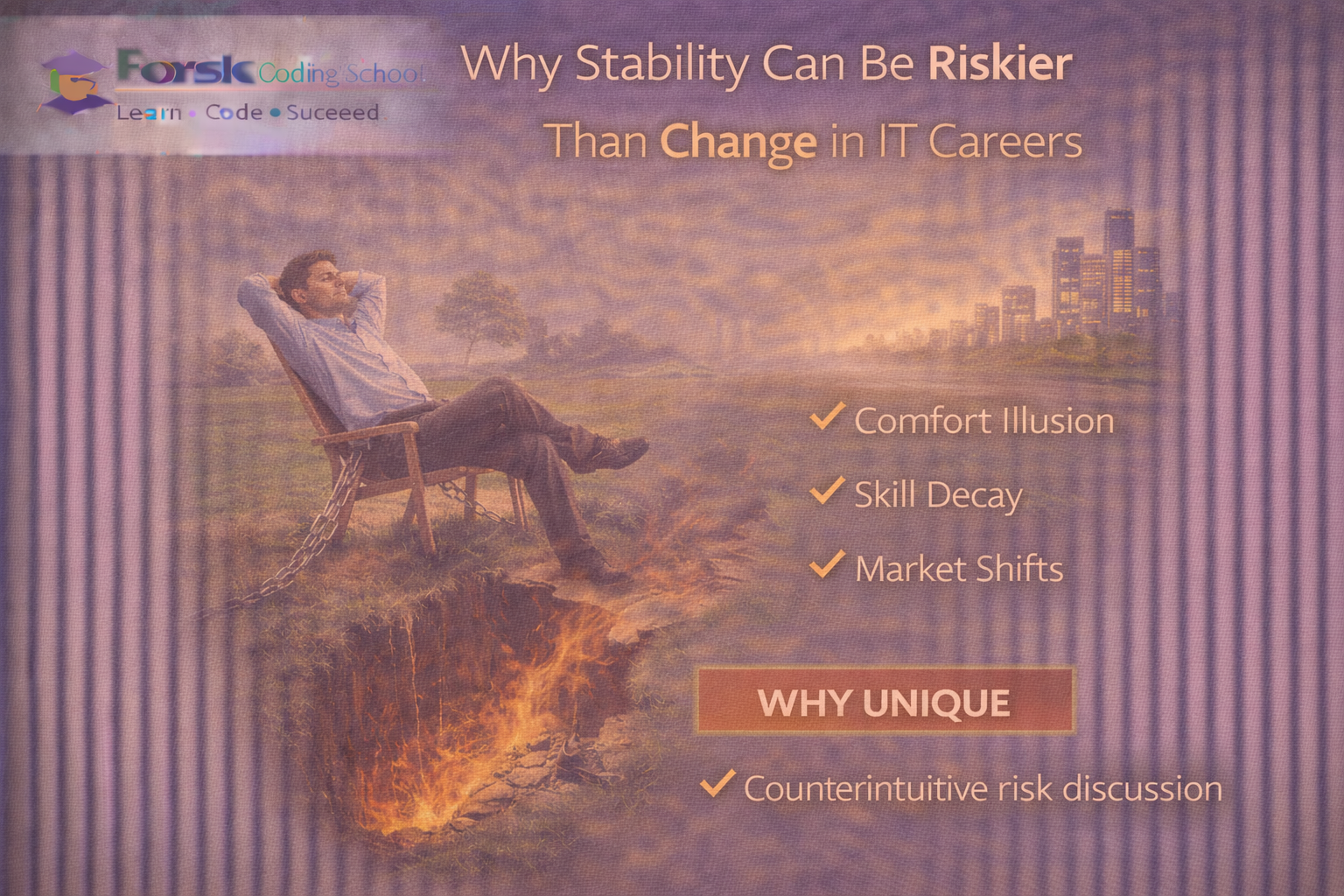
In IT careers, stability is often seen as the safest goal—a steady role, familiar systems, predictable work, and minimal stress. While stability feels comforting, it can quietly become one of the biggest long-term risks. Many professionals discover too late that what felt safe actually reduced their relevance.
This is a counterintuitive risk discussion, not advice to job-hop recklessly.
The Comfort Illusion
Comfort creates the illusion of safety. When work becomes predictable, professionals stop feeling urgency. Learning slows, curiosity fades, and skills stop stretching.
Comfort is not failure—it is stagnation disguised as security.
Skill Decay Happens Silently
Technical skills decay without pressure. Tools evolve, practices change, and expectations rise. When professionals stay too long in low-challenge environments, skills remain static while the market moves forward.
Skill decay is dangerous because it is invisible—until an external change forces a reality check.
Stability Reduces Market Awareness
Stable roles often reduce exposure to hiring realities. Professionals stop interviewing, stop benchmarking, and stop tracking demand.
As a result:
- Market expectations feel shocking
- Confidence drops suddenly
- Options narrow under pressure
This is why stability can feel safe right up until it isn’t.
Change Builds Adaptation Muscles
Change—new systems, new teams, new constraints—forces recalibration. Professionals who experience controlled change build adaptability, learning speed, and resilience.
Adaptability, not tenure, protects long-term careers.
Market Shifts Don’t Wait for Comfort
Technology markets shift regardless of individual readiness. New architectures, tools, and business models reshape demand continuously.
Professionals who anchor their identity to stable environments struggle most when change becomes unavoidable.
Choosing Healthy Instability
This is not about constant switching. Healthy instability means:
- Taking on new responsibilities
- Entering unfamiliar problem spaces
- Periodically challenging comfort
These choices keep skills alive and perspectives fresh.
Final Thought
Stability feels safe, but relevance is safer. In IT careers, controlled change builds resilience, while unchecked comfort increases risk. Professionals who balance stability with periodic disruption protect themselves from market shocks and long-term stagnation. Growth often requires leaving comfort—not safety.