Why Some IT Professionals Become “Go-To” People in Teams
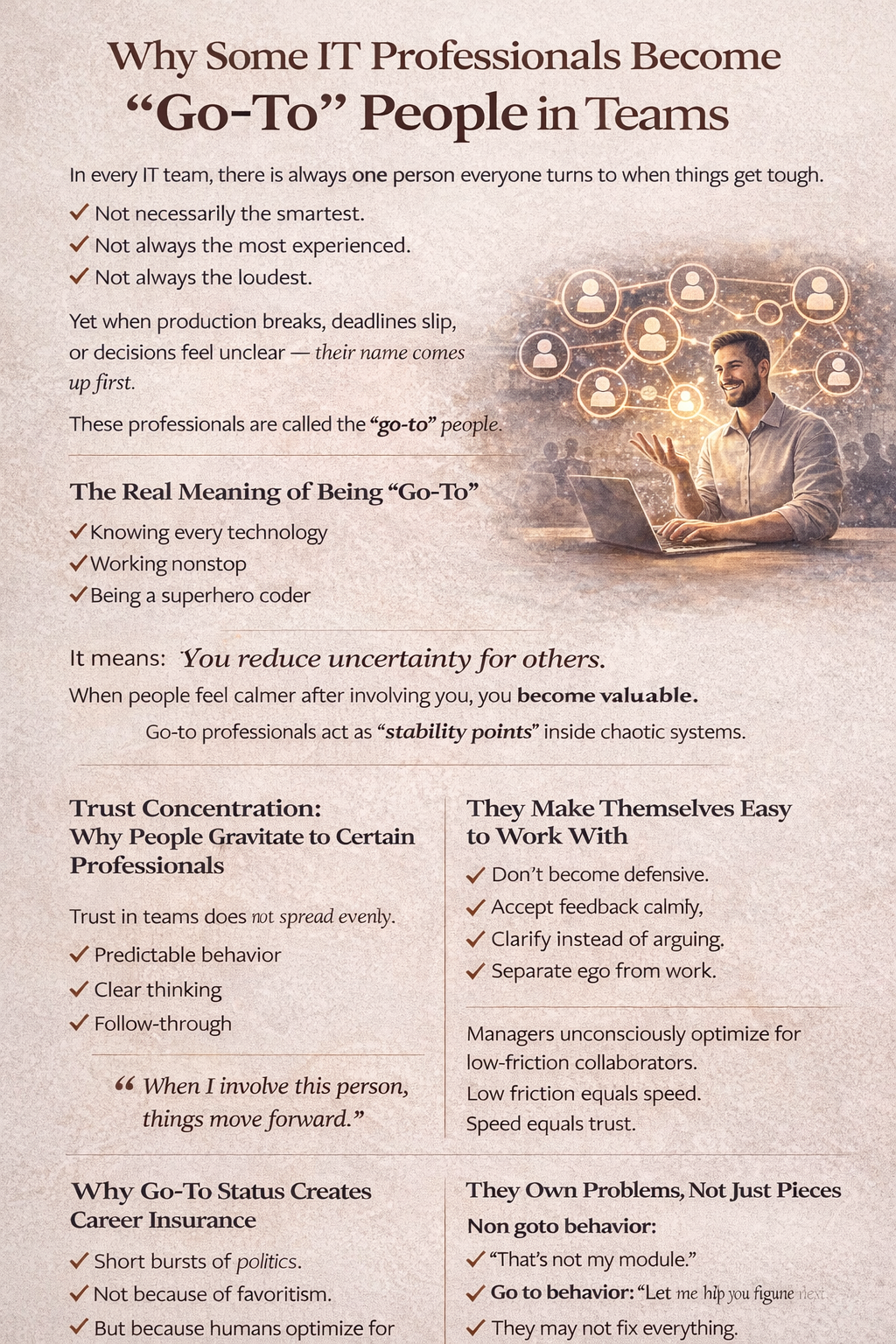
In every IT team, there is always one person everyone turns to when things get tough.
Not necessarily the smartest.
Not always the most experienced.
Not the loudest.
Yet when production breaks, deadlines slip, or decisions feel unclear — their name comes up first.
These professionals are called the “go-to” people.
They hold a unique kind of power inside organizations — not through hierarchy or titles, but through trust, usefulness, and reliability.
This article explains how that leverage is actually earned.
The Real Meaning of Being “Go-To”
Being a go-to person does not mean:
- Knowing every technology
- Working nonstop
- Being a hero coder
It means:
You reduce uncertainty for others.
When people feel calmer after involving you, you become valuable.
Go-to professionals act as stability points inside chaotic systems.
Trust Concentration: Why Certain People Attract More Responsibility
Trust inside teams does not spread evenly.
It concentrates around individuals who repeatedly demonstrate:
- Predictable behavior
- Clear thinking
- Follow-through
Over time, small interactions build a pattern:
“When I involve this person, things move forward.”
That pattern becomes trust.
Once trust concentrates around you, requests multiply naturally.
Reliability Signals Matter More Than Talent Signals
Most IT professionals try to signal talent.
Go-to professionals signal reliability.
Talent signals:
- Talks about advanced frameworks
- Mentions complex algorithms
- Shows certificates
Reliability signals:
- Shows up on time
- Responds when promised
- Finishes what they start
- Communicates delays early
Organizations prefer reliable contributors over brilliant but unpredictable ones.
Because unreliable brilliance creates risk.
Leverage Through Usefulness
Leverage does not come from rare syntax.
It comes from being useful at moments that matter.
Examples:
- You quickly narrow where a bug likely exists
- You know who to involve when blocked
- You explain problems in simple language
- You translate business needs into technical steps
This usefulness multiplies impact without multiplying effort.
Why Hardworking People Are Not Always Go-To
Effort is invisible.
Teams do not experience your effort.
They experience outcomes.
If your work:
- Requires constant clarification
- Breaks unexpectedly
- Creates more questions than answers
You may be working very hard — but increasing cognitive load.
Go-to people reduce cognitive load.
Go-To Professionals Think in Outcomes, Not Tasks
Task thinkers ask:
What did I finish?
Outcome thinkers ask:
What problem did I reduce?
Two people close the same ticket.
Only one ensures:
- Edge cases handled
- Documentation updated
- Stakeholders informed
Only one becomes go-to.
They Make Themselves Easy to Work With
Go-to professionals:
- Don’t become defensive
- Accept feedback calmly
- Clarify instead of arguing
- Separate ego from work
Managers unconsciously optimize for low-friction collaborators.
Low friction equals speed.
Speed equals trust.
Consistency Beats Intensity
Short bursts of excellence don’t build go-to status.
Consistency does.
Small reliable actions repeated daily compound into reputation.
Reputation compounds faster than skills.
They Own Problems, Not Just Pieces
Non go-to behavior:
“That’s not my module.”
Go-to behavior:
“Let me help you figure this out.”
They stay with problems until progress happens.
Ownership builds gravity.
Gravity attracts trust.
Why Go-To Status Creates Career Insurance
During restructuring or change, leaders ask:
Who would we struggle to operate without?
Go-to professionals appear on that list.
Not because they know everything.
But because work flows through them.
A Simple Mental Model
Before closing any task, ask:
Did I make someone else’s work easier?
If yes → you are moving toward go-to.
If no → you only finished a task.
Final Thought
Go-to professionals are not created by extraordinary intelligence.
They are created by extraordinary reliability plus usefulness.
Skills get you hired.
Usefulness gets you trusted.
Trust gives you leverage.
And leverage shapes long-term IT careers.