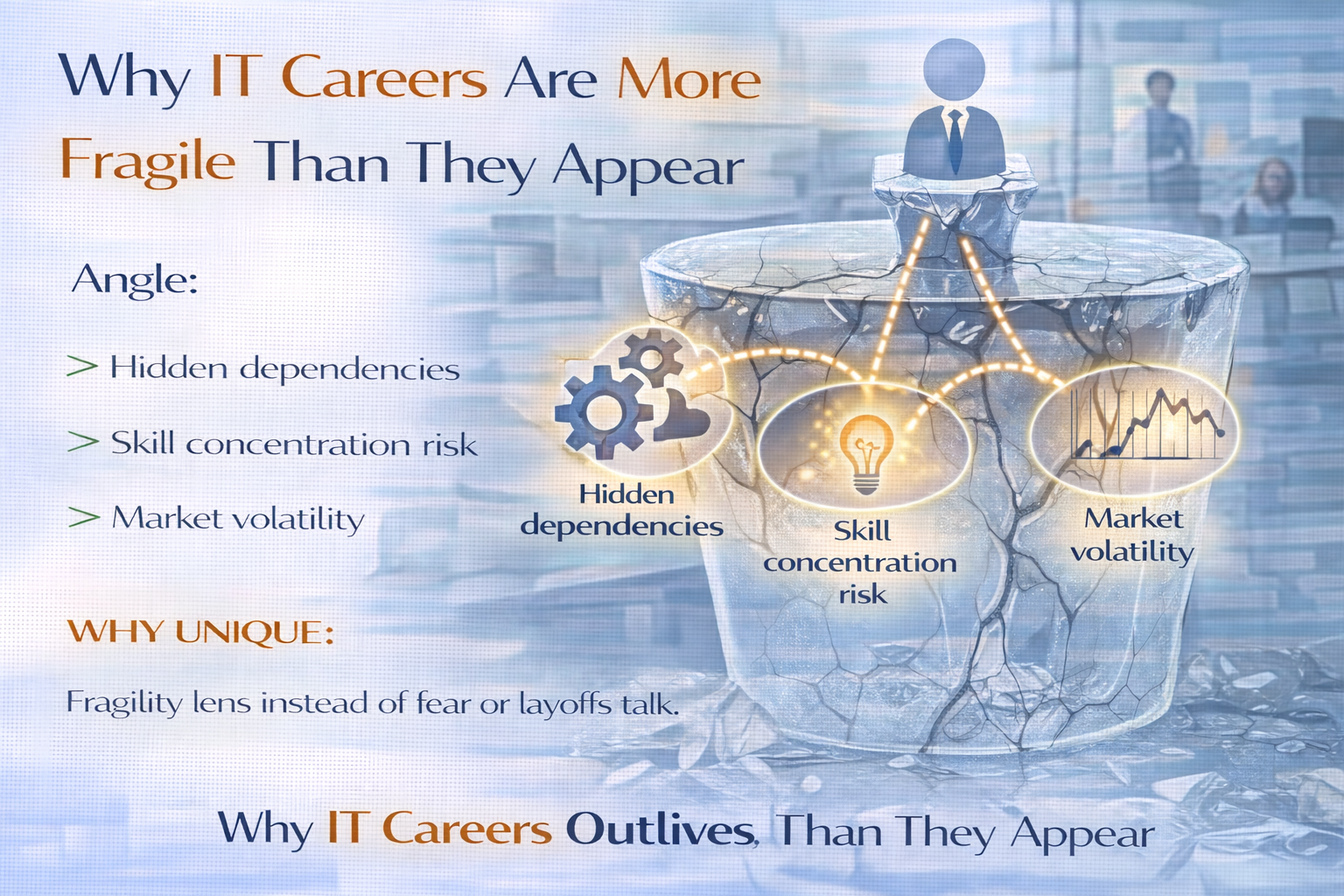
IT careers often look stable from the outside. Salaries are steady, demand seems constant, and technology roles appear future-proof. This creates a comforting assumption: once you’re in IT, you’re safe.
That assumption is misleading.
This article looks at IT careers through a fragility lens—not fear, not layoffs, but structural weakness hidden beneath apparent stability.
Apparent Stability Masks Hidden Dependencies
Many IT careers rely on fragile dependencies:
- A single product or platform
- One dominant client or business domain
- A narrow internal system no one else uses
As long as these dependencies hold, everything feels stable. When they break, careers are exposed suddenly—not gradually.
Fragility is not about frequency of change. It’s about what happens when change arrives.
Skill Concentration Risk
Skill concentration is the career equivalent of putting all capital into one asset.
Examples include:
- Deep expertise in a declining framework
- Long-term reliance on proprietary tools
- Experience limited to one type of system or scale
These skills perform well—until the market shifts. Then value drops sharply.
The issue is not specialization itself. It’s unbuffered specialization.
Market Volatility Is Structural, Not Temporary
IT markets move in cycles:
- Technology adoption waves
- Hiring booms and freezes
- Tool relevance rising and falling
Volatility is not an anomaly. It’s a permanent condition.
Careers built without volatility tolerance break under stress. Careers built with it bend.
Why Fragility Goes Unnoticed
Fragile careers often look successful:
- Titles progress
- Pay increases
- Responsibilities remain manageable
Fragility stays invisible until pressure exceeds tolerance. By then, adjustment is expensive and slow.
This is why career shocks feel “sudden”—the weakness existed long before the event.
Fragile vs Resilient Career Structures
Fragile careers:
- Depend on a narrow skill set
- Rely on one employer or domain
- Collapse quickly under stress
Resilient careers:
- Spread value across skills
- Maintain optionality
- Absorb shocks without total reset
The difference is structural—not motivational.
Final Thoughts
IT careers are more fragile than they appear—not because the industry is unstable, but because many careers are built without risk awareness.
Recognizing fragility early is not pessimism.
It is the first step toward building resilience.
Stability is not the absence of shocks.
It is the ability to survive them.